Caribbean · Side · Soup
Callaloo
A leafy green cooked down with onion, tomato and scotch bonnet until soft and glossy. A side dish in Jamaica, though the same name covers an entirely different soup elsewhere in the Caribbean.
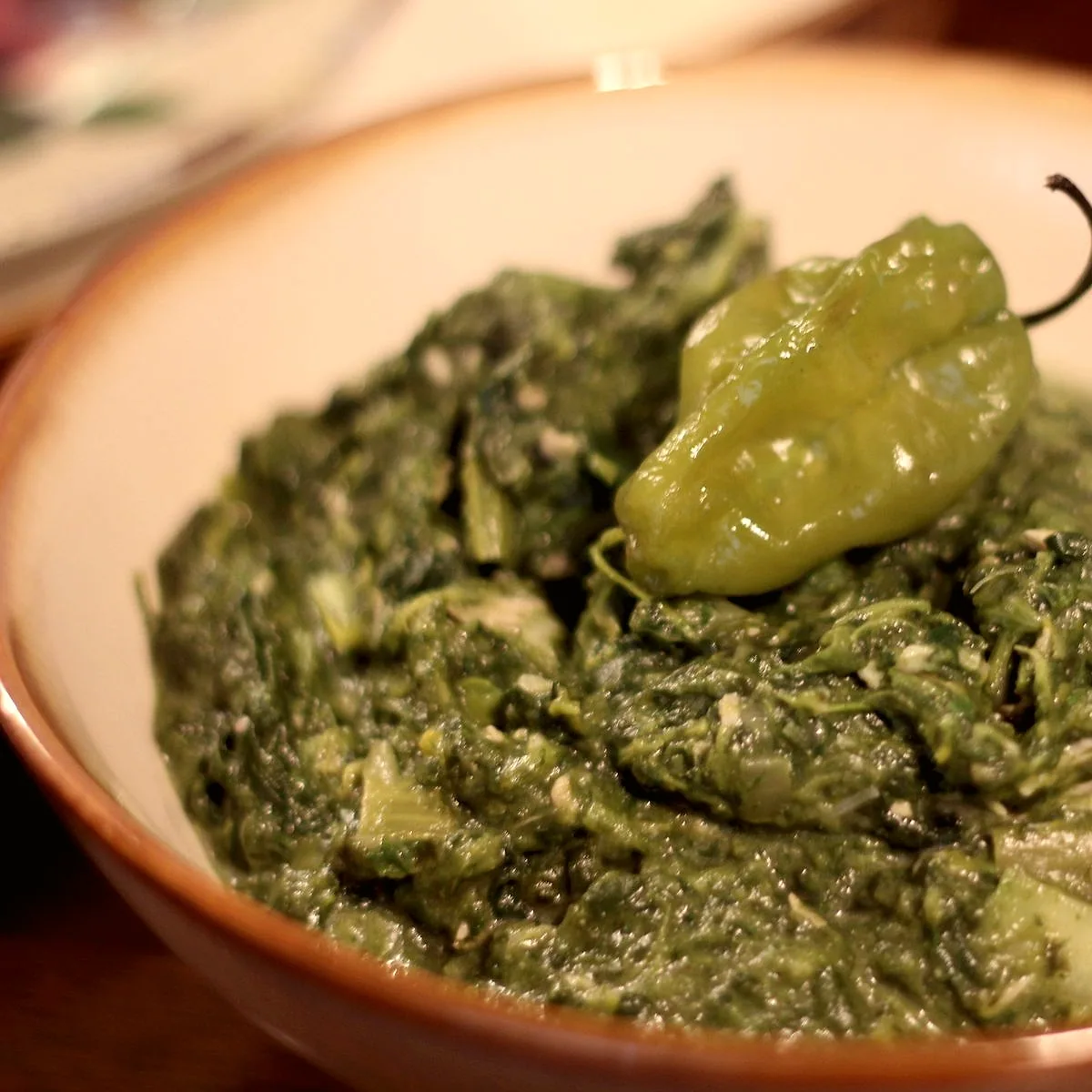

CC BY 2.0. Cropped and colour-adjusted for this site.
The same dish, adapted. Every quantity, time and figure below changes with the version.
Method
Heat the 20 ml vegetable oil in a wide pan over a medium heat and cook the 80 g white onion, 2 garlic cloves (10 g) and 1 ½ spring onions (20 g) for 5m, until softened.
Add the 150 g ripe tomatoes, 2 g fresh thyme, 4 g scotch bonnet, 4 g fine sea salt and 1 g ground black pepper, then stir in the 500 g fresh amaranth in batches as it wilts down. Cover and cook for 15m, stirring occasionally, until completely soft and glossy. Remove the scotch bonnet before serving.
Common pitfallLeaving the scotch bonnet whole and removing it before serving seasons the pot with its heat and fruitiness without the risk of an unexpectedly fierce mouthful; a burst or chopped pepper is far hotter than the dish is meant to be.
Method
Heat the 15 ml vegetable oil in a large pot over a medium heat and cook the 60 g white onion, 2 garlic cloves (10 g) and 1 spring onion (15 g) for 5m, until softened.
Add the 400 g fresh dasheen, 150 g okra, 200 g pumpkin, 200 g cooked crab, 400 ml coconut milk, 500 ml water, 2 g fresh thyme, 4 g scotch bonnet and 5 g fine sea salt. Bring to a simmer and cook for 30m, until the dasheen and pumpkin are completely soft. Remove the scotch bonnet.
Common pitfallDasheen leaves that are not cooked through retain calcium oxalate crystals that irritate the throat; the leaves need the full simmering time, not a quick wilt.
Blend the soup until smooth and thick, either in a blender in batches or directly in the pot with an immersion blender, then return to a brief simmer to heat through. This takes about 5m.
Blending the soup once the dasheen and okra have fully softened is what gives it its characteristic thick, smooth body; the okra's mucilage and the dasheen's starch are what hold that texture together.
The word "callaloo" is the more stable thing about the dish; what it names changes from island to island. The name itself is traced to West Africa, specifically to the Mbundu people of what is now Angola, where recipes for a dish called calalu are recorded in both Angola and neighbouring São Tomé [1] [2]. It travelled to the Caribbean in the same forced migration that carried okra and other West African vegetables into the region's cooking more generally.
What that inherited name attaches to, though, is not one plant. In Jamaica, Belize and several other islands, callaloo means a wild, indigenous variety of amaranth, quickly stir-fried with aromatics into a side dish that holds its shape. In Trinidad and neighbouring islands, callaloo instead means the leaf of dasheen (taro, the same plant grown across the tropics for its starchy corm) pureed into a thick, coconut-milk stew with okra [1] [2]. The two dishes are cooked differently, eaten differently, and taste of two different plants, sharing little beyond the name and their shared West African root.
Because "callaloo" is a name rather than a fixed recipe, a reader following one from a Jamaican source and one from a Trinidadian source should expect two different dishes on the plate, not two versions of the same one.
Sources
- Callaloo, WikipediaDescribes the West African etymology of "callaloo", its roots in West African and Taino cookery, and the divergence between Jamaican amaranth callaloo and the dasheen- or Xanthosoma-leaf callaloo of Trinidad and other islands.
- The Varieties of Caribbean Callaloo vs. Haitian Kalalou, Heritage Food StoriesFood historian and culinary anthropologist Chef Mireille traces callaloo to the Mbundu people of Angola, with recipes for calalu recorded in both Angola and São Tomé, and separately describes Jamaican callaloo as a quick amaranth stir-fry against Trinidad's pureed, coconut-milk dasheen-leaf-and-okra stew.