Colombian · Main Course
Bandeja Paisa
Red beans, rice, ground beef, chorizo, pork chicharrón, fried egg, ripe plantain, avocado and a small arepa, all served together on one large tray. Antioquia's enormous everyday platter.
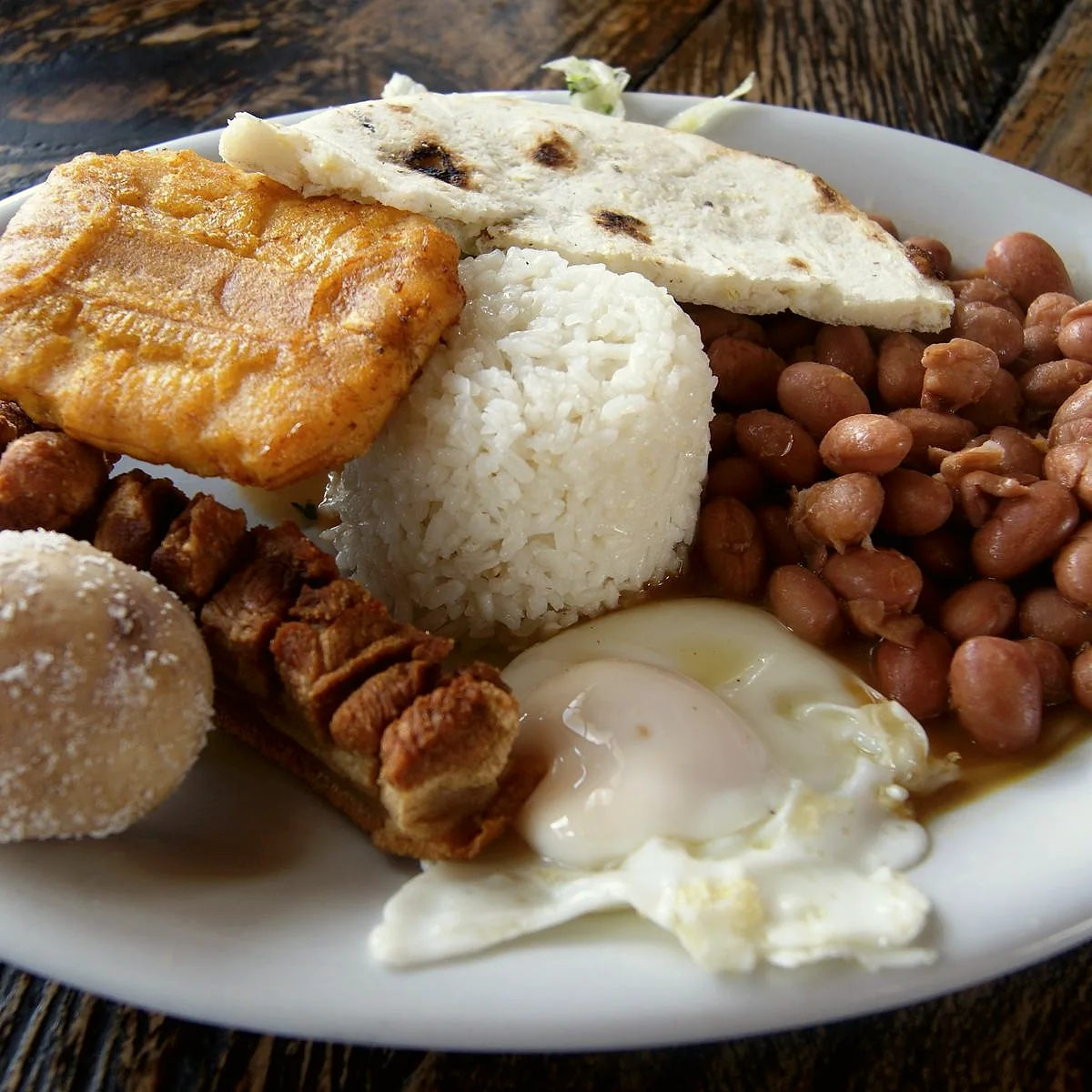

CC BY-SA 3.0. Cropped and colour-adjusted for this site.
Method
Soak the 150 g dried kidney beans in plenty of cold water for 8h, then drain.
Simmer the soaked beans in the 600 ml water with the 60 g white onion, 2 garlic cloves (10 g), 100 g ripe tomatoes and half the 8 g fine sea salt for 1h, until completely soft and the liquid has thickened.
Meanwhile, cook the 300 g basmati rice according to the packet instructions. This takes about 20m.
Combine the 150 g precooked corn flour with the remaining 8 g fine sea salt and the 180 ml water to form a soft dough, divide into four and pat into flat rounds, then cook on a dry, hot griddle, turning once or twice, until golden and cooked through. This takes about 20m in total.
Fry the 200 g pork belly in a dry pan over a medium heat for 20m, until deeply browned and crisp.
Season the 300 g beef mince and cook it in a hot pan, breaking it up or shaping it into thin patties as preferred, for 12m, until browned through.
Cook the 200 g raw chorizo in a pan over a medium heat for 12m, turning occasionally, until cooked through and browned.
Heat half the 40 ml vegetable oil in a pan and fry the 300 g ripe plantain for 10m, turning once, until golden and caramelised at the edges.
Heat the remaining 40 ml vegetable oil and fry the 4 eggs (200 g) for 6m, until the whites are set and the yolks still soft.
Divide the beans, rice, beef, chicharrón, chorizo, fried eggs, plantain, 1 avocado (150 g) and arepas between large plates or trays. This takes about 8m.
Common pitfallCooking every element separately and only combining them on the plate, rather than stewing them together, is what keeps each component's own texture (the beans soft, the chicharrón crisp, the egg yolk still runny) intact rather than blurred into one dish.
Bandeja paisa is usually introduced as ancient farm food, fuel for nineteenth-century miners and field labourers in Antioquia who needed a calorie-dense plate to get through a physical day's work. The individual foods on the tray do have that kind of pedigree: beans, rice, pork and maize were all staples of the region's rural diet, traditionally eaten as a bean soup alongside a separate "seco" plate of rice, fried pork rind and a corn arepa [2].
The tray as it exists today, though, is very likely a newer invention than its reputation suggests, and its documented history begins not in Antioquia but in Bogotá. The name "bandeja paisa" itself was coined only in 1950, at a meeting of the hotel and tourism association Cotelco assembling a manual of Colombia's typical dishes, when its delegates found that Antioquia's own everyday plate had no settled name of its own [1]. One account of how the dish took its combined, tray-served form points to a Bogotá restaurant, El Zaguán de las Aguas, where Antioquian staples were piled together onto large plates for a tourist-facing event rather than served separately as at home [2].
The distinction matters for what the dish actually represents. Its ingredients are genuinely rooted in Antioquian farm cooking; the platter itself, piled improbably high and now one of the more expensive dishes on a Colombian menu, is closer to a twentieth-century, Bogotá-shaped tribute to that cooking than to a meal any nineteenth-century miner would have recognised on his own plate.
Sources
- Historia de la bandeja paisa, plato típico de Antioquia, Radio Nacional de ColombiaColombia's national public broadcaster reports that the name "bandeja paisa" was coined in Bogotá in 1950, at a meeting of the hotel and tourism association Cotelco compiling a manual of typical Colombian dishes, after finding that Antioquia's own traditional plate (locally called "seco") had no standard name of its own.
- La bandeja paisa: un invento bogotano, Al PonienteA Colombian news and opinion outlet traces the everyday Antioquian meal to bean soup with a "seco" plate of rice, fried pork rind and a corn arepa, and attributes the combined, tray-served platter to a Bogotá restaurant, El Zaguán de las Aguas, which piled typical Antioquian ingredients onto large plates for a tourist-facing event.