
7.62×51mm NATO
Introduced 1954NATO standard
Also known as 7.62 NATO, T65: the same cartridge under different names, all of which find this page.
Dimensions and pressure
Generated from the schema, like every specification table on this site, so a figure recorded on this entry cannot be missing from the table.
Identity
- Designed by
- not recorded
- Introduced
- 1954
- Production
- not recorded
- Standards body
- NATO
- Case type
- Rimless
- Case shape
- Bottleneck
Dimensions
- Bullet diameter
No free dimensional standard publishes the NATO round under that name. Borrowed from the C.I.P. datasheet for the commercial .308 Winchester (G1), which shares the chamber; the two are not interchangeable at the pressure limit.
- Bore diameter
- not recorded
- Case length
No free dimensional standard publishes the NATO round under that name. Borrowed from the C.I.P. datasheet for the commercial .308 Winchester (L3), which shares the chamber; the two are not interchangeable at the pressure limit.
- Overall length
No free dimensional standard publishes the NATO round under that name. Borrowed from the C.I.P. datasheet for the commercial .308 Winchester (L6), which shares the chamber; the two are not interchangeable at the pressure limit.
- Rim diameter
No free dimensional standard publishes the NATO round under that name. Borrowed from the C.I.P. datasheet for the commercial .308 Winchester (R1), which shares the chamber; the two are not interchangeable at the pressure limit.
- Neck diameter
No free dimensional standard publishes the NATO round under that name. Borrowed from the C.I.P. datasheet for the commercial .308 Winchester (H2), which shares the chamber; the two are not interchangeable at the pressure limit.
- Base diameter
No free dimensional standard publishes the NATO round under that name. Borrowed from the C.I.P. datasheet for the commercial .308 Winchester (P1), which shares the chamber; the two are not interchangeable at the pressure limit.
Pressure
- Maximum pressure
The cited article gives 60,191 psi by NATO EPVAT, which is 415.0 MPa, exactly the C.I.P. figure for the .308 Winchester, so the number appears to be a conversion of it rather than an independent measurement. STANAG 2310 is not free.
- Pressure standard
- NATO
SAAMI and C.I.P. measure pressure differently and their figures are not interchangeable, which is why the body is always named beside the figure.
Loads
Velocity is recorded per barrel length as published. A gun page interpolates between these points and never projects beyond them.
M80 ball
- Bullet mass
- 9.525 g147.0 grsource
Published as 147 gr; 1 gr = 0.06479891 g exactly.
- Cartridge mass
- not recorded
- Bullet type
- FMJ
- G1 BC
- not recorded
- G7 BC
- not recorded
| Barrel | Velocity |
|---|---|
| 558.8 mm22.00 in | 853 m/s2,799 fps |
M80A1 enhanced performance round
- Bullet mass
- 8.424 g130.0 grsource
Published as 130 gr; 1 gr = 0.06479891 g exactly.
- Cartridge mass
- not recorded
- Bullet type
- EPR
- G1 BC
- not recorded
- G7 BC
- not recorded
| Barrel | Velocity |
|---|---|
| 558.8 mm22.00 in | 930 m/s3,051 fps |
M118LR long range
- Bullet mass
- 11.34 g175.0 grsource
Published as 175 gr; 1 gr = 0.06479891 g exactly.
- Cartridge mass
- not recorded
- Bullet type
- BTHP
- G1 BC
- not recorded
- G7 BC
- not recorded
| Barrel | Velocity |
|---|---|
| 558.8 mm22.00 in | 792 m/s2,598 fps |
Chambered in
Computed from every entry that lists this cartridge. Nothing here is hand-maintained.
- ArmaLite AR-10
ArmaLite
- B&T APC308
Brügger & Thomet
- FN FAL
FN Herstal
- FN SCAR
FN Herstal
- IWI Galil
Israel Weapon Industries
- Lee–Enfield
Royal Small Arms Factory
- M240 machine gun
FN Herstal
- M60 machine gun
Saco Defense
- PGM Ultima Ratio
PGM Précision
- SIG SG 542
SIG Sauer AG
- Walther WA 2000
Carl Walther GmbH
Gallery
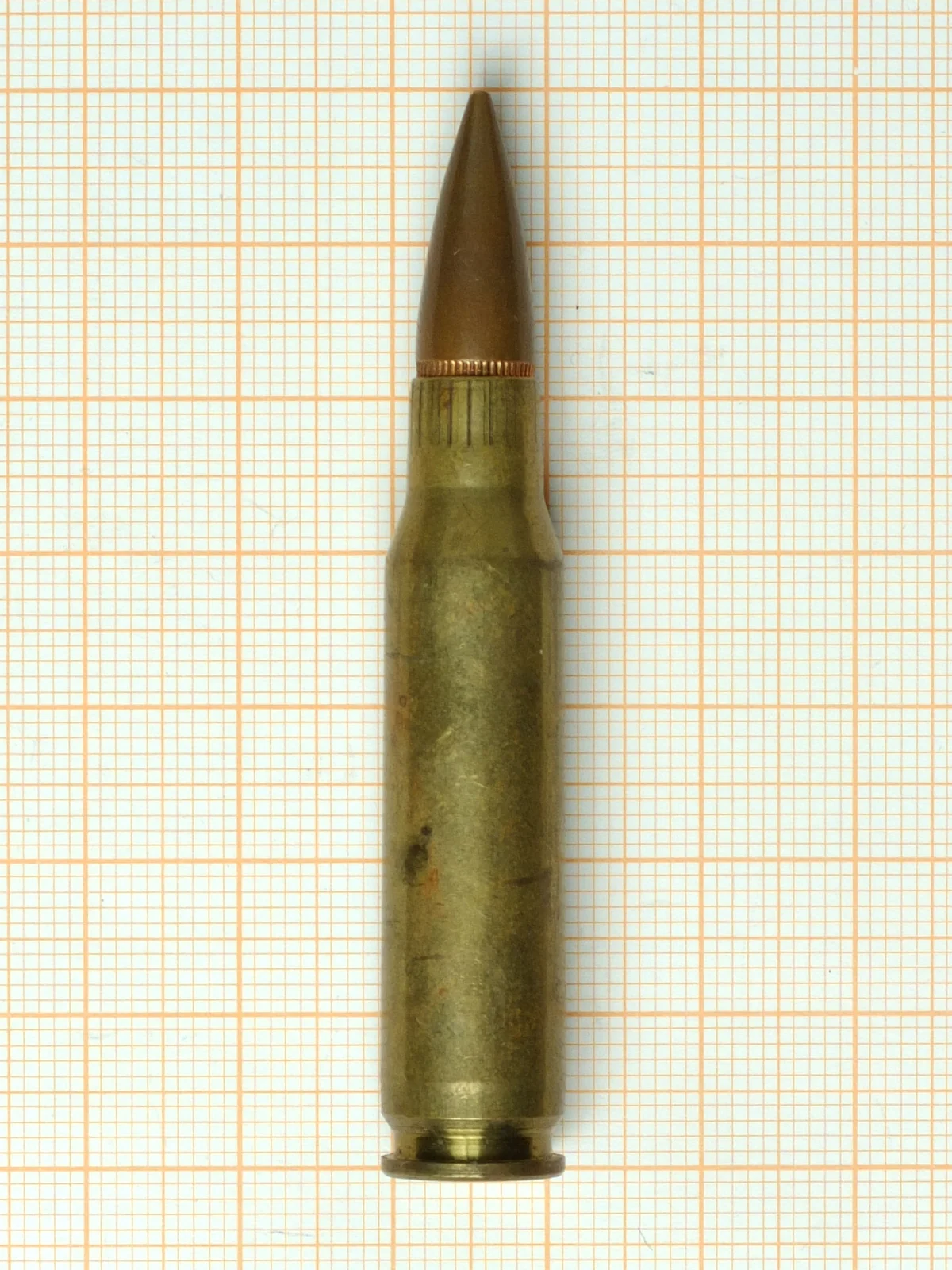
Image credit
- Title
- File:Cartridge 7.62x51mm NATO CC BY-SA 4.0 by Grasyl.jpg
- Author
- Grasyl(attribution required)
- Licence
- CC BY-SA 4.0
- Source
- https://commons.wikimedia.org/wiki/File:Cartridge_7.62x51mm_NATO_CC_BY-SA_4.0_by_Grasyl.jpg

Detail
The round that lost the argument it was created to win. The United States spent the decade after 1944 shortening the .30-06 case while insisting the result was a genuinely new cartridge, and pushed it through NATO standardisation in 1954 against British work on a lighter .280. Within fifteen years every army that adopted it had concluded the recoil was too much for controllable automatic fire from a shoulder weapon, and the intermediate cartridge they had rejected won anyway.
What it left behind is a superb machine-gun and marksman round. The FN FAL, the M14, the MAG and the SVD’s Western equivalents all live on the fact that a 9.5 g bullet at 850 m/s still carries useful energy past 800 m.
Its dimensions here are the .308 Winchester’s, because no free standard publishes the military round. That substitution is stated on every affected figure rather than hidden; the two chambers accept each other’s ammunition but are not specified to the same pressure.
References
- 7.62×51mm NATO · 1372335181 · read 2026-08-31
- C.I.P. TDCC datasheet — 308 Win. · 2008-09-23 · read 2026-08-31
Last verified 2026-08-31 · review status: agent-populated