
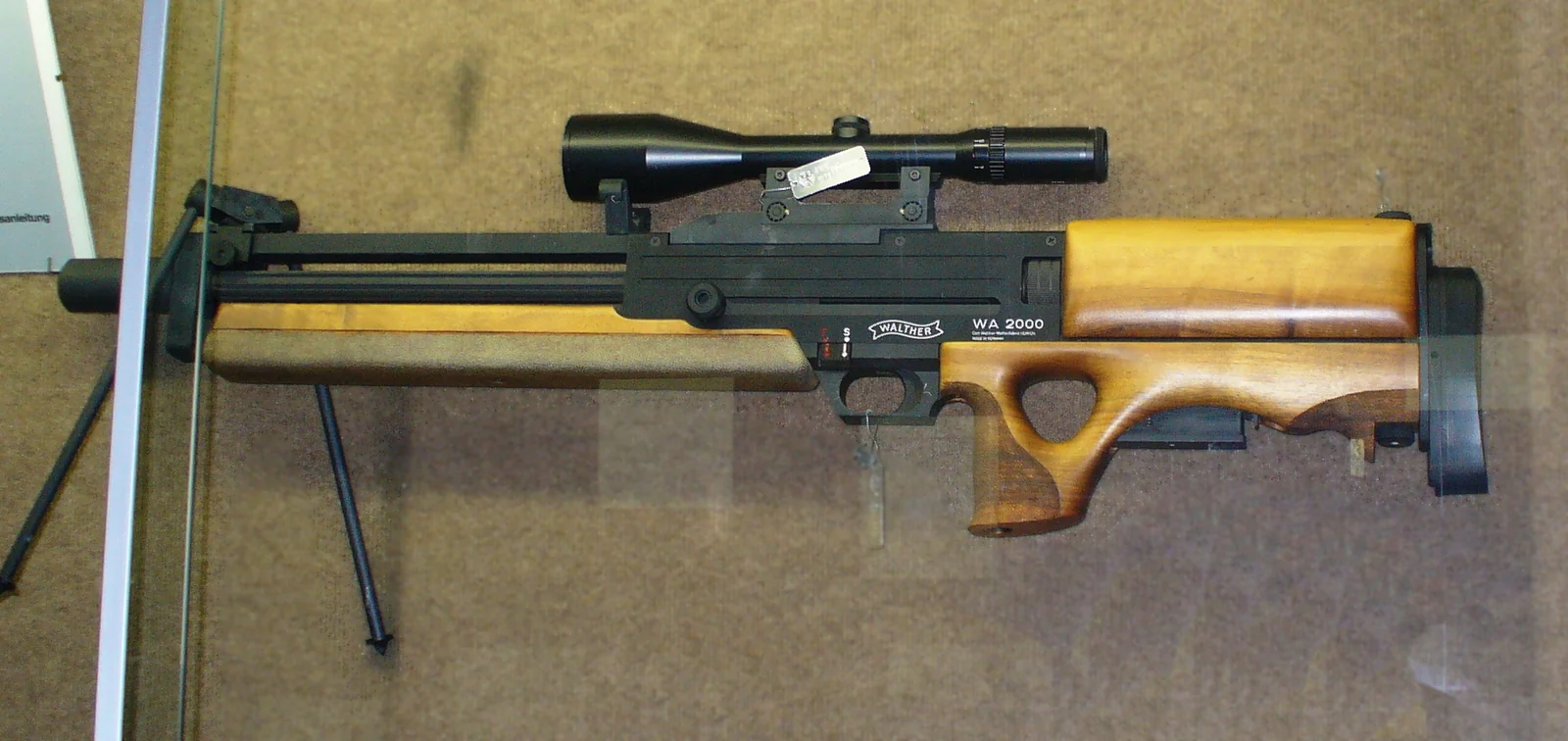
Image credit
- Title
- File:Walther WA 2000.JPG
- Author
- Atirador(attribution required)
- Licence
- CC BY-SA 3.0
- Source
- https://commons.wikimedia.org/wiki/File:Walther_WA_2000.JPG

How Muzzle energy is calculated
E = ½ · m · v²
Not calculated: v has no sourced figure yet. Nothing is substituted for a missing input.
1 of 2 inputs link to their source.
How Muzzle velocity is calculated
no sourced velocity for this load
Not calculated: muzzle velocity has no sourced figure yet. Nothing is substituted for a missing input.
No input on this calculation carries a clickable source yet.
How Loaded mass is calculated
m_loaded = m_empty + m_magazine + n · m_cartridge
Not calculated: m_magazine has no sourced figure yet. Nothing is substituted for a missing input.
Assumptions
- One magazine, filled to the stated capacity. Spare magazines, optics, slings and lights are the owner’s, not the arm’s.
1 of 4 inputs link to their source.
How Free recoil is calculated
E_recoil = ½ · m_firearm · v_recoil²
Not calculated: v_recoil has no sourced figure yet. Nothing is substituted for a missing input.
Assumptions
- Propellant gas momentum is excluded: ARMAG does not record charge weights. This is therefore a lower bound on the real free recoil, consistent between entries but smaller than a figure that includes the gas term.
- Free recoil: the arm is unrestrained. Stock design, muzzle devices, stance and shooter mass are not modelled, because none of them is a property of the arm.
1 of 2 inputs link to their source.
How Capacity is calculated
as published for the primary chambering
Inputs
- capacity5estimatedFrom the Wikipedia infobox, uncited there: a 5-round box magazine for .300 Winchester Magnum, in place of the 6-round magazine used for the other chamberings.
No input on this calculation carries a clickable source yet.
Derived figures
Computed from the sourced values above. Open ƒ on any figure for the formula, its inputs, and the assumptions it makes.
How Momentum is calculated
p = m · v
Not calculated: v has no sourced figure yet. Nothing is substituted for a missing input.
1 of 2 inputs link to their source.
How Sectional density is calculated
SD = mass(gr) / (7000 · diameter(in)²)
Inputs
- mass12.96 g200.0 grverifiedsource200 gr as published on the product page, converted to grams (1 gr = 0.06479891 g).
- diameter7.85 mm0.3091 inverifiedsourceCartridge maximum, dimension G1.
Assumptions
- Reported in the conventional lb/in² so it is directly comparable with published figures.
2 of 2 inputs link to their source.
How Power factor is calculated
PF = mass(gr) · velocity(fps) / 1000
Not calculated: velocity has no sourced figure yet. Nothing is substituted for a missing input.
Assumptions
- A competition classification defined by the IPSC and USPSA rulebooks, stated in their units. It describes a scoring category, not an effect.
1 of 2 inputs link to their source.
How Magazine dump is calculated
t = (n − 1) / (rpm / 60)
Not calculated: rpm has no sourced figure yet. Nothing is substituted for a missing input.
Assumptions
- Cyclic rate held for the whole magazine, no stoppages, trigger held down. A theoretical figure for comparing mechanisms, not a measured one.
No input on this calculation carries a clickable source yet.
How Sight error at 1 mm is calculated
θ = atan(misalignment / sight radius)
Not calculated: sight radius has no sourced figure yet. Nothing is substituted for a missing input.
Assumptions
- Shows what a stated aiming error costs. The misalignment is the reader’s figure; the site does not claim how well anyone aims.
No input on this calculation carries a clickable source yet.
Specifications
Every row here is generated from the schema, so a figure recorded on this entry cannot be missing from the table, and the same rows, read the same way, are what the comparison shows.
Identity
- Type
- Rifle
- Action
- Self-loading
- Fire modes
- Semi-automatic
- Operating system
- not recorded
- Designed in
- Germany
- Produced in
- Introduced
- 1981
- Production
- 1978–1988
Dimensions and mass
- Mass, empty
- 6.95 kg15.32 lbsource
Unloaded, without scope, as published in Walther USA's own owner's manual.
- Magazine, empty
- not recorded
- Length
- 905 mm35.63 inestimated
From the Wikipedia infobox, uncited there.
- Length, folded
- not recorded
- Width
- not recorded
- Height
- not recorded
- Barrel length
- 650 mm25.59 inestimated
From the Wikipedia infobox, uncited there.
Sights and rifling
- Sight radius
- not recorded
- Sight height over bore
- not recorded
- Rifling twist
- not recorded
- Twist direction
- not recorded
- Grooves
- not recorded
- Sight graduation
- not recorded
Operation
- Cyclic rate
- not recorded
- Trigger pull
Midpoint of a published 1.2–1.4 kg range, from Walther USA's own owner's manual.
- Effective range
- 700 m765.5 ydestimated
From the Wikipedia infobox, uncited there.
- Units produced
- not recorded
- Launch price
- not recorded
Chamberings
- .300 Winchester Magnumprimary5 rounds
- 7.62×51mm NATO6 rounds
- 7.5×55mm Swiss6 rounds
Scale
A to-scale outline against family siblings. The dimensions are sourced; the shape is a representative outline for the type, and says so.
- Walther WA 2000905 mm35.63 inheight not recorded
Representative outline: the dimensions are sourced, the shape is not. Overall length, and barrel length where recorded, are drawn from this entry's own figures; the profile is a generic one for the firearm type and says nothing about this arm's actual contours. Walther WA 2000 records no height, so its outline is drawn at the type's proportion. That height is part of the shape, not a measurement.
Detail
The WA 2000 is a semi-automatic bullpup sniper rifle Walther designed in response to the Munich massacre at the 1972 Summer Olympics. Development ran through the late 1970s, production began in 1978 and the rifle was brought to market in 1981, and its users were German police units.
Its most visible feature is its bullpup layout, which places the bolt behind the grip so the barrel can run the full length of the weapon without extending the rifle’s overall length. This is a way of keeping a full-length barrel’s accuracy in a shorter package. The barrel itself is clamped only at the front and rear, isolated from the rest of the stock so nothing else touches or distorts it, and fluted to help it shed heat and resist vibration. It is a gas-operated, self-loading design firing from a closed bolt with a seven-lug rotating bolt head, feeding from a single-stack box magazine, and it carries no iron sights at all: Walther designed it around a Schmidt & Bender 2.5–10× telescopic sight from the outset. Its primary chambering, .300 Winchester Magnum, was chosen specifically for consistent accuracy across a range of distances, and Walther also built barrels for 7.62×51mm NATO and 7.5×55mm Swiss.
Only 176 were built before production ended in 1988: reviewers and later writers have generally agreed it was too expensive to sell in volume and not robust enough for military field use, positioning it instead for law-enforcement sale, which limited its market from the start. That rarity has made surviving examples valuable collector’s items, with auction prices in the tens of thousands of dollars.
Its unloaded mass and magazine capacity for the 7.62×51mm NATO chambering come from Walther USA’s own archived owner’s manual and are recorded as verified; overall length, barrel length, effective range and the .300 Winchester Magnum and 7.5×55mm Swiss magazine capacities come from Wikipedia’s own uncited infobox and are recorded as estimated. No rifling twist rate is published for any of its three chamberings.
References
This entry's own bibliography. Every citation key on this page resolves into this list.
- Walther WA 2000 · Wikipedia · 1359036858 · read 2026-09-24 · CC BY-SA 4.0
- WA 2000 Owner's Manual · Walther USA · 2004 · read 2026-09-24
Last verified 2026-09-24 · review status: agent-populated