
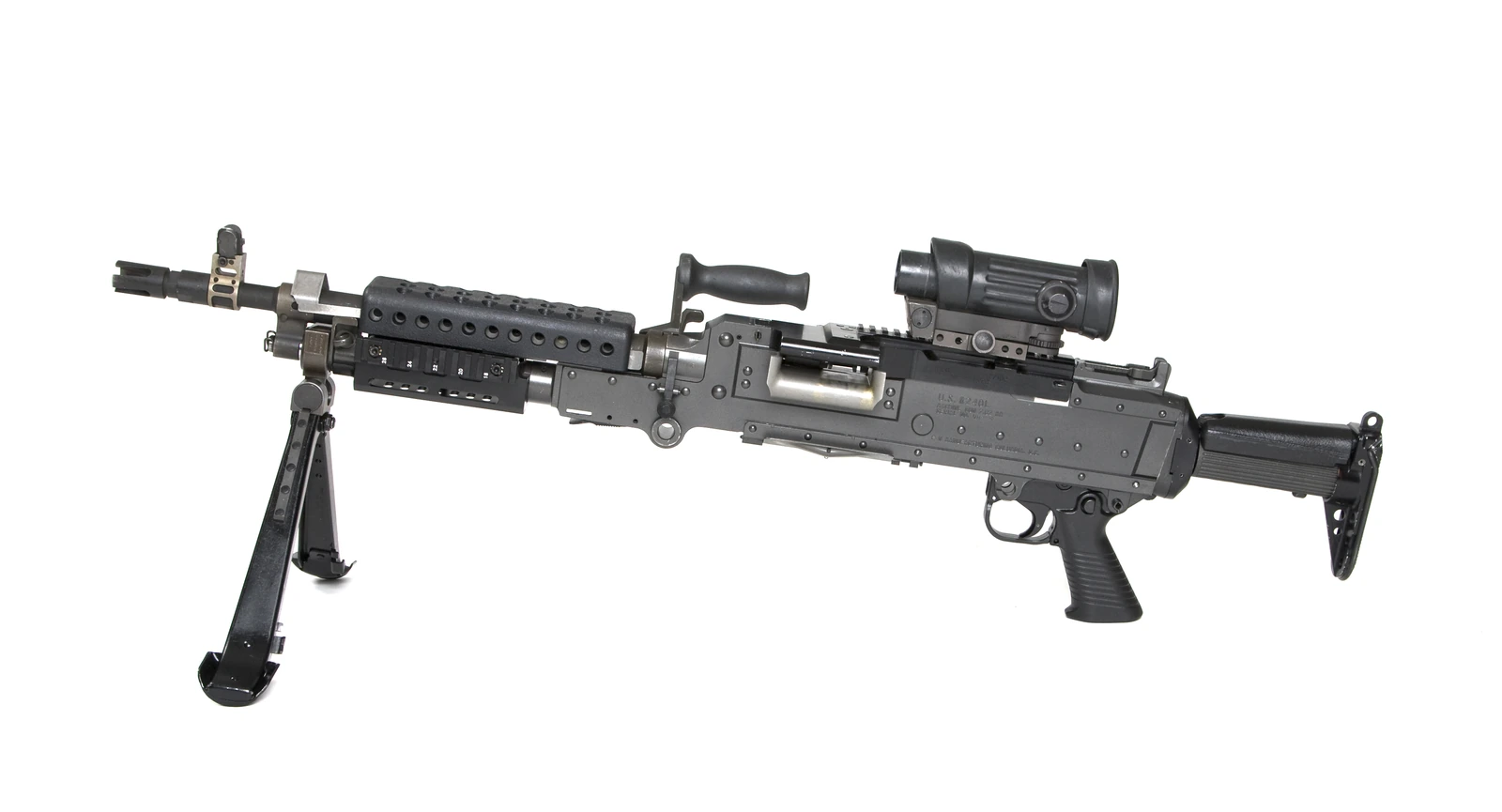
Image credit
- Title
- File:PEO M240L ELCAN Left.jpg
- Author
- Photo Courtesy of PEO Soldier
- Licence
- Public domain
- Source
- https://commons.wikimedia.org/wiki/File:PEO_M240L_ELCAN_Left.jpg

How Muzzle energy is calculated
E = ½ · m · v²
Inputs
- m9.525 g147.0 grverifiedsourcePublished as 147 gr; 1 gr = 0.06479891 g exactly.
- v853 m/s2,799 fpsverifiedMeasured with a 558.8 mm barrel, not this arm's 630 mm. Velocity outside the sourced range is not projected.
1 of 2 inputs link to their source.
How Muzzle velocity is calculated
nearest sourced barrel length, no extrapolation
Inputs
- v at 558.8 mm853 m/s2,799 fpsverifiedsourceBallistics table of the cited article.
Assumptions
- This figure belongs to a 558.8 mm barrel. It is shown because it is the closest measurement that exists, not because it applies here.
1 of 1 inputs link to their source.
How Loaded mass is calculated
m_loaded = m_empty + m_magazine + n · m_cartridge
Not calculated: m_magazine has no sourced figure yet. Nothing is substituted for a missing input.
Assumptions
- One magazine, filled to the stated capacity. Spare magazines, optics, slings and lights are the owner’s, not the arm’s.
2 of 4 inputs link to their source.
How Free recoil is calculated
E_recoil = ½ · m_firearm · v_recoil²
Inputs
- m_firearm12.52 kg27.60 lbestimatedsourceM240B configuration, converted from the infobox's 27.6 lb, uncited on Wikipedia
- v_recoil0.6489 m/s2.129 fpsestimated
Assumptions
- Propellant gas momentum is excluded: ARMAG does not record charge weights. This is therefore a lower bound on the real free recoil, consistent between entries but smaller than a figure that includes the gas term.
- Free recoil: the arm is unrestrained. Stock design, muzzle devices, stance and shooter mass are not modelled, because none of them is a property of the arm.
1 of 2 inputs link to their source.
How Capacity is calculated
as published for the primary chambering
Inputs
- capacity100estimatedsourceM13 disintegrating-link belt, commonly carried in 100-round pouches; a 50-round assault pouch and the non-disintegrating DM1 belt are also published as feed options
1 of 1 inputs link to their source.
Derived figures
Computed from the sourced values above. Open ƒ on any figure for the formula, its inputs, and the assumptions it makes.
How Momentum is calculated
p = m · v
Inputs
- m9.525 g147.0 grverifiedsourcePublished as 147 gr; 1 gr = 0.06479891 g exactly.
- v853 m/s2,799 fpsverifiedMeasured with a 558.8 mm barrel, not this arm's 630 mm. Velocity outside the sourced range is not projected.
1 of 2 inputs link to their source.
How Sectional density is calculated
SD = mass(gr) / (7000 · diameter(in)²)
Inputs
- mass9.525 g147.0 grverifiedsourcePublished as 147 gr; 1 gr = 0.06479891 g exactly.
- diameter7.85 mm0.3091 inestimatedsourceNo free dimensional standard publishes the NATO round under that name. Borrowed from the C.I.P. datasheet for the commercial .308 Winchester (G1), which shares the chamber; the two are not interchangeable at the pressure limit.
Assumptions
- Reported in the conventional lb/in² so it is directly comparable with published figures.
2 of 2 inputs link to their source.
How Power factor is calculated
PF = mass(gr) · velocity(fps) / 1000
Inputs
- mass9.525 g147.0 grverifiedsourcePublished as 147 gr; 1 gr = 0.06479891 g exactly.
- velocity853 m/s2,799 fpsverifiedMeasured with a 558.8 mm barrel, not this arm's 630 mm. Velocity outside the sourced range is not projected.
Assumptions
- A competition classification defined by the IPSC and USPSA rulebooks, stated in their units. It describes a scoring category, not an effect.
1 of 2 inputs link to their source.
How Magazine dump is calculated
t = (n − 1) / (rpm / 60)
Inputs
- n100estimatedsourceM13 disintegrating-link belt, commonly carried in 100-round pouches; a 50-round assault pouch and the non-disintegrating DM1 belt are also published as feed options
- rpm600 rpmestimatedsourcemidpoint of the published, uncited base rate of 550-650 rounds a minute on the single-port gas setting; three higher adjustable gas settings are also published, up to 850-950 rounds a minute
Assumptions
- Cyclic rate held for the whole magazine, no stoppages, trigger held down. A theoretical figure for comparing mechanisms, not a measured one.
2 of 2 inputs link to their source.
How Sight error at 1 mm is calculated
θ = atan(misalignment / sight radius)
Not calculated: sight radius has no sourced figure yet. Nothing is substituted for a missing input.
Assumptions
- Shows what a stated aiming error costs. The misalignment is the reader’s figure; the site does not claim how well anyone aims.
No input on this calculation carries a clickable source yet.
Specifications
Every row here is generated from the schema, so a figure recorded on this entry cannot be missing from the table, and the same rows, read the same way, are what the comparison shows.
Identity
- Type
- Machine gun
- Action
- Self-loading
- Fire modes
- Fully automatic
- Operating system
- Gas, long-stroke piston
- Feed
- Roles
- Designed in
- Belgium
- Produced in
- Introduced
- 1977
- Production
- 1977–present
Dimensions and mass
- Mass, empty
M240B configuration, converted from the infobox's 27.6 lb, uncited on Wikipedia
- Magazine, empty
- not recorded
- Length
converted from the infobox's 49.7 in, uncited on Wikipedia
- Length, folded
- not recorded
- Width
converted from the infobox's 4.7 in, uncited on Wikipedia
- Height
converted from the infobox's 10.4 in, uncited on Wikipedia
- Barrel length
converted from the infobox's 24.8 in, uncited on Wikipedia
Sights and rifling
- Sight radius
- not recorded
- Sight height over bore
- not recorded
- Rifling twist
- not recorded
- Twist direction
- not recorded
- Grooves
- not recorded
- Sight graduation
- not recorded
Operation
- Cyclic rate
midpoint of the published, uncited base rate of 550-650 rounds a minute on the single-port gas setting; three higher adjustable gas settings are also published, up to 850-950 rounds a minute
- Trigger pull
- not recorded
- Effective range
midpoint of the published, uncited 800-1800 m range, which depends on mount
- Units produced
- not recorded
- Launch price
- not recorded
Chamberings
- 7.62×51mm NATOprimary100 rounds
Scale
A to-scale outline against family siblings. The dimensions are sourced; the shape is a representative outline for the type, and says so.
- M240 machine gun1,262 mm49.69 in
Representative outline: the dimensions are sourced, the shape is not. Overall length, and barrel length where recorded, are drawn from this entry's own figures; the profile is a generic one for the firearm type and says nothing about this arm's actual contours.
Gallery
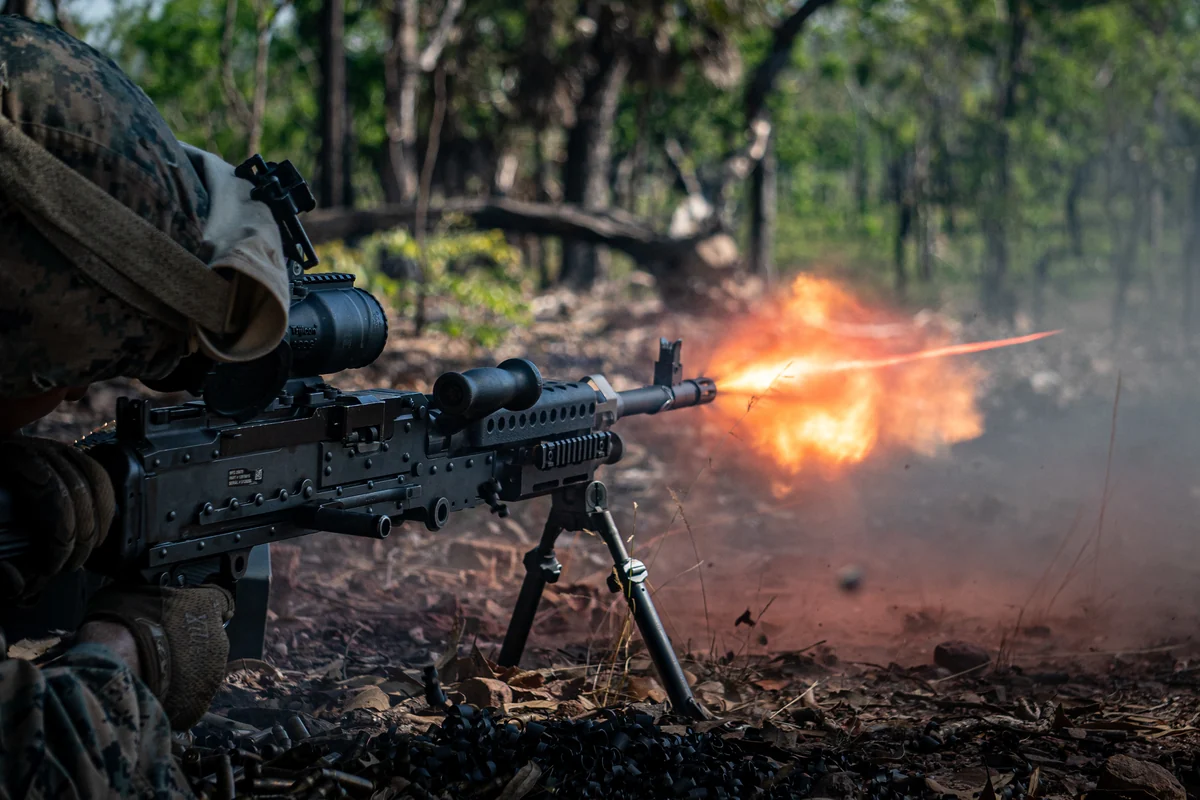
Image credit
- Title
- File:Bounding with the M240B machine gun (6763237).jpg
- Author
- U.S. Marine Corps photo by Cpl. Lydia Gordon
- Licence
- Public domain
- Source
- https://commons.wikimedia.org/wiki/File:Bounding_with_the_M240B_machine_gun_(6763237).jpg
.jpg)
Detail
The M240 is the US military’s designation for a family of machine guns built on FN Herstal’s MAG design, engineered in Belgium in the 1950s by Ernest Vervier and already in wide international service before the United States adopted it. The US military first fielded it in armoured vehicle and coaxial mounts in the 1970s, well before issuing it as a dismounted infantry weapon, which is why “M240” spans several distinct roles and configurations under one family designation rather than a single fixed pattern.
The configuration described in this entry, the M240B, is the lightened, dismounted-infantry version fielded from the early 2000s onward, fitted with a rail-mounted stock, pistol grip and bipod so it could be carried and fired by a two-man infantry team rather than only from a vehicle mount or tripod. It replaced the M60 as the US Army and Marine Corps’ standard squad-level medium machine gun, valued for a reputation for reliability that the ageing M60 fleet had not matched by the 1990s. Earlier and later M240 variants (the vehicle-mounted M240C and the further-lightened M240L) share the same basic action but differ in furniture, mount and, in the M240L’s case, in receiver material, and this entry does not attempt to give them separate figures.
Mechanically it is gas-operated with a long-stroke piston, firing from an open bolt, and its gas system offers multiple adjustable ports that let a gunner trade cyclic rate for reduced fouling or vice versa. This is a feature not present on the M60 it replaced. Production and support in the United States passed from FN’s own American subsidiary to other contractors over the weapon’s service life, including U.S. Ordnance and Barrett Firearms Manufacturing, while FN Herstal in Belgium continues to build the parent MAG design for other militaries worldwide.
Every figure in this entry is transcribed from Wikipedia’s infobox rather than a primary FN or US Army source, none of it individually cited on Wikipedia itself, so all figures here are recorded as estimated rather than verified. No muzzle velocity is recorded because no source found ties the infobox’s published 853 m/s figure to a stated barrel length, and reported cyclic rate varies considerably with the gas regulator’s setting; the lowest, base setting is recorded here rather than the higher settings the infobox also publishes.
References
This entry's own bibliography. Every citation key on this page resolves into this list.
- M240 machine gun · Wikipedia · 1372830647 · read 2026-09-04 · CC BY-SA 4.0
Last verified 2026-09-04 · review status: draft