
Lee–Enfield
Royal Small Arms Factory1895–1957Smokeless revolution
Also known as SMLE, Rifle No. 4, .303
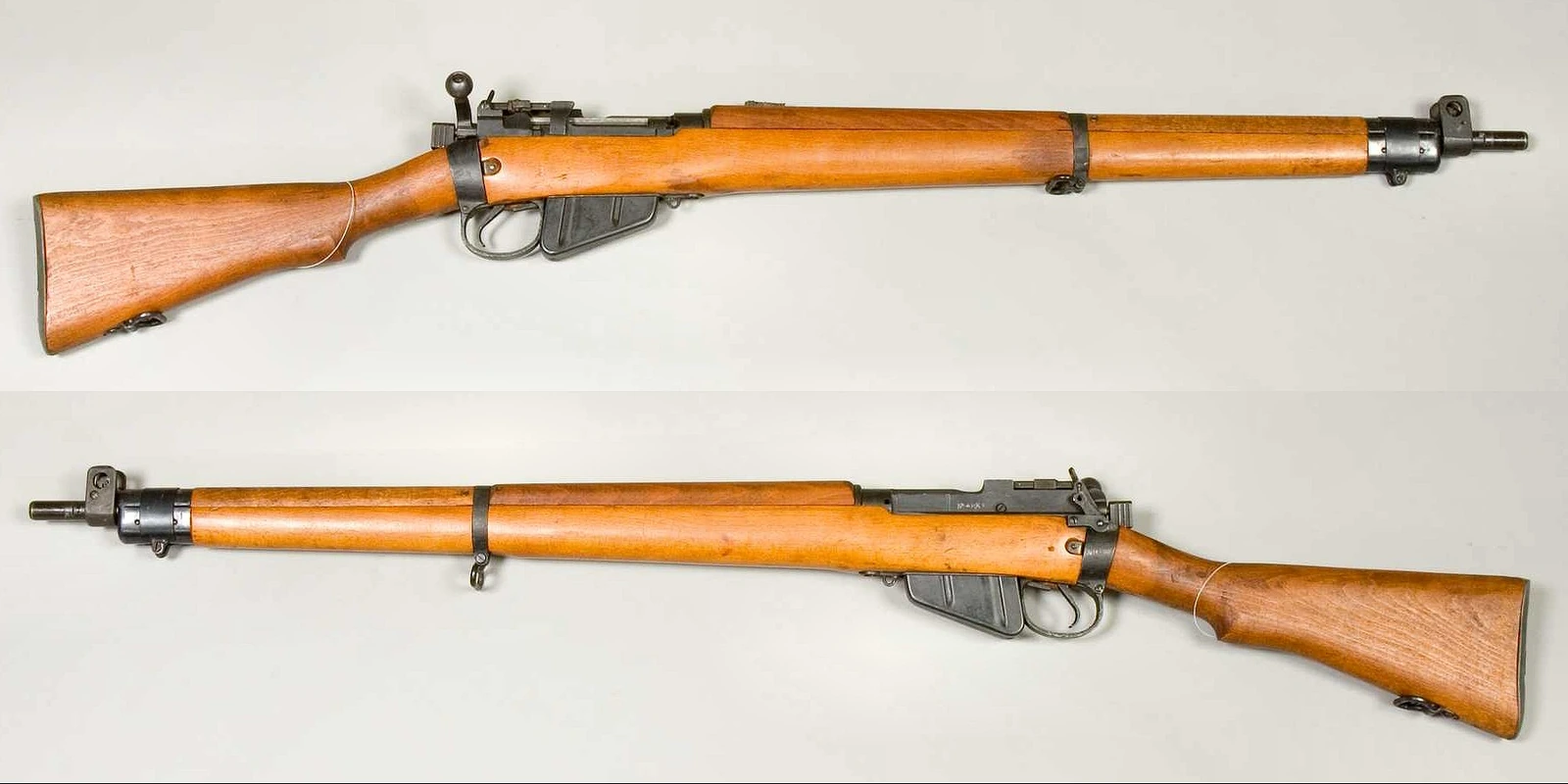
Image credit
- Title
- File:Lee-Enfield No 4 Mk I (1943) - AM.032027.jpg
- Author
- Armémuseum (The Swedish Army Museum)
- Licence
- Public domain
- Source
- https://commons.wikimedia.org/wiki/File:Lee-Enfield_No_4_Mk_I_(1943)_-_AM.032027.jpg
_-_AM.032027.jpg)
How Muzzle energy is calculated
E = ½ · m · v²
Not calculated: m has no sourced figure yet. Nothing is substituted for a missing input.
No input on this calculation carries a clickable source yet.
How Muzzle velocity is calculated
no sourced velocity for this pairing
Not calculated: muzzle velocity has no sourced figure yet. Nothing is substituted for a missing input.
No input on this calculation carries a clickable source yet.
How Loaded mass is calculated
m_loaded = m_empty + m_magazine + n · m_cartridge
Not calculated: m_empty has no sourced figure yet. Nothing is substituted for a missing input.
Assumptions
- One magazine, filled to the stated capacity. Spare magazines, optics, slings and lights are the owner’s, not the arm’s.
1 of 4 inputs link to their source.
How Free recoil is calculated
E_recoil = ½ · m_firearm · v_recoil²
Not calculated: m_firearm has no sourced figure yet. Nothing is substituted for a missing input.
Assumptions
- Propellant gas momentum is excluded: ARMAG does not record charge weights. This is therefore a lower bound on the real free recoil, consistent between entries but smaller than a figure that includes the gas term.
- Free recoil: the arm is unrestrained. Stock design, muzzle devices, stance and shooter mass are not modelled, because none of them is a property of the arm.
No input on this calculation carries a clickable source yet.
How Capacity is calculated
as published for the primary chambering
Inputs
- capacity10verifiedsourceDetachable box magazine, normally loaded in place from two five-round charger clips.
1 of 1 inputs link to their source.
Derived figures
Computed from the sourced values above. Open ƒ on any figure for the formula, its inputs, and the assumptions it makes.
How Momentum is calculated
p = m · v
Not calculated: m has no sourced figure yet. Nothing is substituted for a missing input.
No input on this calculation carries a clickable source yet.
How Sectional density is calculated
SD = mass(gr) / (7000 · diameter(in)²)
Not calculated: mass has no sourced figure yet. Nothing is substituted for a missing input.
Assumptions
- Reported in the conventional lb/in² so it is directly comparable with published figures.
1 of 2 inputs link to their source.
How Power factor is calculated
PF = mass(gr) · velocity(fps) / 1000
Not calculated: mass has no sourced figure yet. Nothing is substituted for a missing input.
Assumptions
- A competition classification defined by the IPSC and USPSA rulebooks, stated in their units. It describes a scoring category, not an effect.
No input on this calculation carries a clickable source yet.
How Magazine dump is calculated
t = (n − 1) / (rpm / 60)
Not calculated: rpm has no sourced figure yet. Nothing is substituted for a missing input.
Assumptions
- Cyclic rate held for the whole magazine, no stoppages, trigger held down. A theoretical figure for comparing mechanisms, not a measured one.
1 of 2 inputs link to their source.
How Sight error at 1 mm is calculated
θ = atan(misalignment / sight radius)
Not calculated: sight radius has no sourced figure yet. Nothing is substituted for a missing input.
Assumptions
- Shows what a stated aiming error costs. The misalignment is the reader’s figure; the site does not claim how well anyone aims.
No input on this calculation carries a clickable source yet.
Specifications
Every row here is generated from the schema, so a figure recorded on this entry cannot be missing from the table, and the same rows, read the same way, are what the comparison shows.
Identity
- Type
- Rifle
- Action
- Bolt action
- Fire modes
- Single shot
- Operating system
- Manually operated
- Roles
- Designed in
- United Kingdom
- Produced in
- Introduced
- 1895
- Production
- 1895–1957
Dimensions and mass
- Mass, empty
- not recorded
- Magazine, empty
- not recorded
- Length
- not recorded
- Length, folded
- not recorded
- Width
- not recorded
- Height
- not recorded
- Barrel length
- not recorded
Sights and rifling
- Sight radius
- not recorded
- Sight height over bore
- not recorded
- Rifling twist
- not recorded
- Twist direction
- not recorded
- Grooves
- not recorded
- Sight graduation
- not recorded
Chamberings
- .303 Britishprimary10 rounds
- 7.62×51mm NATO10 rounds
Scale
A to-scale outline against family siblings. The dimensions are sourced; the shape is a representative outline for the type, and says so.
Representative outline: the dimensions are sourced, the shape is not. Overall length, and barrel length where recorded, are drawn from this entry's own figures; the profile is a generic one for the firearm type and says nothing about this arm's actual contours.
Not drawn: Lee–Enfield (no sourced overall length).
Lineage
What came from it
- Derivatives De Lisle carbine
Detail
James Paris Lee’s bolt locks at the rear of the receiver rather than the front, which every textbook will tell you is the weaker arrangement, and it is. What it also does is put a short, smooth stroke under the firer’s hand with the bolt handle already near the trigger, and give the whole action enough spring that the bolt can be worked without breaking the shoulder weld. A trained rifleman could put fifteen aimed rounds a minute into a target at 300 yards, which is roughly double what a Mauser-armed one managed.
The magazine holds ten rather than five, alone among the service bolt rifles of its generation, and detaches, although it was never meant to be changed in action; it is filled in place from chargers.
The design’s other defining property is that it could be simplified without being redesigned. The No. 4 of 1941 dropped the nose cap, moved to an aperture sight and accepted a much rougher finish, and it is the same rifle.
This entry has no weight, no overall length and no barrel length. The cited article publishes those figures only in a per-model table rather than in its infobox, and this site does not transcribe a figure it cannot attach to a specific configuration.
References
This entry's own bibliography. Every citation key on this page resolves into this list.
- Lee–Enfield · Wikipedia · 1368996931 · read 2026-08-31 · CC BY-SA 4.0
Last verified 2026-08-31 · review status: agent-populated