
M60 machine gun
Saco Defense1957–presentEarly Cold War
Also known as Machine Gun, Caliber 7.62mm, M60
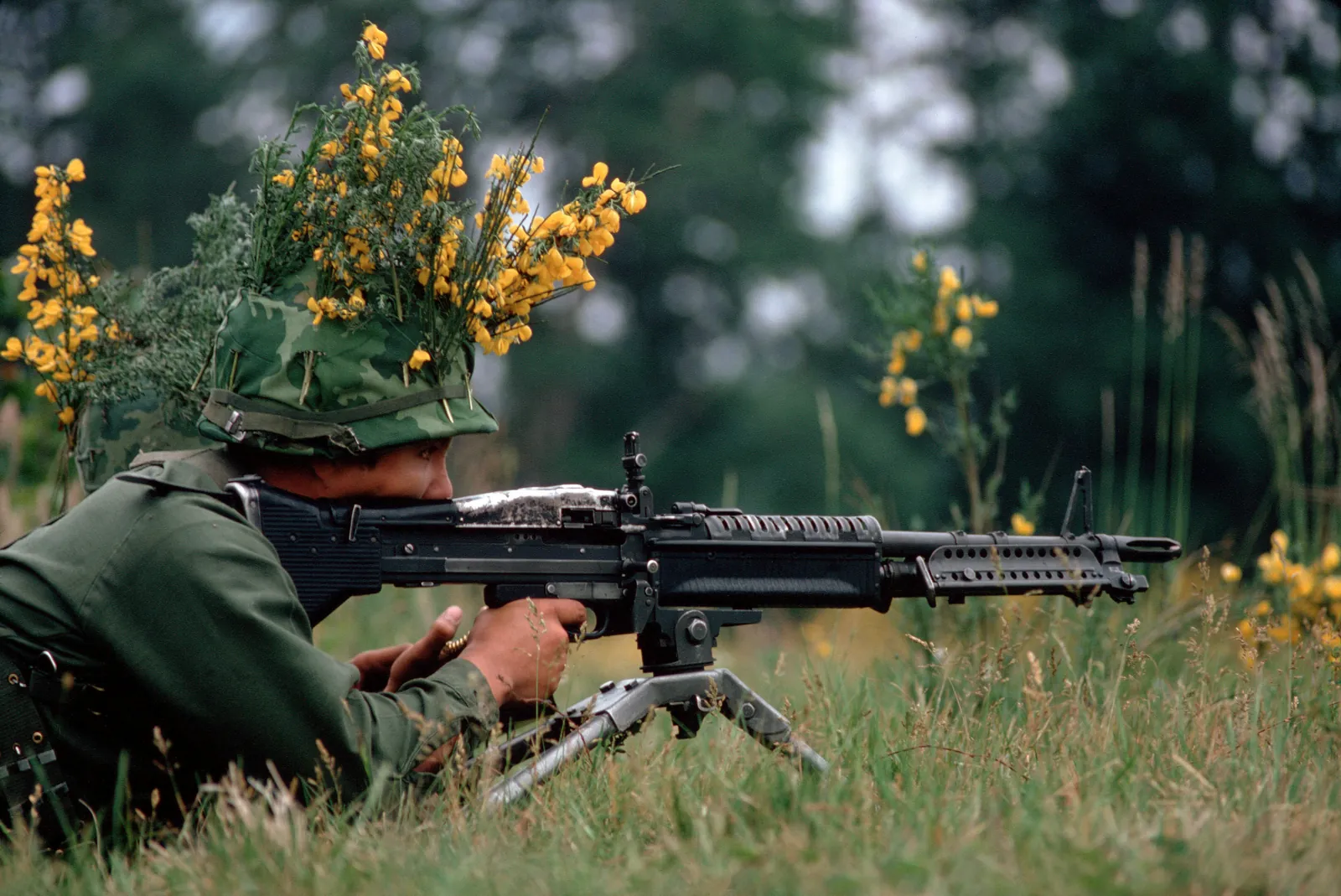
Image credit
- Title
- File:M60 machine gun DA-ST-84-04992.jpg
- Licence
- Public domain
- Source
- https://commons.wikimedia.org/wiki/File:M60_machine_gun_DA-ST-84-04992.jpg

How Muzzle energy is calculated
E = ½ · m · v²
Inputs
- m9.525 g147.0 grverifiedsourcePublished as 147 gr; 1 gr = 0.06479891 g exactly.
- v853 m/s2,799 fpsverifiedMeasured with a 558.8 mm barrel, not this arm's 560 mm. Velocity outside the sourced range is not projected.
1 of 2 inputs link to their source.
How Muzzle velocity is calculated
nearest sourced barrel length, no extrapolation
Inputs
- v at 558.8 mm853 m/s2,799 fpsverifiedsourceBallistics table of the cited article.
Assumptions
- This figure belongs to a 558.8 mm barrel. It is shown because it is the closest measurement that exists, not because it applies here.
1 of 1 inputs link to their source.
How Loaded mass is calculated
m_loaded = m_empty + m_magazine + n · m_cartridge
Not calculated: m_magazine has no sourced figure yet. Nothing is substituted for a missing input.
Assumptions
- One magazine, filled to the stated capacity. Spare magazines, optics, slings and lights are the owner’s, not the arm’s.
2 of 4 inputs link to their source.
How Free recoil is calculated
E_recoil = ½ · m_firearm · v_recoil²
Inputs
- m_firearm10.4 kg22.93 lbverifiedsourcewith bipod attached, per World.Guns.ru's specification table for the base M60
- v_recoil0.7812 m/s2.563 fpsestimated
Assumptions
- Propellant gas momentum is excluded: ARMAG does not record charge weights. This is therefore a lower bound on the real free recoil, consistent between entries but smaller than a figure that includes the gas term.
- Free recoil: the arm is unrestrained. Stock design, muzzle devices, stance and shooter mass are not modelled, because none of them is a property of the arm.
1 of 2 inputs link to their source.
How Capacity is calculated
as published for the primary chambering
Inputs
- capacity100verifiedsourcedisintegrating belt, published as carried in 100- or 200-round assault packs
1 of 1 inputs link to their source.
Derived figures
Computed from the sourced values above. Open ƒ on any figure for the formula, its inputs, and the assumptions it makes.
How Momentum is calculated
p = m · v
Inputs
- m9.525 g147.0 grverifiedsourcePublished as 147 gr; 1 gr = 0.06479891 g exactly.
- v853 m/s2,799 fpsverifiedMeasured with a 558.8 mm barrel, not this arm's 560 mm. Velocity outside the sourced range is not projected.
1 of 2 inputs link to their source.
How Sectional density is calculated
SD = mass(gr) / (7000 · diameter(in)²)
Inputs
- mass9.525 g147.0 grverifiedsourcePublished as 147 gr; 1 gr = 0.06479891 g exactly.
- diameter7.85 mm0.3091 inestimatedsourceNo free dimensional standard publishes the NATO round under that name. Borrowed from the C.I.P. datasheet for the commercial .308 Winchester (G1), which shares the chamber; the two are not interchangeable at the pressure limit.
Assumptions
- Reported in the conventional lb/in² so it is directly comparable with published figures.
2 of 2 inputs link to their source.
How Power factor is calculated
PF = mass(gr) · velocity(fps) / 1000
Inputs
- mass9.525 g147.0 grverifiedsourcePublished as 147 gr; 1 gr = 0.06479891 g exactly.
- velocity853 m/s2,799 fpsverifiedMeasured with a 558.8 mm barrel, not this arm's 560 mm. Velocity outside the sourced range is not projected.
Assumptions
- A competition classification defined by the IPSC and USPSA rulebooks, stated in their units. It describes a scoring category, not an effect.
1 of 2 inputs link to their source.
How Magazine dump is calculated
t = (n − 1) / (rpm / 60)
Inputs
- n100verifiedsourcedisintegrating belt, published as carried in 100- or 200-round assault packs
- rpm550 rpmverifiedsourcepublished as a single figure; Wikipedia's own infobox instead gives an uncited range of 550-650 rounds a minute
Assumptions
- Cyclic rate held for the whole magazine, no stoppages, trigger held down. A theoretical figure for comparing mechanisms, not a measured one.
2 of 2 inputs link to their source.
How Sight error at 1 mm is calculated
θ = atan(misalignment / sight radius)
Not calculated: sight radius has no sourced figure yet. Nothing is substituted for a missing input.
Assumptions
- Shows what a stated aiming error costs. The misalignment is the reader’s figure; the site does not claim how well anyone aims.
No input on this calculation carries a clickable source yet.
Specifications
Every row here is generated from the schema, so a figure recorded on this entry cannot be missing from the table, and the same rows, read the same way, are what the comparison shows.
Identity
- Type
- Machine gun
- Action
- Self-loading
- Fire modes
- Fully automatic
- Operating system
- Gas, short-stroke piston
- Feed
- Roles
- Designed in
- United States
- Produced in
- Introduced
- 1957
- Production
- 1957–present
Dimensions and mass
- Mass, empty
- 10.4 kg22.93 lbsource
with bipod attached, per World.Guns.ru's specification table for the base M60
- Magazine, empty
- not recorded
- Length
- 1,067 mm42.01 insource
base M60; Wikipedia's own infobox gives a different, uncited figure of 1,105 mm
- Length, folded
- not recorded
- Width
- not recorded
- Height
- not recorded
- Barrel length
- 560 mm22.05 insource
base M60, matching Wikipedia's own uncited infobox figure
Sights and rifling
- Sight radius
- not recorded
- Sight height over bore
- not recorded
- Rifling twist
- not recorded
- Twist direction
- not recorded
- Grooves
- not recorded
- Sight graduation
- not recorded
Chamberings
- 7.62×51mm NATOprimary100 rounds
Scale
A to-scale outline against family siblings. The dimensions are sourced; the shape is a representative outline for the type, and says so.
- M60 machine gun1,067 mm42.01 inheight not recorded
Representative outline: the dimensions are sourced, the shape is not. Overall length, and barrel length where recorded, are drawn from this entry's own figures; the profile is a generic one for the firearm type and says nothing about this arm's actual contours. M60 machine gun records no height, so its outline is drawn at the type's proportion. That height is part of the shape, not a measurement.
Gallery
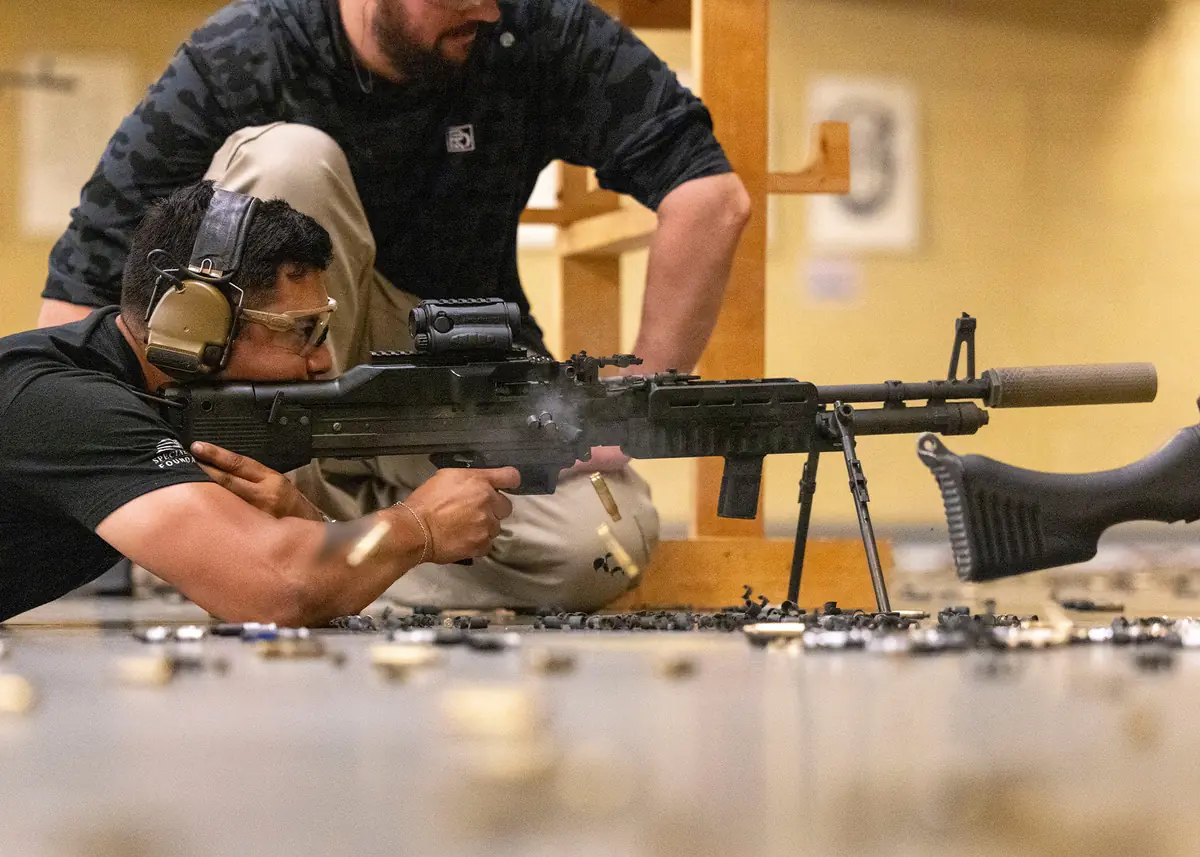
Image credit
- Title
- 5th SFG(A) 63rd Annual Legion Week Family Range
- Author
- Staff Sgt. Martin Rainen
- Licence
- Public domain
- Source
- https://www.dvidshub.net/image/8654434/5th-sfga-63rd-annual-legion-week-family-range
- Note
- Work of the United States Government, uncopyrighted under 17 U.S.C. §105: photographed for the Army (5th Special Forces Group (Airborne)), VIRIN 240919-A-YR619-1047. DVIDS states no separate licence per asset.
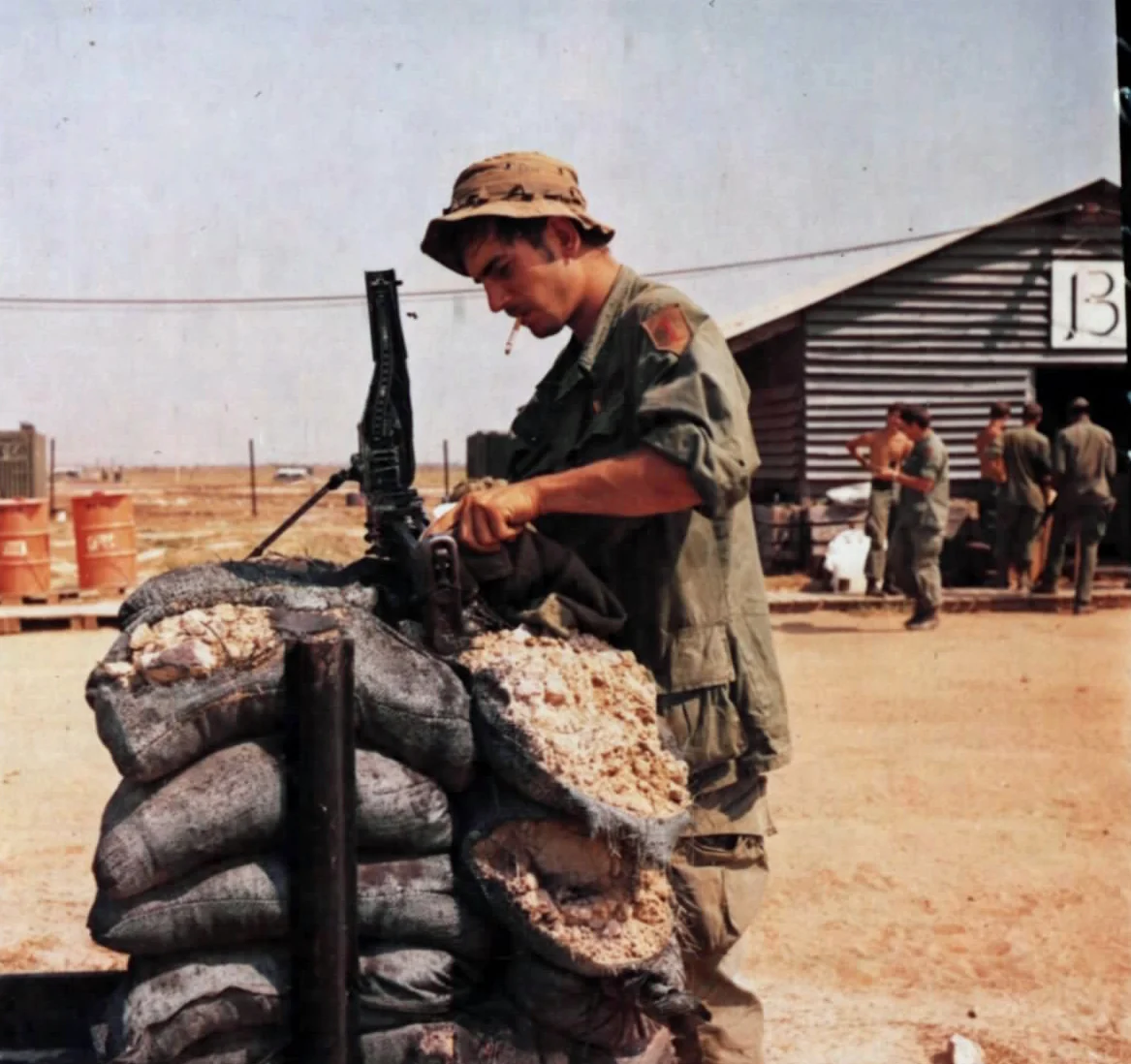
Image credit
- Title
- File:16th Infantry Regiment soldier cleans his M60 machine gun.jpg
- Author
- SP6 McDaniel
- Licence
- Public domain
- Source
- https://commons.wikimedia.org/wiki/File:16th_Infantry_Regiment_soldier_cleans_his_M60_machine_gun.jpg

Detail
The M60 was developed by the US Army between 1952 and 1957 to give American infantry a general-purpose machine gun in the newly standardised 7.62×51mm NATO cartridge, following an uneven line of postwar prototypes (the T24, a failed rechambering of the German MG42 for .30-06, and the T44 and T52 series that followed it) that combined the belt-feed mechanism of the MG42 with the gas system and bolt of the German FG42 rifle. Adopted as the M60 and built chiefly by Saco Defense, the Maine ordnance division of the Maremont Corporation, it became the US military’s standard squad and vehicle machine gun through the Vietnam War and remained in first-line infantry service for decades afterward, cemented in cultural memory partly by that war and by the nickname “the Pig” its users gave it.
Mechanically it is gas-operated with a short-stroke piston, firing from an open bolt with a rotating bolt head, and it was the first American service machine gun to offer a quick-change barrel, a feature that let a crew swap an overheated barrel in the field to sustain a high rate of fire, a capability earlier US machine guns of its era lacked. It fires from a disintegrating metallic-link belt, commonly carried in 100- or 200-round assault packs, and its bipod and integral carrying handle reflect its role as a crew-served weapon that a two- or three-man team could still move and fire on foot rather than only from a fixed mount.
The M60’s design and reliability record prompted a series of later revisions, most visibly the lightened M60E3, and production and overhaul responsibility eventually passed from Saco Defense to other contractors including U.S. Ordnance, which continues to support the M60 family. This entry describes the base M60 rather than the E3 or later variants, which differ enough in weight and barrel configuration to be a different set of figures.
Wikipedia’s own infobox gives a length of 1,105 mm with no citation, which conflicts with the 1,067 mm this entry records from World.Guns.Ru’s dedicated specification table; the World.Guns.Ru figure is used here as the more directly sourced of the two, and the discrepancy is noted rather than silently resolved. No muzzle velocity is recorded because no source found ties a published velocity figure to a stated test-barrel length. No published rifling twist rate or free C.I.P./SAAMI dimensional standard applies beyond the 7.62×51mm NATO cartridge itself.
References
This entry's own bibliography. Every citation key on this page resolves into this list.
- M60 machine gun · Wikipedia · 1372545355 · read 2026-09-04 · CC BY-SA 4.0
- M60 general purpose machine gun · World.Guns.Ru — Modern Firearms · read 2026-09-04
- M60 and M60E3 7.62mm Machine Gun · Federation of American Scientists · read 2026-09-04
Last verified 2026-09-04 · review status: draft