Filipino · Soup
Sinigang na Baboy
Pork simmered into a tamarind-soured broth with daikon, aubergine, long beans and water spinach, tart before it is anything else.
Also known asPork sinigang
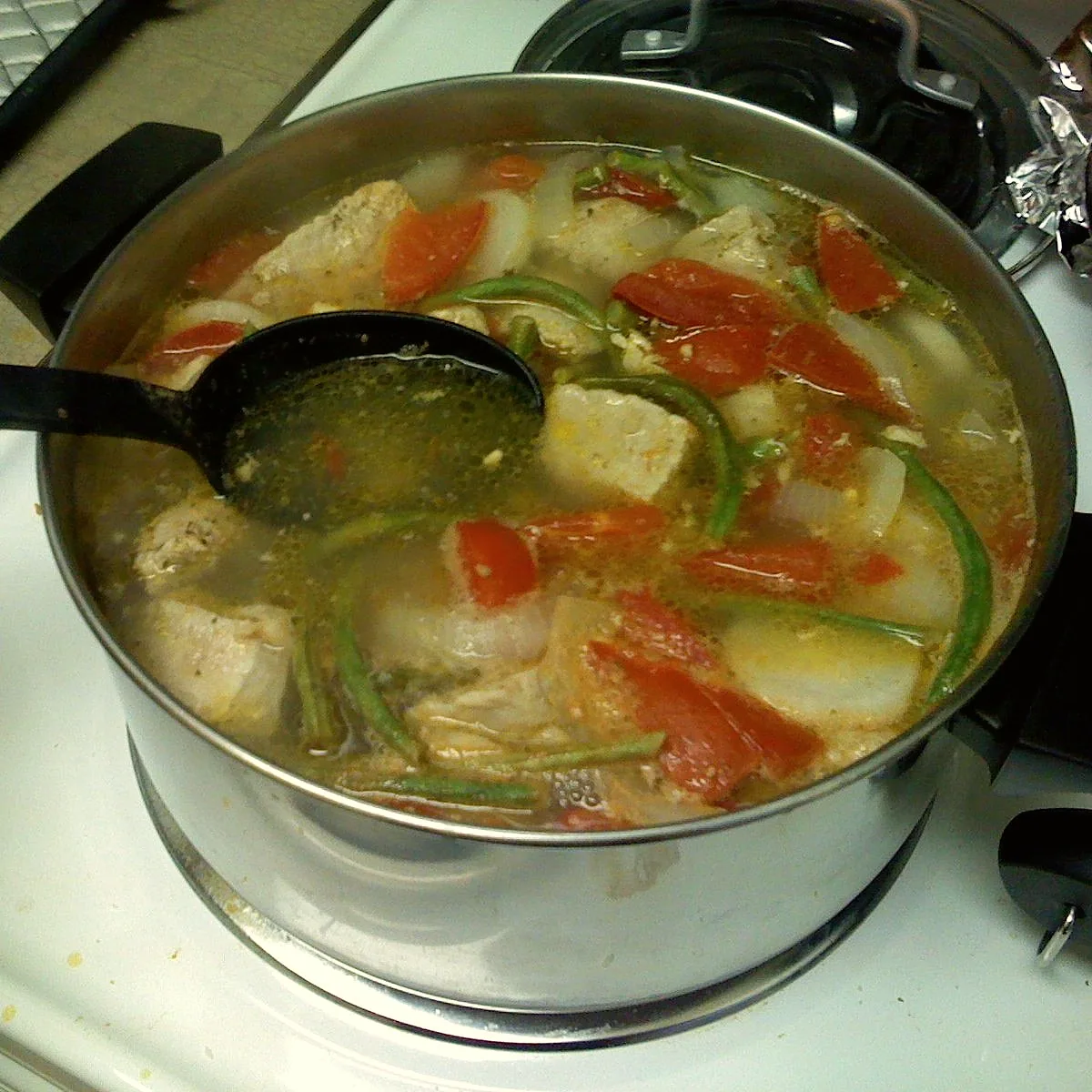

CC BY 2.0. Cropped and colour-adjusted for this site.
The same dish, adapted. Every quantity, time and figure below changes with the version.
Method
Combine the 700 g pork belly, 1.8 L water and 100 g yellow onion in a large pot, bring to the boil, then lower the heat and simmer for 45m, skimming off any scum, until the pork is tender.
Stir in the 150 g ripe tomatoes and the strained 60 g tamarind liquid and simmer for 5m, until the tomato begins to break down.
Add the 150 g daikon and simmer for 10m, until almost tender.
Add the 100 g long beans, 150 g aubergine and 1 jalapeño (15 g) and simmer for 5m, until the vegetables are just cooked through.
The vegetables go in by how long they take to cook, quickest last, so the daikon does not turn to mush before the water spinach has even wilted.
Season with the 15 ml fish sauce, then take the pot off the heat and stir through the 100 g water spinach for 3m, just long enough for it to wilt. Serve at once.
Common pitfallWater spinach wilts in well under a minute; left in the simmering pot rather than stirred through off the heat, it turns grey and loses its texture.
Method
Combine the 1.4 L water, 100 g yellow onion, 150 g ripe tomatoes and the strained 50 g tamarind liquid in a large pot and simmer for 10m, until the tomato begins to break down.
Add the 150 g daikon and simmer for 10m, until almost tender.
Add the 100 g long beans, 150 g aubergine and 1 jalapeño (15 g) and simmer for 5m, until the vegetables are just cooked through.
Add the 500 g shrimp and simmer for 4m, until they turn pink and curl.
Common pitfallShrimp toughen within moments of being fully cooked, so they go in last and only long enough to turn pink and curl, off a hard boil.
Season with the 15 ml fish sauce, then take the pot off the heat and stir through the 100 g water spinach for 3m, just long enough for it to wilt. Serve at once.
The name describes a method rather than one fixed dish: sinigáng means "stewed," from the Tagalog verb sigáng, "to stew" [1] [4]. Sour broth is built around meat, fish or seafood and whatever vegetables were to hand. Tamarind now dominates as the souring agent, but the dish draws on a wide range of other acidic fruits and leaves besides: unripe mango, calamansi, bilimbi, santol, guava and more, chosen by what is available [1] [5]. The food historian Doreen Fernandez, writing in 1975, argued that this adaptability is the point: a technique built to use whatever sour fruit is at hand, workable across every class and budget, which in her view makes sinigang more representative of Filipino taste than adobo [2].
The dish's reputation has outgrown that quiet, undocumented history. In 2021 the food and travel review site TasteAtlas ranked sinigang na baboy, the pork version, as the world's best-rated soup, ahead of Scottish cullen skink and Japanese ramen, citing its sourness as a foil for tropical heat [3] [1]. It is now commonly named, alongside adobo, as one of the dishes most likely to stand in for a national dish the Philippines has never officially designated.
Sources
- Sinigang, WikipediaGives the Tagalog etymology, the range of traditional souring agents, and the dish's regional variants.
- Why Sinigang?, Doreen G. Fernandez (1975 essay, reproduced by a reader)Text of food historian Doreen Fernandez's 1975 essay, arguing sinigang's adaptability to any available sour fruit and any household budget makes it more representative of Filipino taste than adobo.
- TasteAtlas: Sinigang na baboy named best soup in the world in 2021, GMA News OnlineReports the 2021 TasteAtlas ranking and its stated reasoning.
- Sinigang: Origins, Variations & the Tradition Behind the Sour Soup, Best in ManilaStates that sinigang's name comes from sigáng, Tagalog for "to stew."
- 39 Ways to Cook Sinigang - Alternative Souring Agents and Fruits, Ang SarapCatalogues sinigang variants soured with green mango, calamansi, kamias (bilimbi), santol and guava, among other fruits.