British · Main Course
Shepherd's Pie
Minced lamb braised with vegetables in a thickened stock, baked under a layer of buttery mashed potato.
Not the same asCottage pie (The same dish made with minced beef rather than lamb; the name shepherd's pie is reserved for the lamb version.)
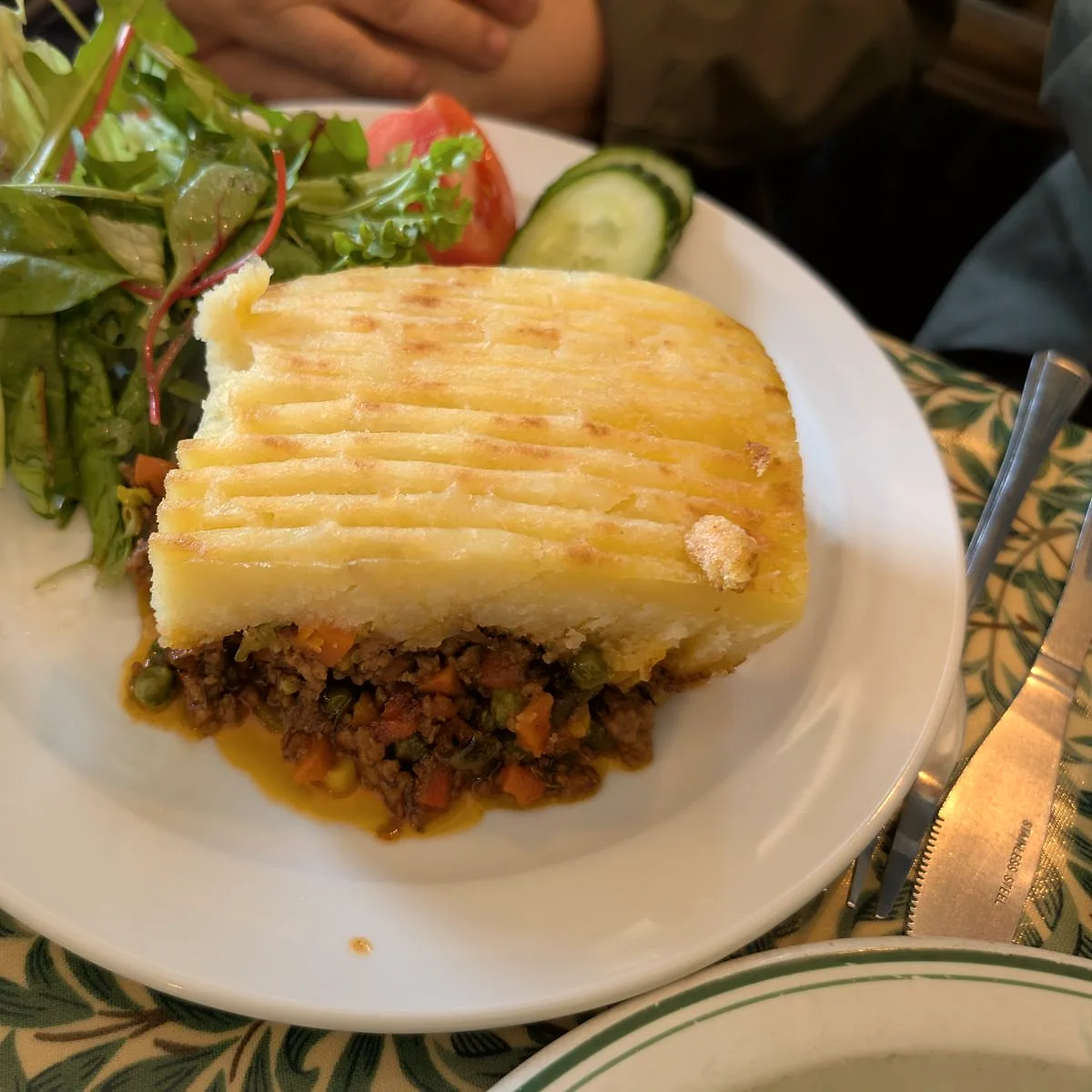

CC0. Cropped and colour-adjusted for this site.
Method
Cover the 1 kg potato with cold salted water, bring to the boil and cook for 20m, until completely tender.
Brown the 600 g lamb mince hard in a dry pan over a high heat for 10m, breaking it up as it cooks, then set aside.
Browning the lamb hard in a separate pan before it joins the vegetables builds the fond and savoury depth that a pot simply simmered from raw never develops.
Melt the 20 g unsalted butter in the same pan and cook the 200 g white onion, the 150 g carrot and the 100 g celery for 10m, until softened, then stir in the 2 garlic cloves (10 g) and the 15 g plain flour and cook briefly.
Return the lamb to the pan with the 3 g fresh thyme, the 30 g tomato purée, the 15 g Worcestershire sauce, the 300 g beef stock, the 4 g fine sea salt and the 2 g ground black pepper. Simmer for 25m, until thickened and no longer watery, then spread into a baking dish and leave to cool slightly.
Drain the potatoes and mash with the 50 g unsalted butter, the 100 g milk, the 4 g fine sea salt and the 1 g ground black pepper until smooth.
Spread the mash evenly over the filling, right to the edges of the dish, and rough up the surface with a fork.
Common pitfallSpreading a thin mash straight over a hot, loose filling lets it sink in rather than sealing the top. The filling wants to have cooled and thickened first, and the mash goes on thick enough to hold its own layer.
Bake at 200 °C for 25m, until the top is golden and the filling bubbles up at the edges.
The pie's original point was thrift, not any particular meat. The earliest documented reference is to "cottage pie": the diarist Parson Woodforde records eating "cottage-pye" on the twenty-ninth of August 1791 [1][3]. The recognisable modern form appears a little earlier still and may in fact predate Woodforde's dinner: Maria Rundell's 1806 cookbook A New System of Domestic Cookery gives a recipe for a dish called "Sanders," minced beef or mutton with onion and gravy under a mashed potato topping; it is a shape any cook today would recognise [1][3].
The name "shepherd's pie," specific to lamb, is later still; the earliest recorded use traced by historians is in an Edinburgh cookbook from 1849, The Practice of Cookery and Pastry [1][3]. The dish became viable at all only once the potato, which reached Britain in the 1580s, had gone from a curiosity to an everyday staple cheap and filling enough to stretch a small amount of meat across a family meal [2]. The now-familiar distinction (lamb for shepherd's pie, beef for cottage pie) is generally explained along economic and regional lines, with lamb the more affordable meat in Ireland and poorer rural Britain and beef more available where cottage pie took hold [2], though the two names were used loosely enough, for long enough, that the split is better understood as a later convention than a rule the dish was born with.
What has not changed is the underlying idea: meat, already cooked or minced and gently sauced, finished under a potato crust in the same oven heat that made the topping worth the trouble in the first place.
Sources
- Shepherd's pie, WikipediaOn Parson Woodforde's 1791 diary reference to "Cottage-Pye," Maria Rundell's 1806 recipe, and the 1849 Edinburgh cookbook recording "shepherd's pie."
- The Origin of Shepherd's Pie, History CooperativeOn the potato's arrival in Britain in the 1580s, and the economic distinction between lamb-based shepherd's pie and beef-based cottage pie.
- This Food in History #24: Shepherd's Pie, Uncultured PalateOn Parson Woodforde's 1791 diary entry, Maria Rundell's 1806 "Sanders" recipe from A New System of Domestic Cookery, and the 1849 Edinburgh Practice of Cookery and Pastry that first names "shepherd's pie."