Indian · Main Course
Seekh Kebab
Lamb mince worked with ginger, garlic, green chilli and warm ground spice until it clings to a skewer, then grilled over fierce heat.
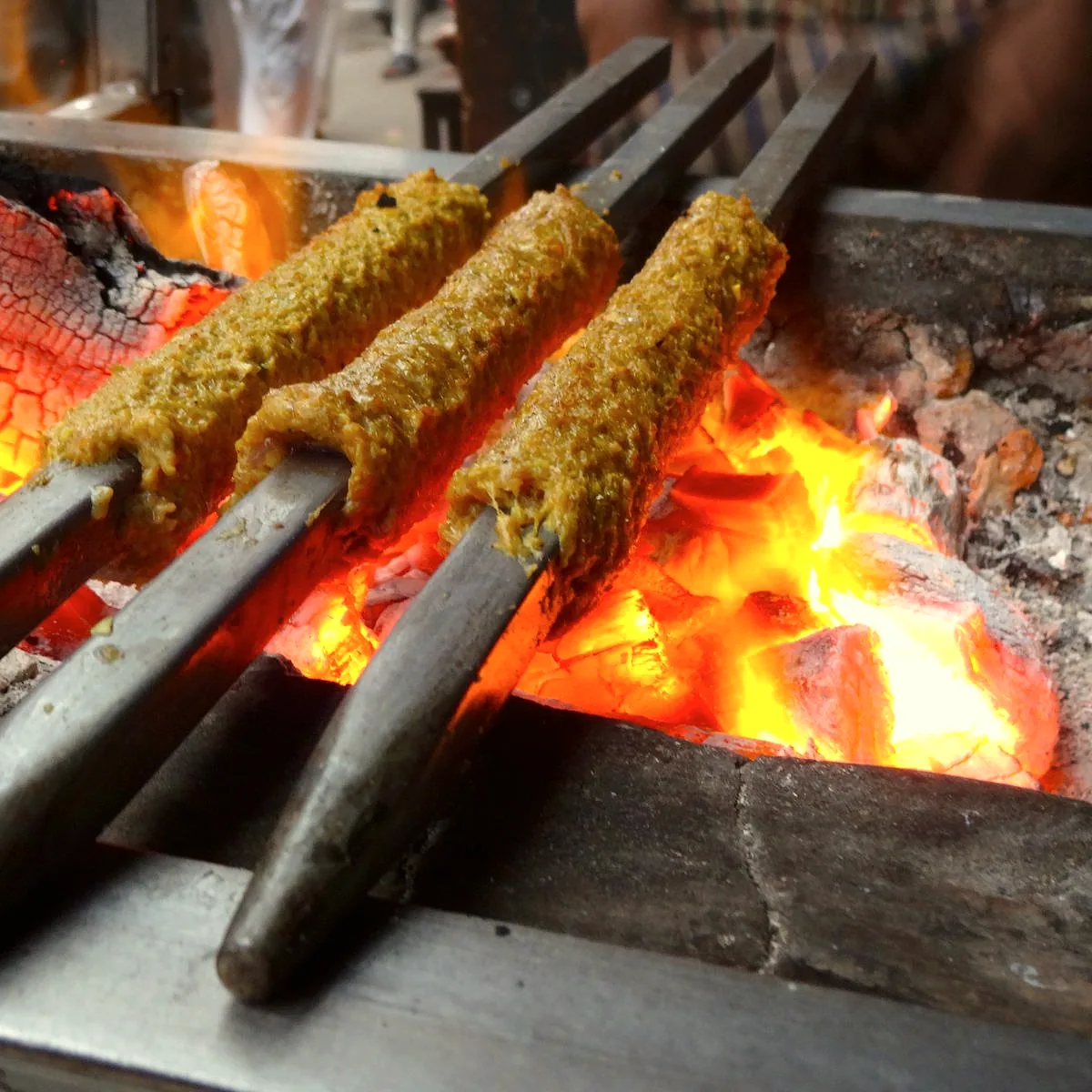

CC BY-SA 4.0. Cropped and colour-adjusted for this site.
Method
Combine the 500 g lamb mince, 50 g yellow onion, 15 g fresh ginger, 2 garlic cloves (10 g), 1 ½ serrano chillies (10 g), 4 g ground cumin, 3 g chilli flakes, 3 g sweet paprika, 10 g fresh coriander, 8 g fresh mint and 7 g fine sea salt in a wide bowl. Knead the mixture by hand for 10m, until it turns dense and sticky and holds together as one mass.
Cover the mince and chill it for 30m, so it firms up and is easier to mould onto the skewers.
Divide the mince into even portions. With wet hands, mould each portion around a skewer, pressing and smoothing it into a long, even cylinder that grips the metal. Work for 10m in total.
Common pitfallMince that has not been squeezed free of the onion's liquid stays slack and will not hold its shape on the skewer. Working it dry and well-kneaded is what lets it grip the metal without a binder.
Grill the skewers over fierce, direct heat, turning them often, for 10m, until well charred outside and cooked through with no pink remaining at the centre.
Kebab itself is an old word before it names any one dish. It reached English by way of Arabic and Persian, and the medieval Arabic and Turkish terms are themselves thought to derive from an older Persian kabab, possibly rooted further back in Aramaic words for burning or roasting [1]. The earliest written description of the dish comes from a tenth-century Baghdad cookbook, which describes kebab as meat cut up and either pan-fried or grilled [1]. Kebab had reached the Indian subcontinent by at least the fourteenth century: the traveller Ibn Battuta recorded it being served in the royal houses of the Delhi Sultanate [1]. A separate account pushes that arrival back a century further, crediting migrants and soldiers who came with the Sultanate's founder, Qutb-ud-din Aibek, in the thirteenth century, bringing kebab with them from Turkey, Iraq and Iran as Delhi was built into an imperial capital [3].
What neither record establishes is seekh kebab specifically: mince, rather than cut meat, worked onto a skewer. The word seekh is simply Urdu and Hindi for skewer, and the dish is documented as belonging to the Indian subcontinent's cuisines without a separate account of when meat began to be minced for it rather than cut into pieces [2]. An article devoted specifically to Delhi's kebab history names several distinct minced and mixed kebabs from the Mughal period (a whole chicken stuffed with minced meat, and a Levantine-derived patty of mince bound with chickpea and egg), but does not single out seekh kebab among them or date it separately [3]. The popular telling that credits Mughal court kitchens with refining kebabs cut into mince is widely repeated but not found in the sourcing available here, and is left out rather than stated as fact.
Sources
- Kebab, WikipediaTraces the word's Persian and Arabic roots and cites Ibn Battuta's fourteenth-century account of kebab served at the Delhi Sultanate court.
- Seekh kebab, WikipediaPlaces seekh kebab's origin in the Indian subcontinent, without a documented date for the mince-on-a-skewer form specifically.
- Delhi's Kebabs: The Taste of Memory, Mangal MediaIndependently dates kebab's arrival in Delhi to the thirteenth-century Sultanate under Qutb-ud-din Aibek, brought by migrants and soldiers from Turkey, Iraq and Iran, and confirms that seekh kebab specifically is not separately documented even in an article devoted to Delhi's kebab history.