Romanian · Main Course
Sarmale
Small rolls of pork and rice wrapped in soured cabbage leaves, layered with smoked bacon and braised slowly until the leaves turn tender.
Not the same asGolubtsy (The Russian and Ukrainian relative, usually wrapped in fresh rather than soured cabbage and simmered in a plain tomato sauce rather than braised with smoked pork and whole soured leaves.)
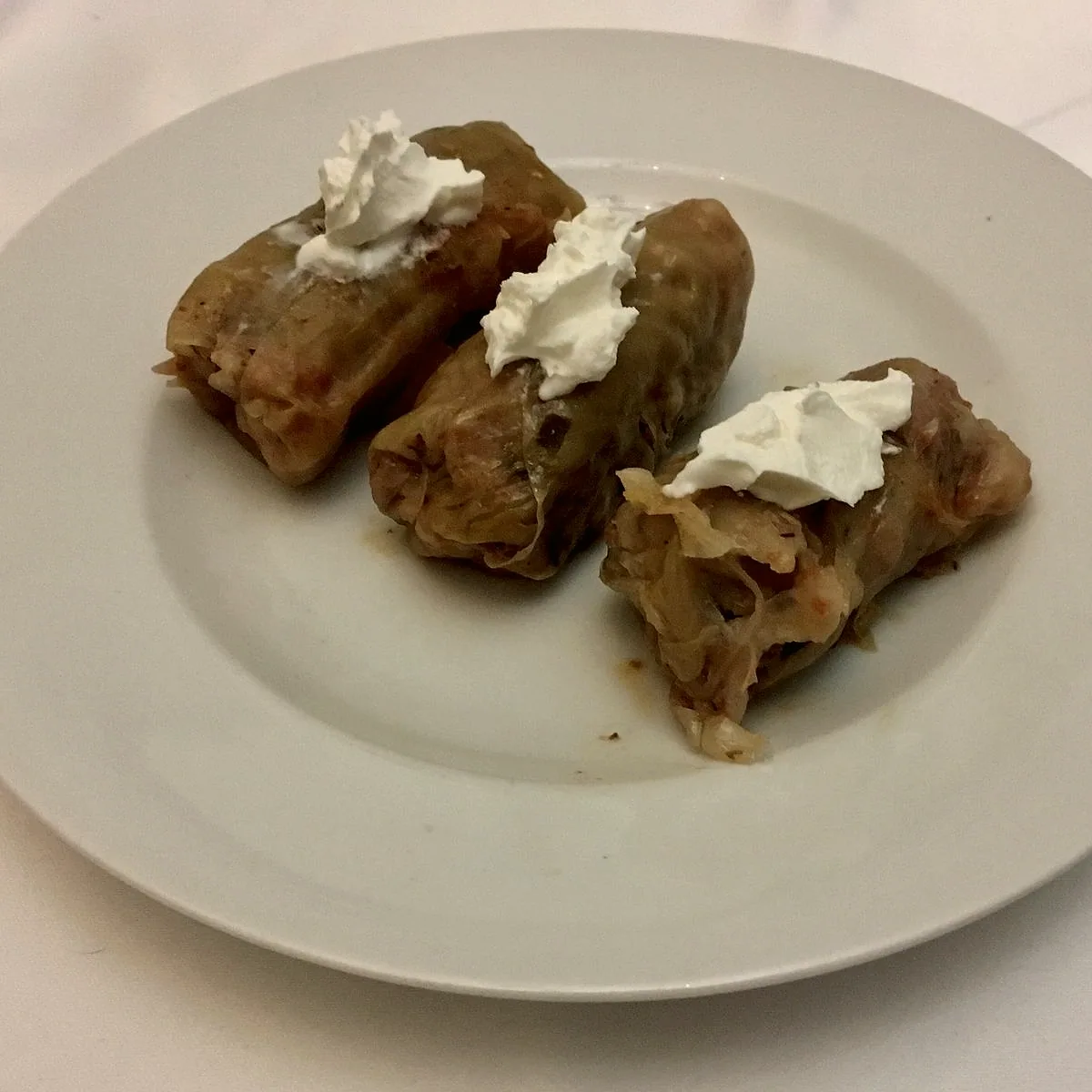

CC0. Cropped and colour-adjusted for this site.
Method
Rinse the 800 g soured cabbage sauerkraut under cold water to remove excess salt, and trim away any thick centre rib.
Combine the 600 g pork mince, the 150 g rice, the 150 g yellow onion, the 10 g dill, half the 40 g tomato purée, the 6 g fine sea salt and the 2 g ground black pepper.
Place a small spoonful of filling on each leaf, fold in the sides, and roll into a tight, compact parcel.
Common pitfallOverfilling each leaf keeps it from wrapping tightly, and a loose roll falls apart in the pot. Sarmale are kept deliberately small and rolled firm, with the raw rice given room inside the leaf to swell as it cooks.
Scatter half the 100 g bacon over the base of a heavy pot, pack in the sarmale in tight layers with the 10 bay leaves (2 g) tucked between them, and scatter over the rest of the bacon.
Pour over the 500 g chicken stock mixed with the rest of the 40 g tomato purée, cover, and braise at 160 °C for 2h 30m, until the leaves are completely tender. Serve with the 100 g cultured soured cream.
A long, low braise is what softens the soured cabbage leaf from tough and chewy to tender enough to cut with a spoon; rushed at a higher heat, the leaves stay leathery while the filling inside overcooks.
Sarmale belongs to a family of wrapped, stuffed dishes (dolma in Turkish) that the food historian Priscilla Mary Işın traces in Ottoman kitchens back to at least the early sixteenth century, when a Persian-language cookbook recorded a recipe for dulma-ye kalam, stuffed cabbage, among the earliest documented versions of the technique [1]. Versions of the dish are found today across the former Ottoman world, each adapted to a different wrapping leaf and filling, and Romania's is one of the more distinctive departures from the dish's Ottoman starting point.
Where Ottoman and Middle Eastern versions typically use fresh or brined vine leaves and lamb, the Romanian version wraps a filling of minced pork, rice and onion in pickled cabbage leaves and simmers the rolls with smoked bacon: cabbage suited to a colder climate standing in for vine leaves, and pork and bacon standing in for the lamb an Ottoman kitchen would have used [2]. The name itself comes from the Turkish sarma, "to wrap," carried into Romanian along with the technique it describes.
The dish's place in the Romanian calendar is as fixed as its recipe. Sarmale is eaten year-round but becomes especially prominent around Christmas, New Year and Easter, prepared as one of the standard dishes of the holiday table [2]. A dish that arrived by way of empire has become, in Romania, a marker of season and family occasion rather than of any foreign origin at all.
Sources
- Bountiful Empire: A History of Ottoman Cuisine, Reaktion BooksPriscilla Mary Işın's history of Ottoman cuisine, which documents an early-sixteenth-century Persian cookbook recipe for dulma-ye kalam, stuffed cabbage, among the earliest recorded versions of the dish.
- Romanian Food: 40 Dishes to Try in Bucharest, Will Fly for FoodOn the Romanian version of sarmale as pickled cabbage leaves wrapped around minced pork, rice and onions, simmered with smoked bacon.