Colombian · Soup
Sancocho de Gallina
Chicken simmered with green plantain, cassava, potato and corn into a light, golden broth, seasoned with tomato, cumin and cilantro rather than the heavier spicing of its Dominican cousin.
Not the same asSancocho Dominicano (Built on two or three meats rather than chicken alone, seasoned with oregano and sour orange, and noticeably heavier and more heavily spiced than the plainer, chicken-only Colombian version.)
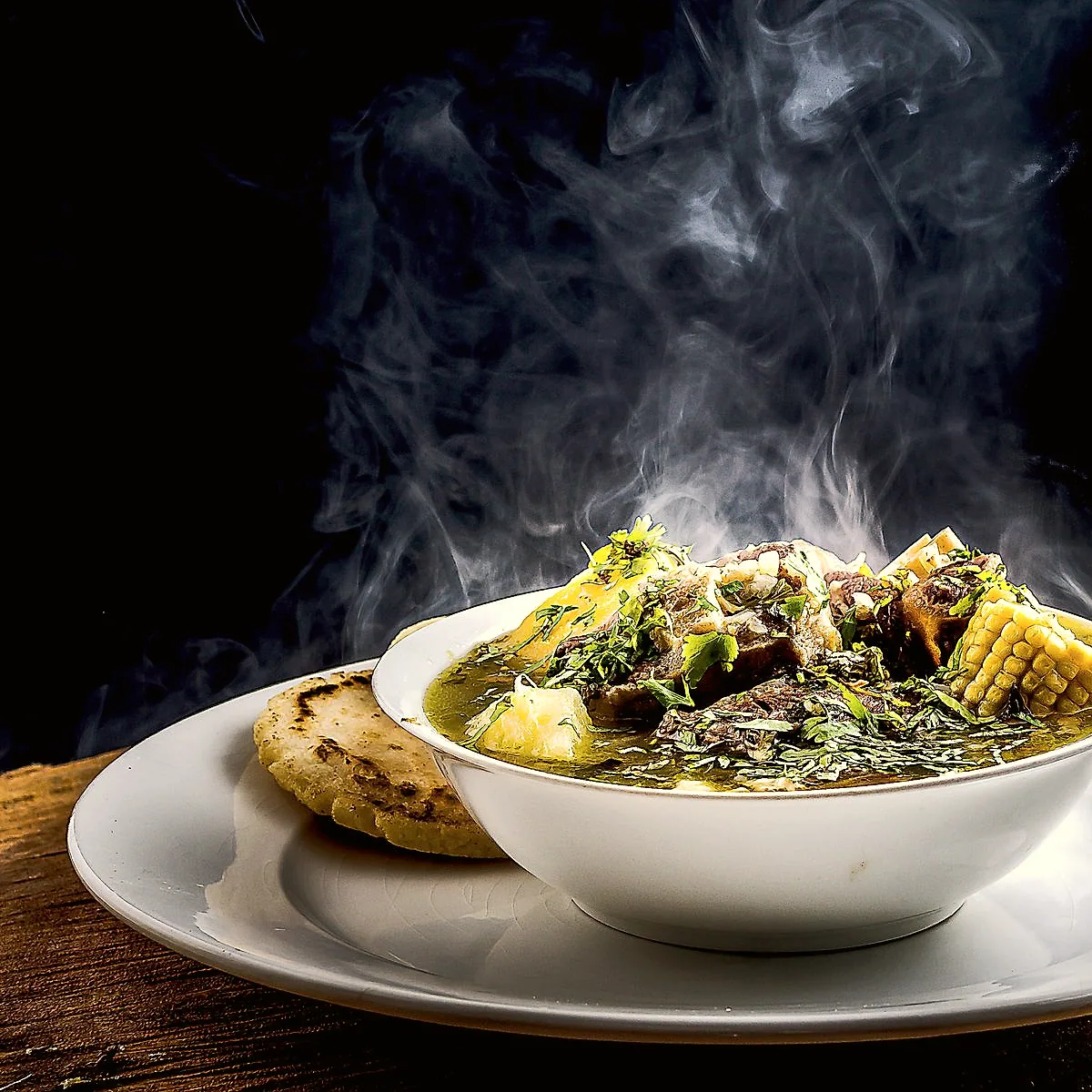

CC BY-SA 4.0. Cropped and colour-adjusted for this site.
Method
Put the 900 g bone-in, skin-on chicken in a large pot with the 2.2 L water, 80 g white onion, 2 ½ garlic cloves (12 g), 150 g ripe tomatoes, 2 g ground cumin and half the 8 g fine sea salt. This takes about 10m.
Bring to a simmer and cook for 40m, until the chicken is tender.
Add the 250 g green plantain, 250 g raw cassava, 250 g potato, 250 g corn and remaining 8 g fine sea salt. This takes about 5m.
Simmer for 30m, until the vegetables are tender and the broth has thickened slightly.
Adding the plantain and root vegetables only after the chicken broth is already established lets them cook in a broth already carrying flavour, rather than diluting it before the chicken has had time to season the pot.
Stir in the 1 ½ spring onions (20 g) and 15 g fresh coriander and serve. This takes about 5m.
Sancocho's Spanish ancestry, repeated on this site for its Dominican and other Caribbean relatives, is not accepted without argument closer to home. The standard version traces the dish to cocido, descended in turn from adafina, the Sephardic Sabbath stew, carried to the Americas by Spanish colonists and reworked locally [1]. Colombian gastronomic anthropologists have pushed back on this lineage for the Colombian dish specifically, pointing out that its two defining ingredients, plantain and yuca, are not Spanish at all (plantain is Asian in origin and yuca American), which makes a straightforward line from a Spanish stew to a Colombian one harder to draw than the standard story suggests [2].
What is not disputed is how specifically Colombian the dish's regional variations are. In Ginebra, in the Valle del Cauca, chicken became the sancocho's defining meat in part because chicken itself was one of the more sought-after and expensive animals available during the colonial period, a prestige that has settled into local tradition long after the economics behind it changed [2]. Along Colombia's coasts and rivers, sancocho is built on fish instead, and on the Atlantic coast a version exists with as many as nine different meats in the pot [2]: a reminder that "sancocho" names a method and a mood as much as a fixed recipe.
That mood runs past the kitchen. Sancocho in Colombia is associated with the paseo de olla, a communal outing built around cooking and eating the dish together outdoors, and the same image of a shared pot has been borrowed by social movements, where gathering around one cooking pot stands for a shared cause rather than a shared meal [2].
Sources
- Sancocho, Encyclopædia BritannicaTraces sancocho's descent from cocido, itself following the Sephardic stew adafina, and describes its spread across Latin America and the Caribbean as colonists carried the dish and it absorbed indigenous and African ingredients specific to each region.
- El sancocho, símbolo de Colombia, Señal Memoria (RTVC, Colombia's national broadcasting archive)Reports gastronomic anthropologists disputing the standard claim that sancocho descends from Spain's olla podrida, on the grounds that its defining ingredients, plantain and yuca, are Asian and American in origin rather than Spanish; describes chicken's colonial-era prestige behind the Valle del Cauca's chicken sancocho, and sancocho's role in communal paseos de olla gatherings.