Polish · Main Course
Pierogi
A Polish boiled dumpling in an egg dough, most often filled with potato and twaróg cheese and finished in butter.
Also known asPierogi ruskie
Not the same asPelmeni (A much smaller, thin-skinned Russian dumpling filled only with raw beef and pork, boiled and served plain rather than pan-fried.)
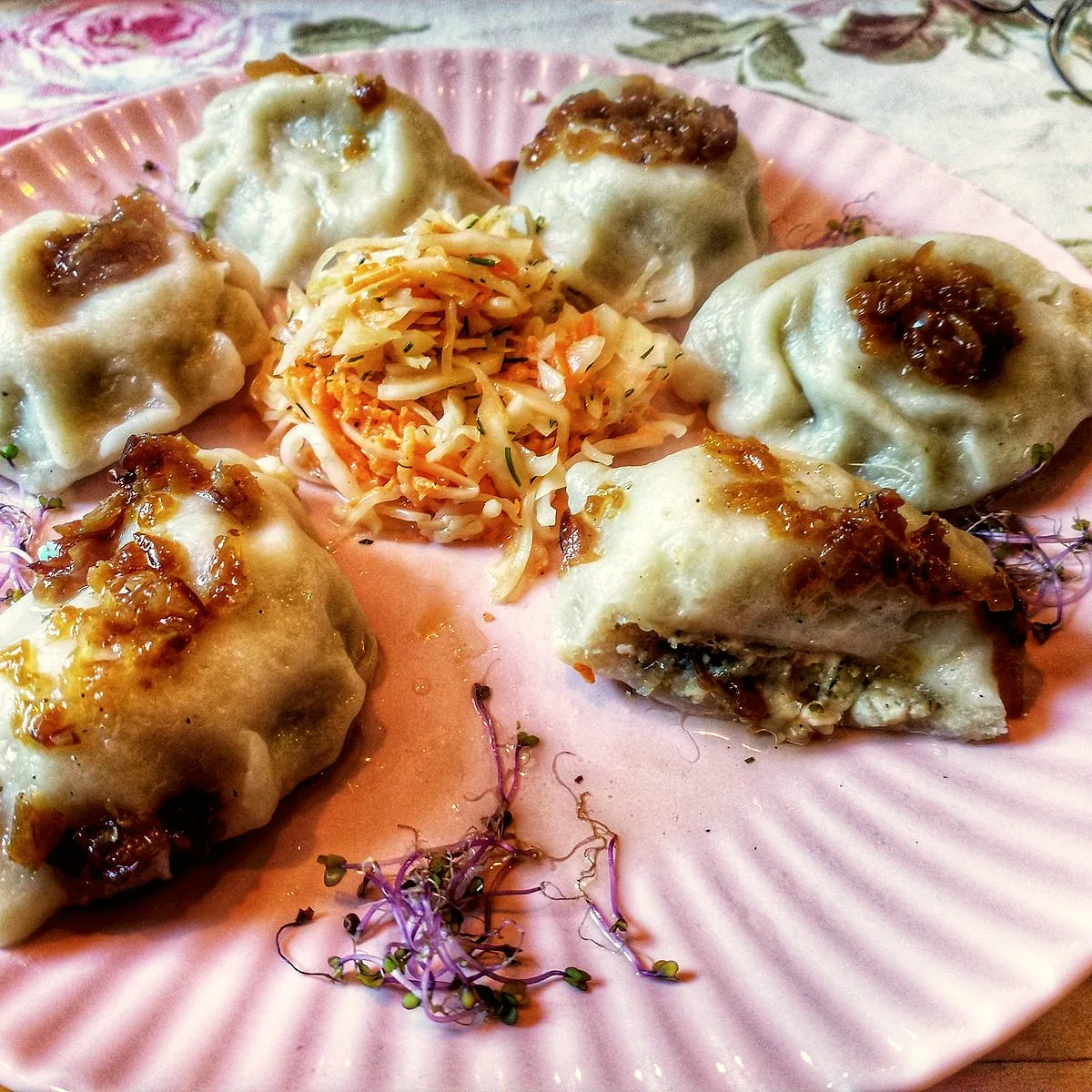

CC BY 4.0. Cropped and colour-adjusted for this site.
The same dish, adapted. Every quantity, time and figure below changes with the version.
Method
Combine the 300 g plain flour, 1 egg (50 g), 140 ml water and 4 g fine sea salt in a bowl and bring together into a firm dough, then turn it out and knead for 10m until smooth and no longer tacky.
Cover the dough and rest it for 30m at room temperature, until it has relaxed and no longer springs back when pressed.
Meanwhile, boil the 500 g potato in salted water until tender, then drain and mash while still hot. Melt the 20 g unsalted butter and cook the 100 g yellow onion gently until soft and golden. Combine the mashed potato, fried onion, 200 g twaróg, 1 g ground black pepper and 4 g fine sea salt, mixing until even, then leave to cool for 25m in total.
Roll the rested dough out thinly on a surface dusted with the 20 g plain flour and cut into rounds about 8 cm across. Spoon filling into the centre of each round, fold in half and crimp the damp edge fully shut into a sealed half-moon.
Common pitfallAn edge crimped with wet fingers seals more reliably than one folded dry; the dough needs a little moisture along the join or it springs back open in the boiling water.
Drop the pierogi into a large pot of well-salted, boiling water and cook for 5m, until they float and the dough is cooked through. Lift out with a slotted spoon.
Melt the 20 g unsalted butter in a wide pan over a medium-high heat and fry the boiled pierogi for 8m, turning once, until golden on both flat sides.
Boiling cooks the dough through, but it leaves the surface pale and slightly slick; the butter afterwards is what gives pierogi their characteristic golden, faintly crisp skin.
Serve at once with the 60 g cultured soured cream spooned over.
Method
Combine the 300 g plain flour, 1 egg (50 g), 140 ml water and 4 g fine sea salt in a bowl and bring together into a firm dough, then turn it out and knead for 10m until smooth and no longer tacky.
Cover the dough and rest it for 30m at room temperature, until it has relaxed and no longer springs back when pressed.
Meanwhile, melt the 20 g unsalted butter in a pan and cook the 100 g yellow onion until soft. Add the 250 g mushrooms and cook until the liquid they release has cooked away, then stir in the 350 g canned sauerkraut and cook the mixture down until dry. Season with the 1 g ground black pepper and 2 g fine sea salt, then spread out and leave to cool for the remainder of 20m.
Cooking the sauerkraut down in butter rather than using it straight from the jar drives off enough of its liquid that the filling holds together instead of soaking through the dough.
Roll the rested dough out thinly on a surface dusted with the 20 g plain flour and cut into rounds about 8 cm across. Spoon filling into the centre of each round, fold in half and crimp the damp edge fully shut into a sealed half-moon.
Drop the pierogi into a large pot of well-salted, boiling water and cook for 5m, until they float and the dough is cooked through. Lift out with a slotted spoon.
Melt the 20 g unsalted butter in a wide pan over a medium-high heat and fry the boiled pierogi for 8m, turning once, until golden on both flat sides.
Method
Combine the 300 g plain flour, 1 egg (50 g), 140 ml water and 4 g fine sea salt in a bowl and bring together into a firm dough, then turn it out and knead for 10m until smooth and no longer tacky.
Cover the dough and rest it for 30m at room temperature, until it has relaxed and no longer springs back when pressed.
Meanwhile, melt the 20 g unsalted butter in a pan and cook the 100 g yellow onion until soft. Add the 350 g pork mince and 1 ½ garlic cloves (8 g) and cook, breaking up the meat, until browned through and no liquid remains. Season with the 2 g ground black pepper and 4 g fine sea salt, then spread out and leave to cool for the remainder of 20m.
Common pitfallFilling built from meat that is still pink in the middle keeps cooking unevenly through the boil; the pork needs to be fully browned and cooled before it goes into the dough.
Roll the rested dough out thinly on a surface dusted with the 20 g plain flour and cut into rounds about 8 cm across. Spoon filling into the centre of each round, fold in half and crimp the damp edge fully shut into a sealed half-moon.
Drop the pierogi into a large pot of well-salted, boiling water and cook for 5m, until they float and the dough is cooked through. Lift out with a slotted spoon.
Melt the 20 g unsalted butter in a wide pan over a medium-high heat and fry the boiled pierogi for 8m, turning once, until golden on both flat sides.
Serve at once with the 60 g cultured soured cream spooned over.
The most repeated origin story credits Saint Hyacinth of Poland with bringing pierogi home after a visit to Kievan Rus' in the thirteenth century, in one telling teaching famine-struck Poles to make the dish from whatever they had to hand [1][2]. Poland's first documented mention of pierogi does date to the thirteenth century, but the saint's role in it is treated as legend rather than established fact; the dish's own name argues against a single dramatic introduction, since it derives from the Proto-Slavic root pirŭ, "feast", a root also behind the Russian pirog and pirozhki, which points to a history shared across the Slavic-speaking world rather than one particular saint's journey [1].
Where the dumpling form itself came from before that is less settled still. One theory has it arriving with Marco Polo's Silk Road contact with Chinese dumplings; another credits Turkic cooking, pointing to düş-vara as a parallel dish, and a more recent hypothesis proposes the Turkic word bureg as the actual root of "pierogi" rather than the Slavic feast-word [1]. None of these accounts is treated as conclusive.
The name of the default filling here is its own piece of etymology, and one regularly misread: "pierogi ruskie" means Ruthenian pierogi, after the East Slavic Ruthenian lands that now sit across parts of Ukraine, Belarus and south-eastern Poland, not Russian, despite how the word looks to an English speaker [1]. It is this potato-and-farmer's-cheese filling, rather than the meat or cabbage versions, that is generally treated as the classic pierogi [2].
Sources
- Pierogi, WikipediaSets out the Saint Hyacinth legend, the Proto-Slavic *pirŭ- etymology, the Ruthenian meaning of "ruskie", and the competing Central Asian and Silk Road theories.
- The History and Traditions Behind Poland's Beloved Pierogi, Delicious PolandRepeats the Saint Hyacinth legend and confirms pierogi ruskie as the potato-and-farmer's-cheese filling regarded as the classic version.