Indian · Main Course
Masala Dosa
A thin, fermented rice-and-lentil crepe from Karnataka, cooked crisp on a griddle and folded around a turmeric-yellow spiced potato filling.
Not the same asIdli (Steamed from a thicker, more lentil-heavy version of the same style of batter, rather than spread thin and pan-fried.)
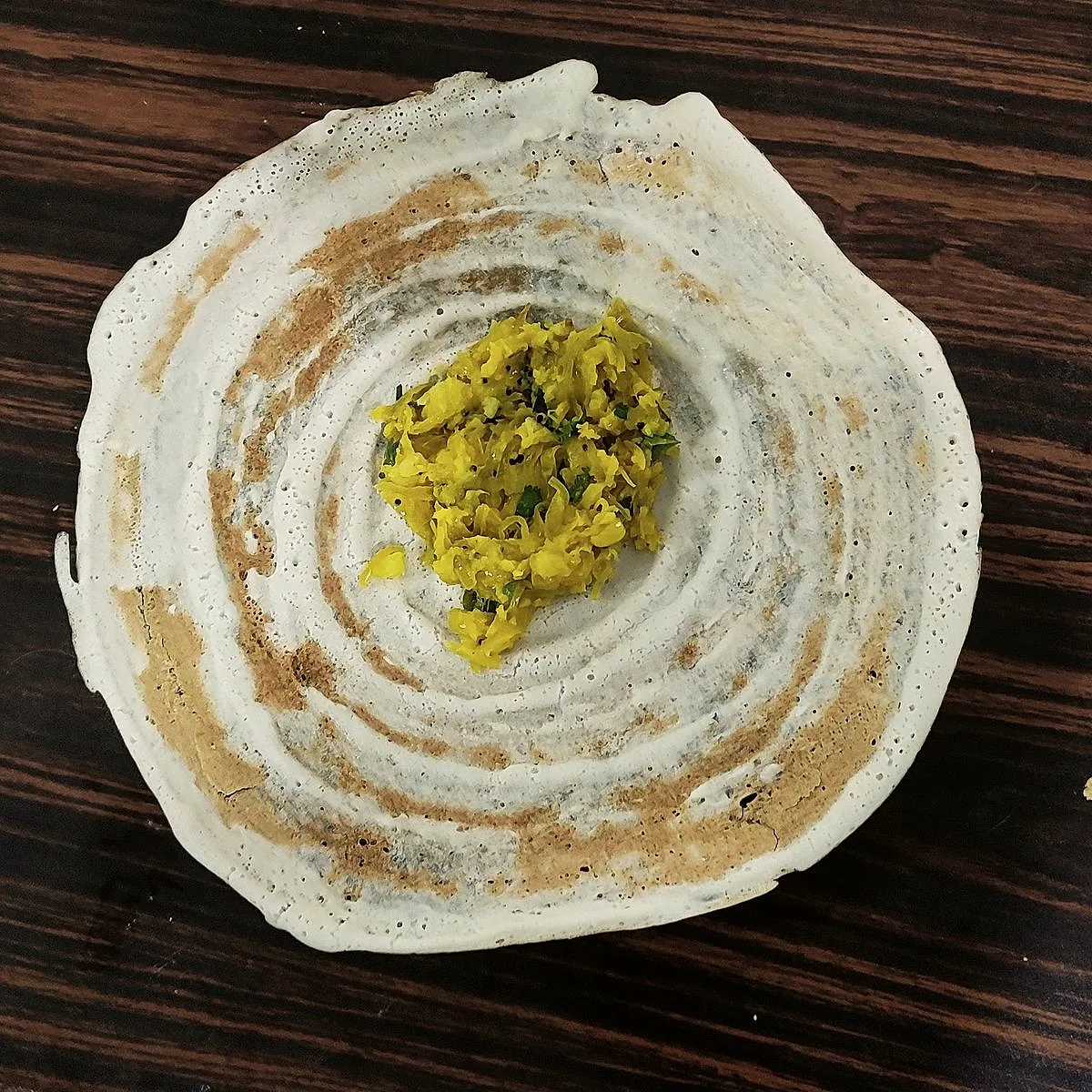
.jpg)
CC BY-SA 4.0. Cropped and colour-adjusted for this site.
The same dish, adapted. Every quantity, time and figure below changes with the version.
Method
Cover the 300 g rice and, in a separate bowl, the 75 g urad dal and 3 g fenugreek seeds with the 500 ml water, dividing it between the two bowls. Leave both to soak at room temperature for 4h, then drain.
Grind the drained dal and fenugreek to a smooth, light paste. Grind the drained rice separately to a fine paste, using the 250 ml water as needed, then combine the two with the 8 g fine sea salt into a batter with the consistency of thin double cream.
Dosa batter is ground finer and thinned further than idli batter, because it has to pour and spread into a thin sheet rather than hold its own shape under a spoon.
Cover the bowl loosely and leave it somewhere warm to ferment for 10h, until risen and faintly sour-smelling. Stir in any remaining 250 ml water afterwards to bring it to a thin, pourable batter.
Put the 500 g potato into the 1 L water and bring to a simmer. Cook for 20m, until completely tender, then drain and roughly crush.
Meanwhile, warm the 15 g ghee in a separate pan. Add the 4 g mustard seeds and let it pop, then add the 3 g curry leaves, 2 g ground turmeric and 2 serrano chillies (16 g) and fry briefly before stirring in the 150 g white onion. Cook for 6m, until the onion has softened.
Fold the crushed potato and the 6 g fine sea salt into the tempered onion and cook for 5m, mashing lightly so the mixture holds together loosely.
Heat a flat griddle and wipe it with a little of the 35 g ghee. Pour on a ladleful of batter and spread it outward from the centre in one continuous spiral into a thin, even round. Drizzle a little more of the 35 g ghee around the edge and cook for most of 20m, until the underside is golden and lacy and the top has dried out; dosa is cooked on one side only. Spoon a line of potato filling across the centre and fold the dosa over it. Repeat with the remaining batter and filling.
Common pitfallSpreading from a puddle of batter with too many passes tears the crepe. One continuous outward spiral from the centre, made quickly before the batter sets, gives an even, unbroken sheet.
Method
Cover the 300 g rice and, in a separate bowl, the 75 g urad dal and 3 g fenugreek seeds with the 500 ml water, dividing it between the two bowls. Leave both to soak at room temperature for 4h, then drain.
Grind the drained dal and fenugreek to a smooth, light paste. Grind the drained rice separately to a fine paste, using the 250 ml water as needed, then combine the two with the 8 g fine sea salt into a batter with the consistency of thin double cream.
Cover the bowl loosely and leave it somewhere warm to ferment for 10h, until risen and faintly sour-smelling. Stir in any remaining 250 ml water afterwards to bring it to a thin, pourable batter.
Put the 500 g potato into the 1 L water and bring to a simmer. Cook for 20m, until completely tender, then drain and roughly crush.
Meanwhile, warm the 15 g ghee in a separate pan. Add the 4 g mustard seeds and let it pop, then add the 3 g curry leaves, 2 g ground turmeric and 2 serrano chillies (16 g) and fry briefly before stirring in the 150 g white onion. Cook for 6m, until the onion has softened.
Blend the softened 12 g chilli flakes, the 4 garlic cloves (20 g), the 8 g tamarind and the 3 g fine sea salt with the 30 ml water to a smooth, thick paste. Warm the 10 ml peanut oil in a small pan and fry the paste for most of 8m, until it darkens slightly and smells cooked rather than raw.
The red chutney is spread on the dosa itself, under the potato, rather than served alongside; it seasons the crepe directly and is what separates a Mysore dosa from a plain masala one.
Fold the crushed potato and the 6 g fine sea salt into the tempered onion and cook for 5m, mashing lightly so the mixture holds together loosely.
Heat a flat griddle and wipe it with a little of the 35 g ghee. Pour on a ladleful of batter and spread it outward from the centre in one continuous spiral into a thin, even round. Drizzle a little more of the 35 g ghee around the edge and cook for most of 22m, until the underside is golden and lacy and the top has dried out; dosa is cooked on one side only. Spread the red chutney thinly over the cooked surface, spoon a line of potato filling across the centre, and fold the dosa over it. Repeat with the remaining batter, chutney and filling.
Common pitfallSpreading from a puddle of batter with too many passes tears the crepe. One continuous outward spiral from the centre, made quickly before the batter sets, gives an even, unbroken sheet.
The plain dosa this dish is built on is old, and exactly how old is argued between two states. The food historian P. Thankappan Nair points to a recipe called dosaka in the Manasollasa, a Sanskrit encyclopedia compiled around 1130 for the Karnataka king Someshvara III, as evidence for a Karnataka origin [2]. K. T. Achaya argued instead that dosa, as dosai, belonged to Tamil culture as far back as the first century AD, citing its presence in early Tamil Sangam-era writing [2]. Neither claim is settled, and both states still consider it theirs.
The potato-filled masala version is a different matter, and its history is much better anchored. One popular story credits Someshvara III's own cooks with inventing it, which cannot be literally true: potatoes did not reach India until Portuguese traders brought them in the sixteenth century, several hundred years after his reign [1]. The version actually eaten today is generally credited to K. Krishna Rao, a restaurateur who popularised Udupi-style cooking in 1930s Madras through his Sri Krishna Vilas and New Woodlands hotels. It is a dish with a documented commercial birth barely a century old, dressed in a much older dosa's reputation [1].
Mysore's contribution came later still: spreading a fried red chilli-and-garlic chutney directly onto the dosa before the potato goes in, which is the whole difference between a plain masala dosa and a Mysore one. The chutney seasons the crepe itself rather than sitting alongside it, which is why it goes on first, closest to the griddled surface, rather than on top of the potato.
Sources
- Masala Dosa, WikipediaOn K. Krishna Rao and the 1930s Udupi-restaurant origin of the filled version, and on why the older Someshvara III legend cannot be literally true.
- Dosa — Indian Food History and Origin Stories, Homegrown IndiaOn the competing Karnataka and Tamil Nadu claims for the plain dosa itself, including K. T. Achaya's dating of dosai to Tamil Sangam-era culture.