Filipino · Starter
Lumpiang Shanghai
Minced pork and vegetables rolled thin and tight in wrappers, deep-fried until crisp. The everyday party-table spring roll.
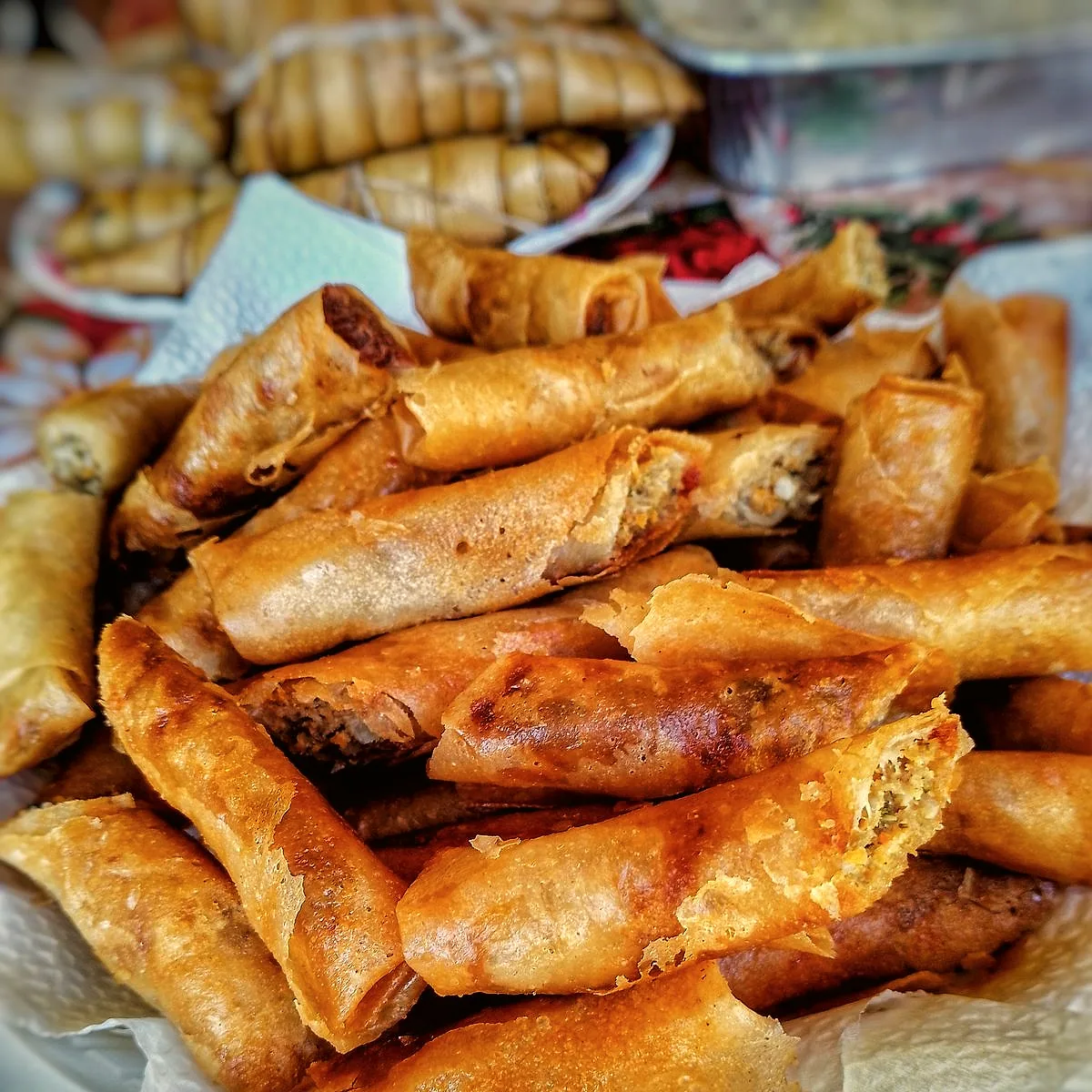

CC BY-SA 4.0. Cropped and colour-adjusted for this site.
Method
Combine the 400 g pork mince, 100 g carrot, 80 g yellow onion, 3 garlic cloves (15 g), 1 ½ spring onions (20 g), 15 ml light soy sauce, 3 g fine sea salt and 2 g ground black pepper in a bowl and mix for 10m, until evenly combined.
Lay out the 25 wrappers (200 g) and spoon a line of filling along one edge of each. Roll tightly into a thin cylinder, sealing the final edge with the 1 egg white (30 g). Repeat for 25m.
Rolling tight and thin, rather than loosely, is what makes the wrapper shatter rather than chew once fried; a loosely rolled piece steams inside its own layers instead of crisping through.
Heat the 500 ml vegetable oil to a steady deep-frying temperature and fry the rolls in batches for 10m, turning, until golden and crisp all over. Drain on paper towels before serving.
Common pitfallA pan overcrowded with rolls drops the oil's temperature, so the wrappers absorb oil and turn greasy before they colour. Frying in batches keeps the temperature steady.
Lumpia is Hokkien before it is Filipino: the word comes from lun, "soft" or "moist," and pia, "cake" or "pastry," carried to the islands by generations of Hokkien Chinese immigrants [1] [2]. The wrapped, rolled shape traces back much further still, to a plain pancake wrapped around spring vegetables in China's Jin dynasty, a custom that spread across later dynasties and, carried by Fujianese migration, left its Hokkien name on related dishes across Southeast Asia long before it had any Philippine connection [2].
What arrived in the Philippines diversified quickly into a whole family of lumpia, distinguished by filling and wrapper rather than by one fixed recipe. Lumpiang Shanghai (thin, cylindrical, packed with minced pork and vegetables and rolled small enough to eat in a bite or two) is generally treated as the most basic and most common of these variants, the one most likely to turn up at a party table or a fast-food counter [1] [3].
Its name is the part nobody has convincingly explained. The dish's own lineage traces to Fujian and Hokkien-speaking migration, not to Shanghai or Shanghainese cooking [2], and food writers covering the dish likewise conclude the "Shanghai" naming cannot be firmly explained [1] [3]. It survives as an open question rather than a settled fact, much like pancit canton's equally puzzling debt to a city it has no real tie to.
Sources
- Lumpiang Shanghai, WikipediaGives the Hokkien etymology of lumpia, describes lumpiang Shanghai as the most basic and common variant, and notes the unresolved "Shanghai" naming.
- Vietnamese loempia: the spring roll's long journey from Jin-dynasty China to Amsterdam, South China Morning PostBy Janice Leung Hayes; traces the wrapped pancake back to China's Jin dynasty and the Hokkien pronunciation "loon pia," carried through Fujianese migration across Southeast Asia.
- Lumpia Shanghai: The History Behind The Filipino Egg Roll, Tasting TableBy Kat Lieu; describes lumpia Shanghai as a common finger food at Filipino family gatherings and potlucks, and states the "Shanghai" naming cannot be firmly explained.