Chinese · Main Course
Kung Pao Chicken
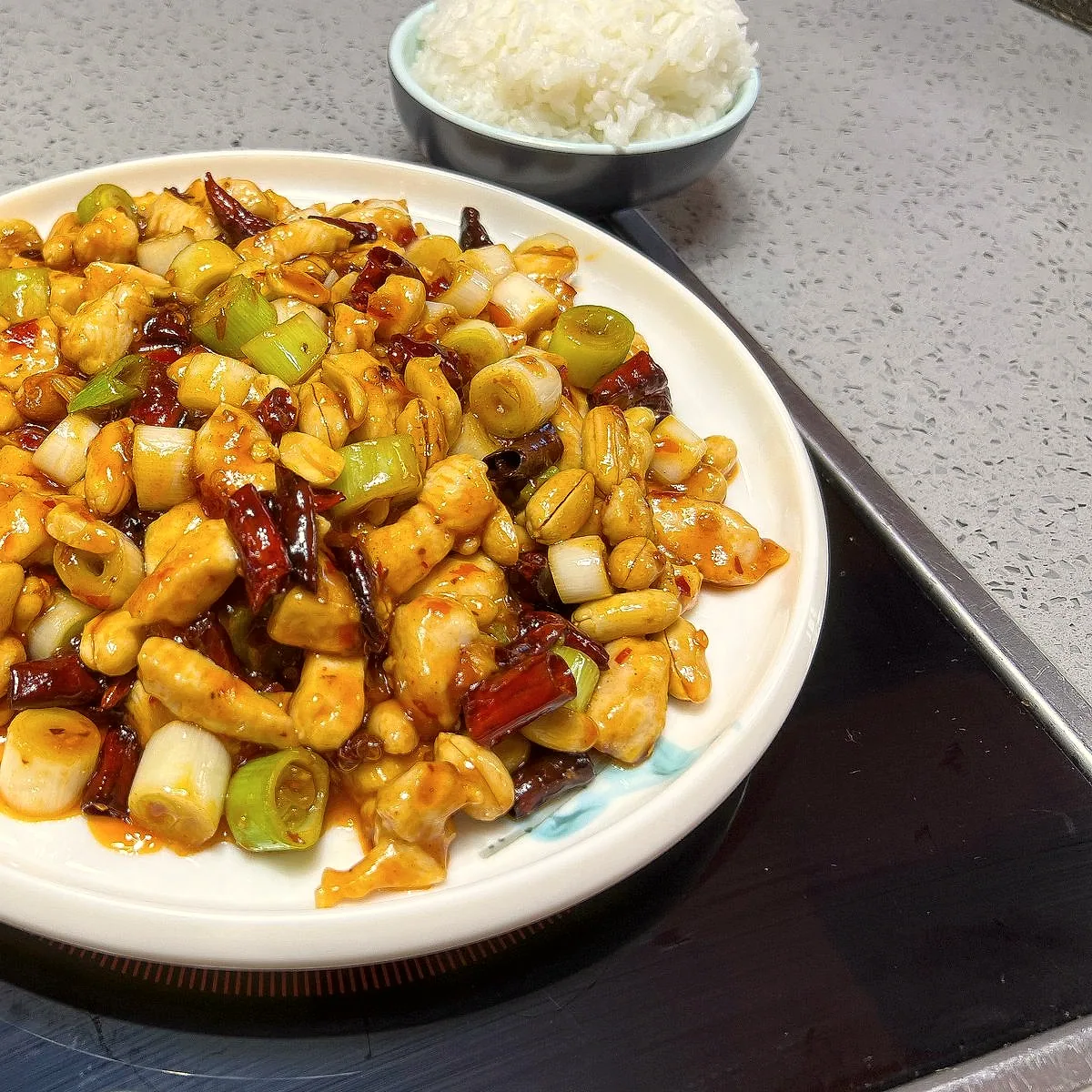
Diced chicken thigh stir-fried with dried chilli, Sichuan pepper and roasted peanuts in a quick, sticky sauce sharpened with black vinegar.
Also known asGongbao jiding
.jpg)
CC BY-SA 4.0. Cropped and colour-adjusted for this site.
Method
Combine the 10 ml light soy sauce, 10 ml Shaoxing wine and 8 g cornflour in a bowl and turn the 400 g chicken thigh through it.
Leave the chicken to marinate for 15m.
Meanwhile, whisk together the 15 ml light soy sauce, 15 ml black vinegar, 15 g caster sugar, 5 g cornflour and 30 ml water until smooth.
Heat the 30 ml peanut oil in a wok over high heat and sear the chicken for 4m, until coloured on the outside, then lift out and set aside.
Lower the heat slightly and add the 4 dried chillies (8 g) and 3 g whole Sichuan pepper, frying for 3m until fragrant and just beginning to darken. Add the 2 garlic cloves (10 g), 8 g fresh ginger and 2 spring onions (30 g) and stir briefly.
The dried chilli and Sichuan pepper are fried in oil that has cooled slightly from searing the chicken, rather than in oil straight off the highest heat, so their flavour infuses the oil without scorching into bitterness.
Return the chicken to the wok, pour in the sauce mixture and toss over high heat for 3m, until thickened and glossy and the chicken is cooked through. Off the heat, stir through the 60 g roasted peanuts.
Common pitfallPeanuts added too early turn soft and lose their bite by the time the dish reaches the table. They go in only at the very end, off the direct heat, to keep their crunch.
The dish's standard origin story names a real, documented person: Ding Baozhen, a Qing dynasty governor of Sichuan whose household chefs are credited with inventing a stir-fried chicken and peanut dish in his honour, later named for the title he held, gongbao, roughly "palace guardian" [1] [2].
The documentary trail does not support it nearly as cleanly as the story suggests. A catalogue of nearly a hundred Chengdu dishes compiled in 1902, only sixteen years after Ding's death, includes nothing resembling kung pao chicken, and the dish does not appear in Chinese cookbooks until the 1950s, and even then in strikingly inconsistent forms, some built on pork rather than chicken, some leaving out the peanuts entirely [2]. A recognisably standard version, with the chicken, chilli, Sichuan pepper and peanuts fixed in something like their current proportions, does not settle into place until the 1990s [2]. Whether Ding Baozhen ever ate anything resembling the dish that now carries his name is, on this evidence, simply not something the record can answer.
What has stayed constant through that unsettled history is the balance the dish is built to strike: dried chilli for heat, Sichuan pepper for the tingling numbness particular to the region, and peanuts added only at the very end to keep their crunch against the soft chicken and glossy sauce.
Sources
- Kung Pao chicken, WikipediaOn the Ding Baozhen naming story and the pun between his title and the dish's name.
- The 'Real' Kung Pao Chicken — And Why I Hope I Never Find It, Sixth ToneNotes the absence of the dish from an 1902 catalogue of Chengdu cooking and its first cookbook appearances only in the 1950s, in widely differing forms.