Chinese · Soup
Hot and Sour Soup
A thickened pork and tofu broth built on black vinegar and white pepper, with wood ear and shiitake for texture and a thin stream of beaten egg folded through at the end.
Also known asSuan la tang
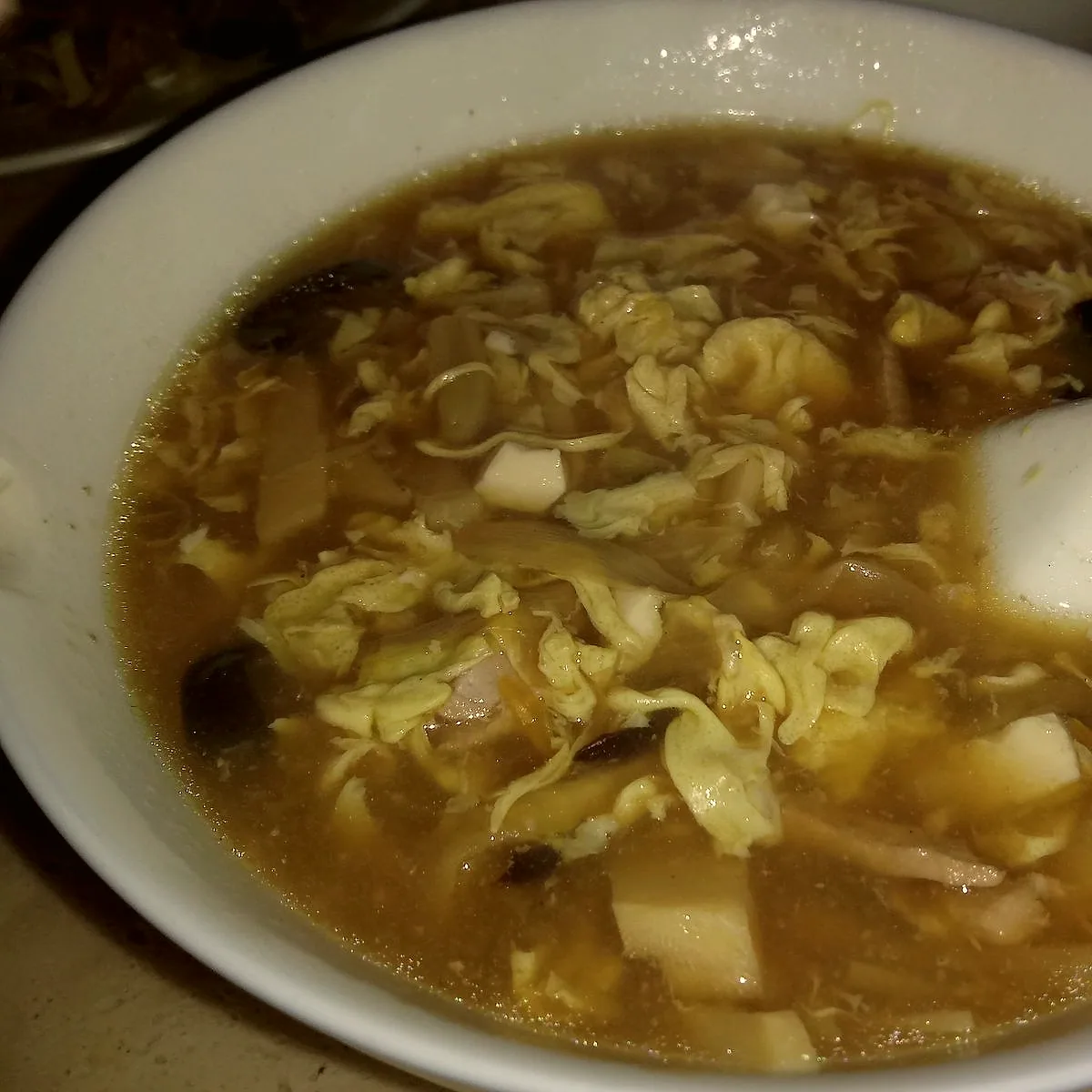

CC BY-SA 4.0. Cropped and colour-adjusted for this site.
Method
Combine the 10 ml light soy sauce and 8 g cornflour in a bowl and turn the 150 g pork shoulder through it, taking 5m.
Bring the 1 L chicken stock to a simmer and add the pork, separating the strands as they go in. Add the 15 g dried shiitake mushrooms, 10 g dried wood ear mushrooms, 100 g tinned bamboo shoots and 200 g firm tofu and simmer for 15m.
Stir in the 50 ml black vinegar, 20 ml light soy sauce, 4 g ground white pepper and 10 g caster sugar, and simmer for 3m.
Stir in the 25 g cornflour mixture in stages, stirring constantly, until the soup thickens to a light coating consistency, over 3m.
Reduce the heat to a bare simmer and pour in the 2 eggs (100 g) in a thin, slow stream, stirring gently, over 2m, so it sets into fine ribbons. Finish with the 10 ml toasted sesame oil and 1 ½ spring onions (20 g).
Pouring the beaten egg in a thin, slow stream over the back of a spoon or fork, into soup that has already thickened and is only gently simmering, is what gives the classic fine egg ribbons rather than large, cloudy clumps.
Few Chinese dishes carry a more disputed regional reputation than this one. The soup's Chinese name, suan la tang, means literally "sour spicy soup," and it is served in Western Chinese restaurants as a byword for Sichuan cooking. That is a claim some writers repeat as settled fact [2] and others treat as a popular myth. On that second account, the soup eaten under this name is barely found in Sichuan at all, where the region's own genuinely Sichuanese "sour and spicy" dish is a bowl of noodles rather than a soup, and the thickened, vinegar-and-pepper soup familiar from restaurant menus is more often traced to Beijing instead. This is a genuinely disputed attribution that at least one other account rejects outright, insisting on the Sichuan version instead [1] [2]. Neither claim is easy to verify from outside China, and the disagreement itself is a fair warning against trusting any single confident attribution for this dish.
The sour-and-spicy combination itself is much older and more widely spread than any single city's claim to it. Cooking of this general character (built on vinegar and pepper heat rather than chilli alone) is traced back as far as the Warring States period, showing up across a broad swathe of northern and central China rather than starting in one province [2]. The pairing is not uniquely Chinese either: closely related sour-and-hot soups turn up independently across South East Asia, from Vietnamese canh chua to Thai tom yum, suggesting the appeal of balancing sourness against heat in a hot broth was reached more than once, by more than one cuisine, rather than travelling outward from a single point of origin [2].
What stays constant wherever the soup is claimed from is its structure rather than its geography: a thickened broth built for contrast, sharp with vinegar and hot with pepper, carrying enough texture (tofu, mushroom, wood ear, a ribbon of egg) to be a meal in a bowl rather than a prelude to one.
Sources
- Hot and sour soup, WikipediaArgues the Sichuan attribution is a popular myth, and that the soup as commonly eaten is barely found in Sichuan itself, where the region's own "hot and sour" dish is a noodle rather than a soup, with the familiar soup better attributed to Beijing.
- Hot and Sour Soup — Traditional Chinese Recipe, 196 FlavorsStates outright that the soup is from Sichuan and not Beijing, and traces early hot-and-sour cooking to the Warring States period across several northern and central Chinese regions and a wider family of sour-hot soups across Southeast Asia.