Greek · Main Course
Gyros
Pork shoulder marinated in lemon, garlic and oregano, stacked on a spit, roasted and shaved into warm pita with tzatziki.
Not the same asSouvlaki (Cubed pork threaded onto individual skewers and grilled, rather than thin-sliced meat stacked on a vertical spit and shaved.)Döner Kebap (The Ottoman dish that gyros descends from. Döner is Turkish, usually lamb and beef, and marinated in yoghurt and paprika rather than lemon and oregano.)
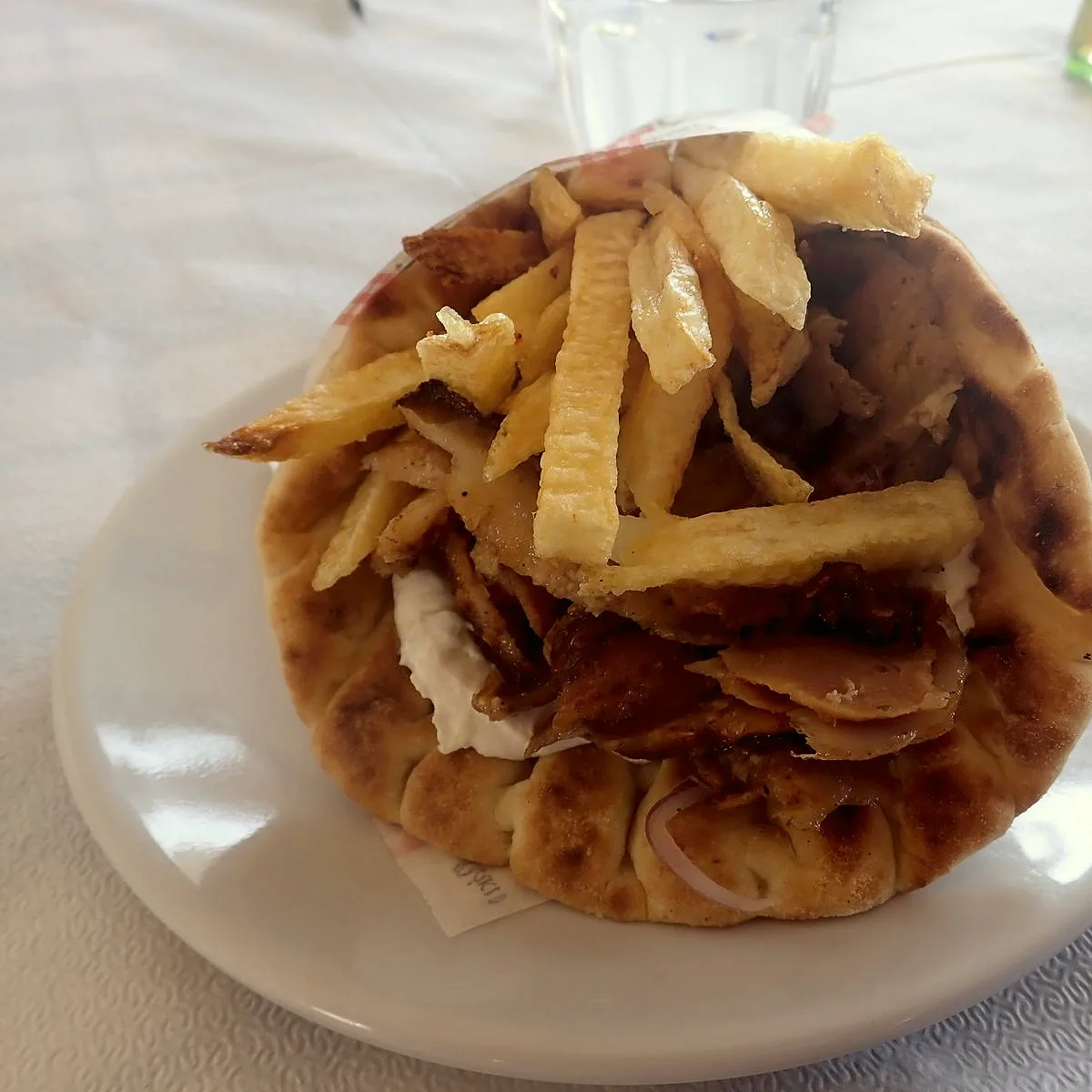

CC BY-SA 4.0. Cropped and colour-adjusted for this site.
Method
Trim the 350 g pork shoulder of excess fat and slice it thinly against the grain.
Whisk the 20 ml extra-virgin olive oil, 30 ml freshly squeezed lemon juice, 2 garlic cloves (10 g), 3 g oregano, 3 g sweet paprika, 2 g ground black pepper and 8 g fine sea salt together, add the sliced pork and turn to coat every piece. Cover and marinate, refrigerated, for 4h.
Thread the marinated pork tightly onto a vertical skewer, pressing each slice down onto the last, building an even, dense cylinder with no gaps.
Threading the slices into a tight, even cylinder is what lets the spit shave clean ribbons; loose or unevenly packed meat falls apart instead of holding a slicing surface.
Roast the stacked pork close to a vertical heat source, turning it steadily, for 1h 10m, until the outer surface is deeply browned and crisp and the centre is cooked through with no pink remaining.
Grate the 80 g cucumber and squeeze it dry in a clean cloth. Stir it into the 120 g yoghurt with the 3 g dill, 1 garlic clove (5 g), 10 ml freshly squeezed lemon juice, 5 ml extra-virgin olive oil and 2 g fine sea salt. Cover and refrigerate until needed.
Common pitfallSkipping the squeeze on the grated cucumber waters the tzatziki down until it slides off the meat instead of clinging to it.
Shave the roasted pork downward off the spit in thin ribbons for 5m.
Warm the 140 g pita bread briefly over direct heat until soft and lightly charred in spots.
Fill the warm pita with the shaved pork, 80 g ripe tomatoes, 50 g white onion and a spoonful of the tzatziki.
The name states the technique: gyros is Greek for "turn", a direct calque of the Turkish döner, itself from dönmek, "to turn" [1]. Both names describe the same vertical spit, developed in Bursa in the 19th-century Ottoman Empire [1]. Gyros is not an independent invention but that Ottoman technique arriving in Greece with the people who cooked it.
It arrived specifically in 1922, when hundreds of thousands of Greek and Armenian refugees from Asia Minor (most from Constantinople and Smyrna) were resettled in Greece under the population exchange that followed the Greco-Turkish War [2]. Armenian cooks among them had a particular reputation for the dish, and as refugees opened small shops across Greek cities, the spit-roasted meat they sold became a fixture of Greek street food [2]. In its new setting the meat shifted from the lamb and beef of a Turkish döner toward pork, the cut that came to define gyros as distinct from its parent dish.
Greek immigration carried gyros onward after the Second World War, and it reached the United States alongside that migration, taking hold in particular in Chicago [2]. By 1970 gyros wraps were already established fast food in both Athens and Chicago, and the Chicago area became the centre of the machinery and pre-formed meat that turned gyros into a mass-produced product across America in the years that followed [1].
Sources
- Gyro (food), WikipediaCovers the etymology, the 19th-century Bursa origin of the vertical spit, the 1922–23 population exchange, and the early-1970s Chicago mass-production era.
- History of Gyro, an Ancient Greek Street Food, Diane KochilasGreek cookbook author and food writer's account of the 1922 arrival of the dish with Asia Minor refugees and its post-war spread abroad.