Caribbean · Main Course
Griot
Cubes of pork shoulder marinated in sour orange and epis, simmered until tender, then fried until the surface crisps and browns.
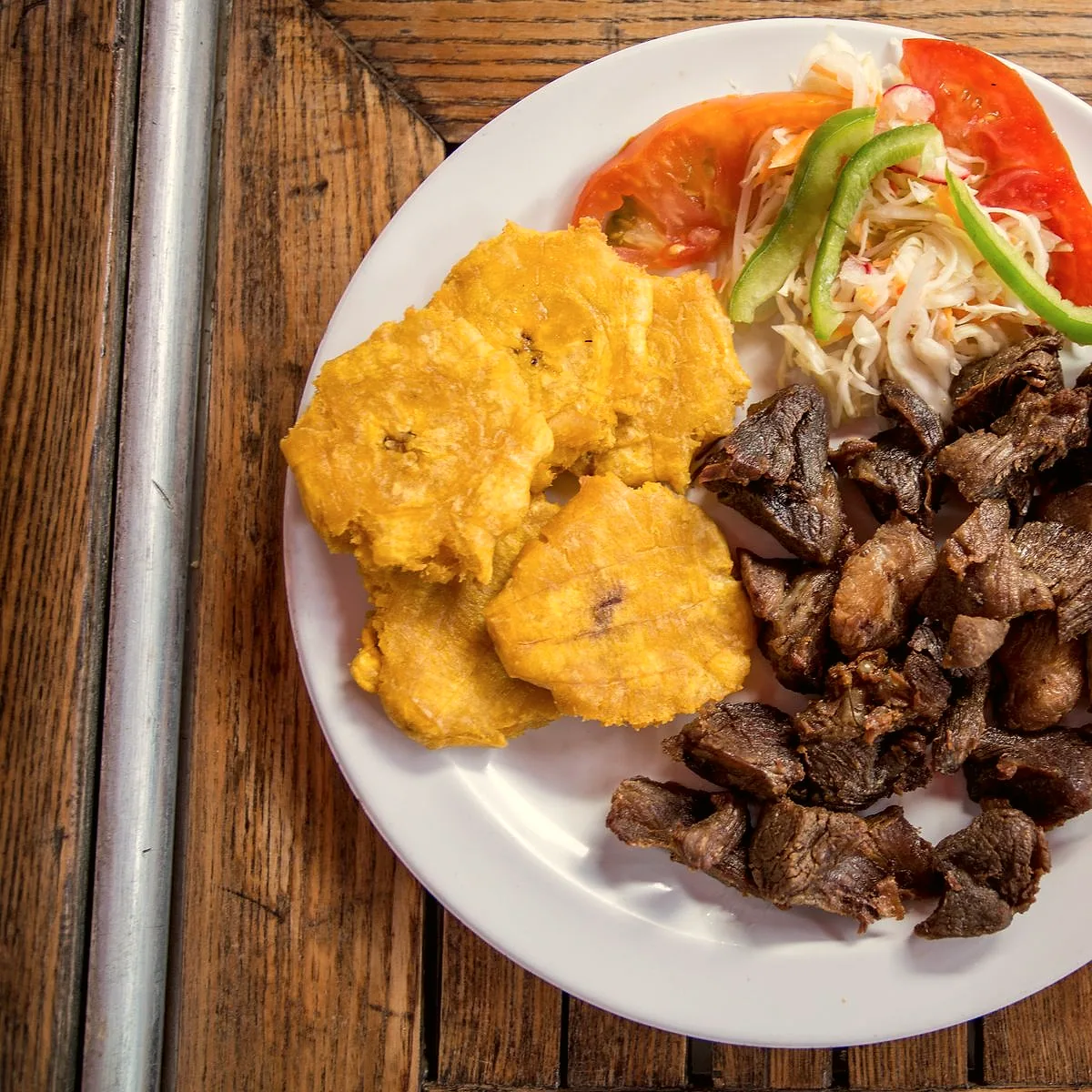

CC BY-SA 4.0. Cropped and colour-adjusted for this site.
Method
Blend the 4 garlic cloves (20 g), 6 g scotch bonnet, 40 g green pepper, 60 g yellow onion, 1 ½ spring onions (20 g), 6 g flat-leaf parsley and 3 g fresh thyme to a coarse paste; this is the epis.
Toss the 1.1 kg pork shoulder with the epis, the 90 ml sour orange, the 30 ml fresh lime juice and the 8 g fine sea salt, then cover and refrigerate for 8h.
Tip the pork and its marinade into a pot with the 350 ml water and the 2 g ground black pepper, bring to a boil, then reduce to a simmer and cook uncovered for 1h, until the pork is tender and the liquid has almost entirely reduced away.
Simmering the pork in its own marinade before frying tenderises it fully first, so the frying step only has to brown and crisp the surface rather than cook the meat through.
Heat the 45 ml vegetable oil in a wide pan over a high heat and fry the pork cubes in batches for 12m, turning occasionally, until deeply browned and crisp on the outside.
Common pitfallCrowding the pan drops the oil temperature and steams the pork instead of browning it; the cubes are fried in batches with space between them.
Griot's name is not settled fact but a theory, and the theory is worth stating as one: some trace it to the griots of West Africa, the hereditary oral historians and storytellers who held a respected, elevated place in their societies, on the reasoning that the Haitian dish was itself originally a food of the island's highest social class rather than everyday fare [1]. Only over time did it move from that restricted table to the popular dish eaten across the country today [1].
The technique is what carries the West African connection more reliably than the name does: marinating meat before cooking it, in a wet paste of aromatics and acid rather than a dry rub, is a practice many enslaved West Africans brought with them to Haiti and adapted to what the island grew, blending with Taíno foodways already on the island into the paste known today as epis [1] [2]. In griot's case that marinade is a wet base of garlic, peppers, herbs and citrus pounded or blended together, into which pork shoulder is submerged before it is boiled tender and then fried until the surface crisps and browns. Sour orange is the traditional souring agent, with lime standing in where sour orange is not to be had [1].
Griot is eaten across Haiti today and, alongside red beans and rice, is among the dishes most closely identified with the country's cooking. It is served with pikliz, a sharp, vinegared cabbage and scotch bonnet slaw, whose heat and acidity cut through the pork's fried richness. This is the same combination of tang against fat that the epis marinade builds in from the start.
Sources
- The History Of Griyo, A Signature Pork Dish In Haiti, Travel NoireCovers the naming theory linking griot to West African griots, its early association with Haiti's upper classes, and the citrus-and-epis marinade tradition.
- Epis, WikipediaCorroborates epis's Taíno-and-African origins and its typical composition of citrus, garlic, herbs and scotch bonnet.