British · Breakfast
Full English Breakfast
A cooked plate of bacon, sausage, egg, black pudding, beans, grilled tomato, mushrooms and fried bread, for one.
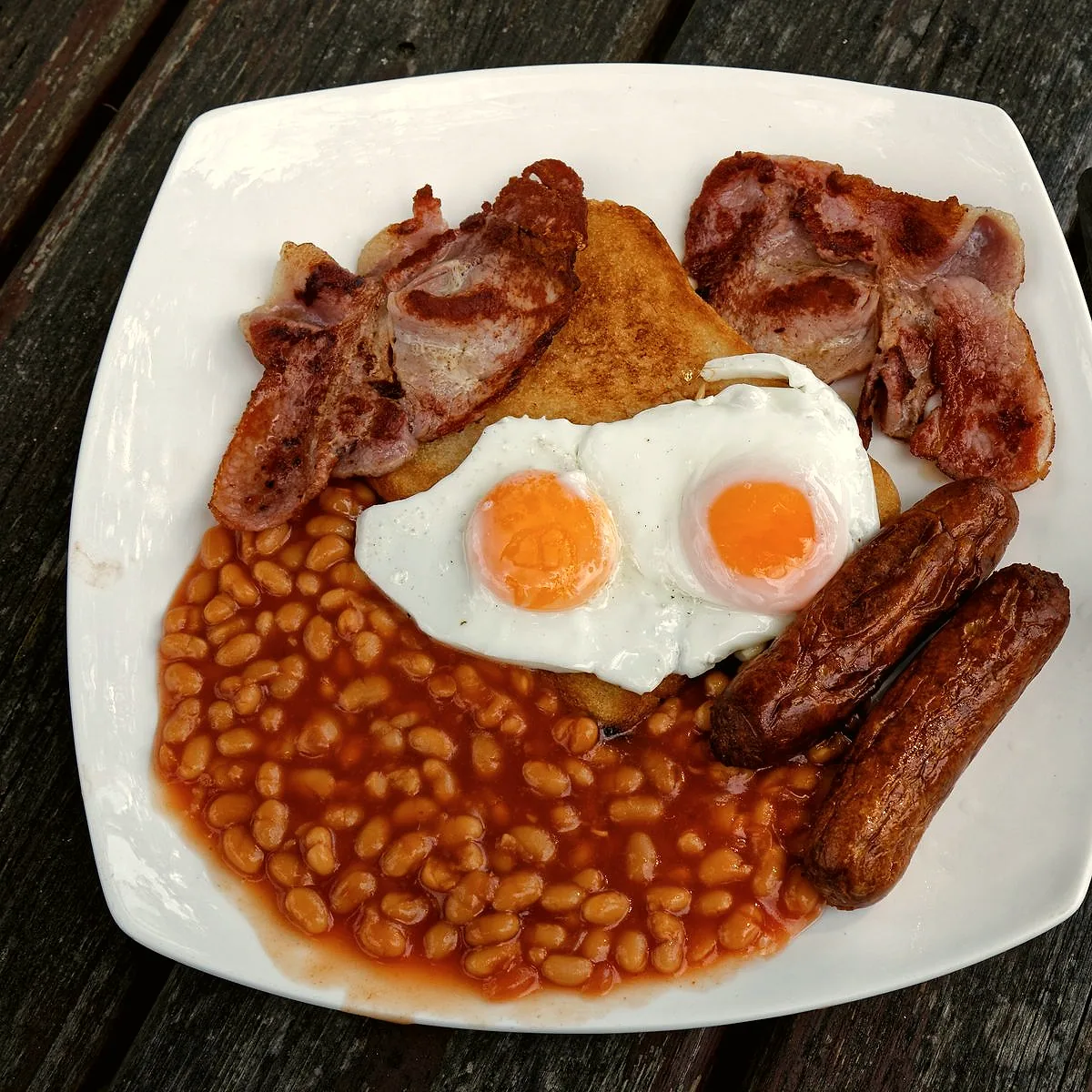

CC BY-SA 4.0. Cropped and colour-adjusted for this site.
Method
Set the 2 sausages (120 g) in a frying pan with the 5 g vegetable oil over a medium heat and cook for 12m, turning regularly, until browned on all sides and cooked through.
In a second pan, fry the 70 g back bacon in the 3 g vegetable oil for 6m, turning once, until browned at the edges.
In the same pan once the bacon is out, fry the 50 g black pudding in the 3 g vegetable oil for 6m, turning once, until crisp at the edges and heated through.
Season the 100 g ripe tomatoes with the 1 g fine sea salt and half the 1 g ground black pepper and grill cut side up, and cook the 60 g mushrooms in the 8 g unsalted butter in a small pan, both for 8m, until the tomato has softened and the mushroom has released its liquid and browned.
Heat the 130 g baked beans in a small saucepan over a low heat for 6m, stirring occasionally, until hot through.
Fry the 35 g sandwich bread in the 12 g unsalted butter in a clean pan for 3m a side, until golden and crisp.
At the same time, fry the 1 egg (50 g) in the 4 g vegetable oil in a separate pan for 3m, until the white is fully set and the yolk is still soft. Season with the rest of the 1 g ground black pepper.
Common pitfallAdding the egg to a pan still crowded with the other items overcooks it before the white has set. It goes into its own space, or its own pan, once everything else is nearly done.
Arrange everything on a warmed plate together and serve at once.
A cooked plate of eggs and cured pork is recorded early: the seventeenth-century writer Sir Kenelm Digby praised poached eggs with fried bacon as breakfast fare, and by 1773 the travel writer Patrick Brydone was contrasting a hearty English breakfast at a lord's house with the lighter continental version [2]. But a large cooked breakfast eaten as a matter of course did not appear in English life generally until the nineteenth century; before that, breakfast across Britain was typically bread, porridge or pottage [1][3].
The meal owes its fixed shape in large part to Victorian country-house hospitality and to Isabella Beeton, whose Book of Household Management (1861) included fried ham and eggs among its breakfast dishes and helped set the pattern that spread from the aristocratic estate to the emerging middle class [1][3]. What is now sold as a "full English" took longer still to assemble: fried potatoes were a post-war addition, and mushrooms, grilled tomatoes, baked beans and black pudding are all credited to the 1960s and 1970s [2]. The cooked breakfast became a working-class staple only once wartime rationing had ended and domestic food storage improved enough to make it an everyday meal rather than an occasional one [1][3].
So the plate now treated as a fixed national institution is a composite, built up over roughly three centuries and only completed within living memory. What holds it together is not tradition so much as a working logic: a frying pan doing several jobs at once, and every element chosen to survive being cooked well ahead of the egg and held warm beside it.
Sources
- Full breakfast, WikipediaOn breakfast across Britain typically being bread, porridge or pottage before the Victorian era, Mrs Beeton's 1861 recipes, and the meal's later spread to the working class in the 1950s.
- The Full English Breakfast — The History of an Iconic British Dish, History HitOn Sir Kenelm Digby's seventeenth-century recipe and Patrick Brydone's 1773 account, and the twentieth-century additions of fried potatoes, mushrooms, tomatoes, baked beans and black pudding.
- Edible Histories: The Full English Breakfast, Borough MarketOn medieval and seventeenth-century breakfasts of bread, porridge or gruel, Mrs Beeton's role in popularising a grander breakfast, and the postwar 1950s spread of the fried breakfast to working people once rationing ended.