Brazilian · Main Course
Feijoada
A long-simmered black bean stew built on dried, salted and smoked pork and beef, served with rice, couve and orange.
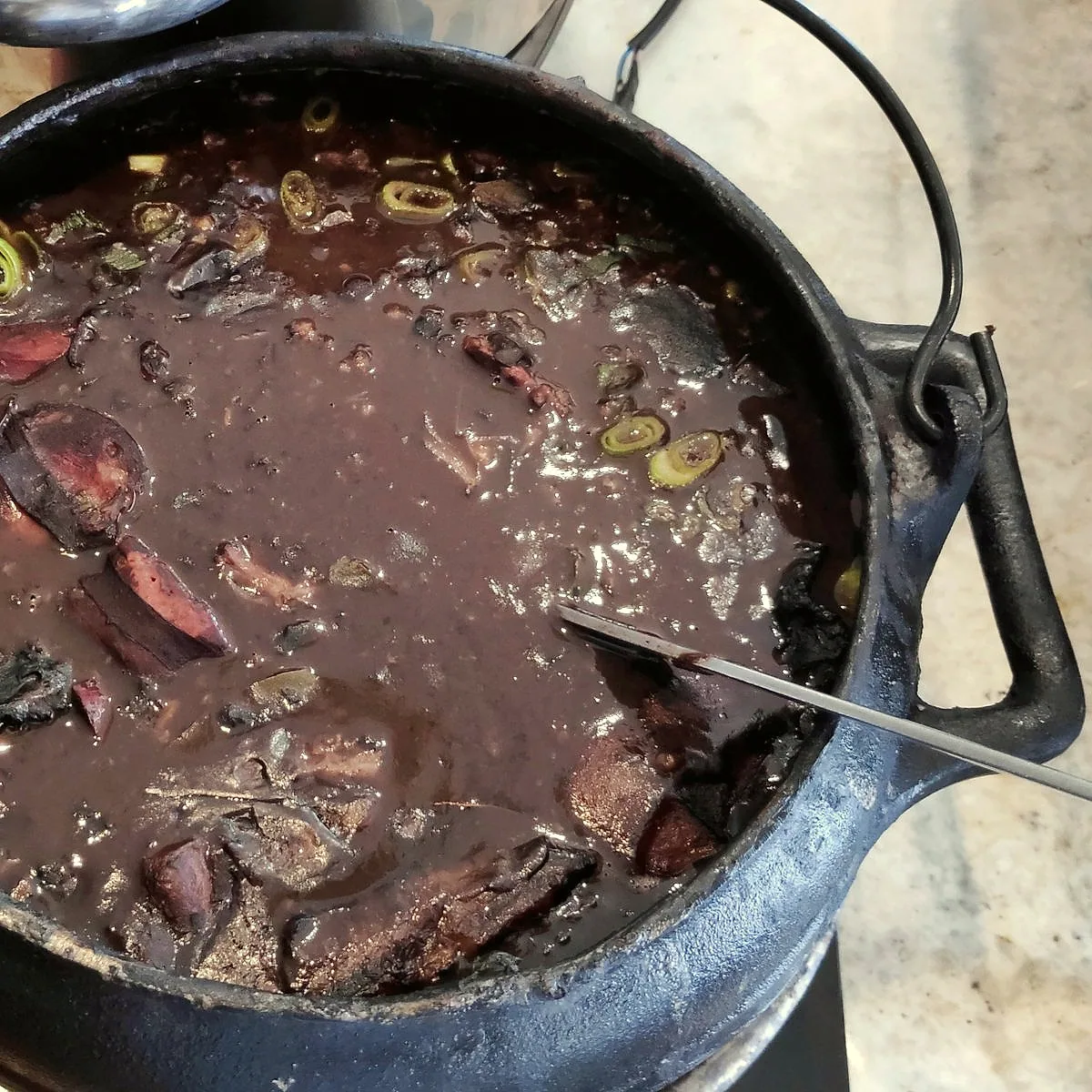

CC BY-SA 4.0. Cropped and colour-adjusted for this site.
Method
Soak the 500 g dried black beans, 200 g carne seca and 150 g raw salt pork separately in plenty of cold water for 8h, changing the water for the meats at least once. Drain and rinse all three before cooking.
The carne seca and salt pork are both preserved with a heavy cure. An overnight soak, with the water changed at least once, draws out enough of that salt that the finished stew is seasoned rather than inedibly salty.
Put the beans, carne seca and salt pork into a large pot with the 2 L water and the 5 bay leaves (1 g). Bring to a simmer and cook for 2h 30m, partially covered, until the beans are fully tender and the meats fall apart easily.
Common pitfallSalting the pot again before tasting is an easy mistake, since the cured meats already carry a great deal of salt into the beans as they render. It is seasoned only at the end, once the meat's own salt has had time to spread through the pot.
While the pot simmers, melt the 20 g lard in a small pan and cook the 200 g yellow onion and 2 garlic cloves (10 g) until soft and golden, then stir them into the pot.
Stir the 200 g linguiça into the pot and simmer for 20m, until the sausage is cooked through and the stew has thickened to a dark, glossy consistency.
Heat the 15 ml extra-virgin olive oil in a wide pan over a high heat and stir-fry the 200 g collard greens and 1 garlic clove (5 g) for 8m, just until wilted and still bright green.
Serve the stew with the couve alongside and the 2 oranges (260 g) slices on the side.
Feijoada's most repeated origin story holds that enslaved people on Brazilian plantations invented it, stewing black beans with the pig's ears, feet and tail their masters discarded. It is a story that frames the dish as an act of resourcefulness born from deprivation, and it is the version most Brazilians are told. Historians working from the documentary record now treat it as largely a modern myth. The food historian Carlos Augusto Ditadi argued the story is "born of modern folklore, in a romanticized vision" of plantation life, unsupported by either culinary tradition or historical evidence, and pointed out that pig's trotters were already an ordinary part of Portuguese cooking well before Brazil existed as a nation [2][3]. Ditadi was not the first to make the case: the writer Guilherme Figueiredo had already argued in 1964 that feijoada did not originate in the slave quarters, and the sociologist Gabriel Bolaffi later asked, pointedly, how two discarded pig parts could plausibly have fed plantations of hundreds [3].
The documented history points toward an Iberian stew adapted and expanded in Brazil rather than an enslaved invention. Feijoada's elaborate, many-meats form has been compared to Portuguese cozido, French cassoulet and similar European bean-and-pork stews built from a shared old-world tradition [1]. Scholar Carlos Alberto Dória draws a sharper distinction still: plain beans, eaten with cornmeal or manioc flour, were genuinely the food of enslaved people, but the full, offal-rich feijoada completa eaten today was for a long period a dish of elite urban restaurants, not plantation kitchens [1]. The earliest known newspaper references to feijoada, from Recife in 1827 and Rio de Janeiro in 1833, likewise say nothing about enslaved origin [2][3]; the earliest restaurant known to have served feijoada as a public dish, G. Lobo in Rio de Janeiro, dates only from the late nineteenth century and was itself demolished decades later during the construction of Avenida Presidente Vargas [3].
What is better documented is feijoada's twentieth-century political life. The anthropologist Luís da Câmara Cascudo placed the dish's spread into ordinary Brazilian kitchens around 1930, the same period in which Brazil's elites began promoting an ideology of "racial democracy" that cast the country as a harmonious blend of its African, Indigenous and European inheritances [1]. Feijoada's adoption as a national dish, uniting a stew once associated with both elite tables and enslaved poverty under one symbol, served that story well, which is exactly why its popular origin legend deserves more scrutiny than it usually gets.
Sources
- Feijoada and Hoppin' John, Southern Cultures (University of North Carolina Press)Academic journal article weighing the popular slavery-origin story against the documented record, citing the anthropologist Luís da Câmara Cascudo, Carlos Alberto Dória, and Gilberto Freyre's 1946 "The Masters and the Slaves."
- Feijoada (Brazilian dish), WikipediaGives the 1827 Recife and 1833 Rio newspaper references as the earliest documented mentions, and cites the food historian Carlos Augusto Ditadi's 1998 argument against the slavery-origin story.
- História da Feijoada, Portal São FranciscoBrazilian educational reference portal corroborating Ditadi's argument and citing the earlier critics Guilherme Figueiredo (1964) and Gabriel Bolaffi (2000), plus the Rio restaurant G. Lobo as the first known public feijoada in the late nineteenth century.