Brazilian · Snack
Coxinha
A teardrop-shaped, breaded and fried snack of shredded chicken wrapped in a dough enriched with the poaching broth itself.
Also known asCoxinha de galinha · Brazil
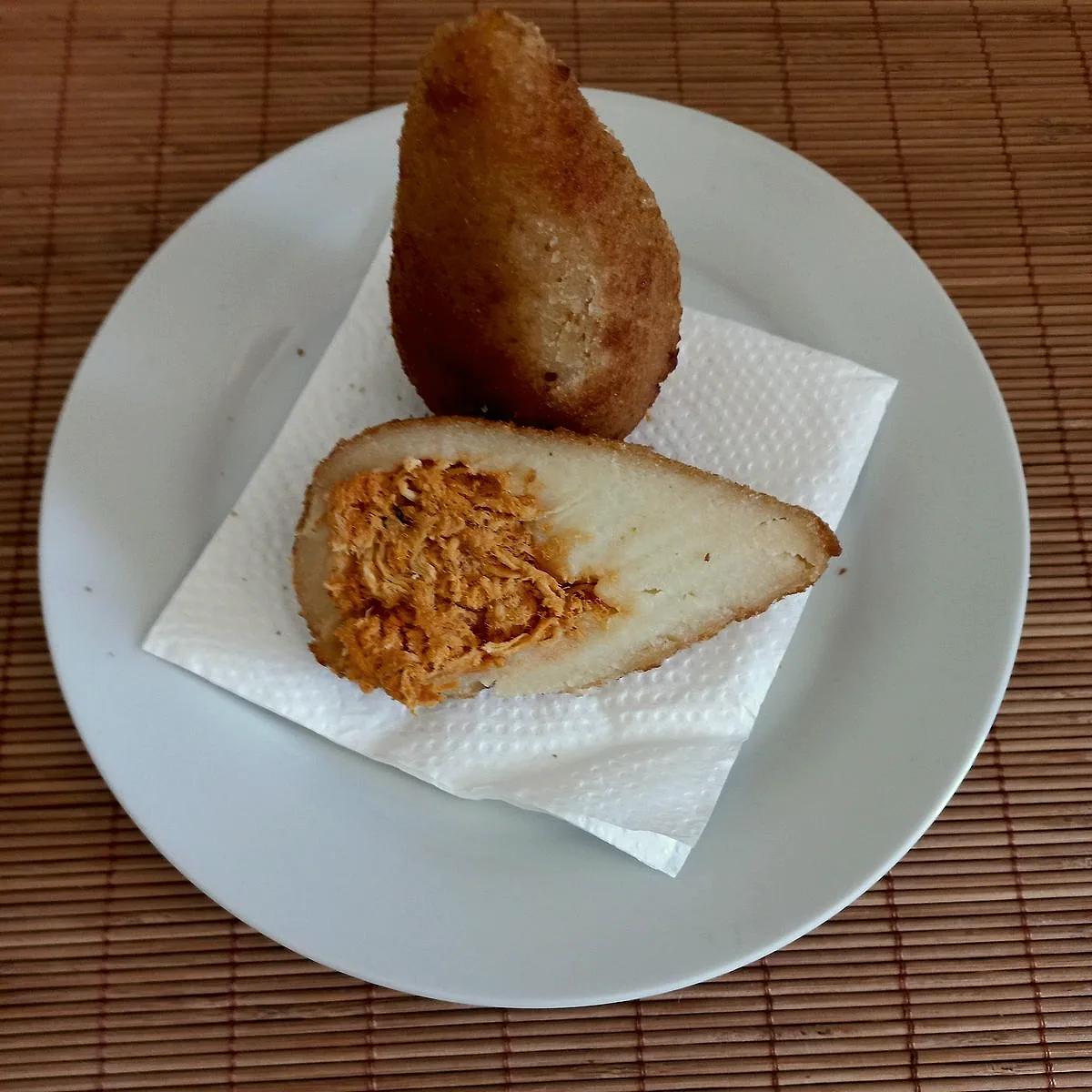

CC BY-SA 4.0. Cropped and colour-adjusted for this site.
Method
Dissolve the 8 g beef bouillon powder in the 1 L water in a saucepan and bring to a simmer with the 100 g white onion and 2 garlic cloves (10 g). Add the 500 g chicken thigh and poach for 25m, until cooked through. Lift out the chicken, strain and reserve the broth.
Shred the poached chicken finely and mix with the 80 g cream cheese, 3 g fine sea salt and 2 g ground black pepper.
Melt the 40 g unsalted butter in the reserved broth and bring to a boil. Tip in the 300 g plain flour and 4 g fine sea salt all at once and stir vigorously over the heat for 15m, until the mixture forms a smooth, heavy dough that pulls cleanly away from the sides of the pan.
Cooking the flour directly into the hot poaching broth, the way a choux paste is made, is what lets the dough hold a sculpted teardrop shape without cracking or tearing; a dough mixed cold from the same ingredients is too short and crumbly to shape by hand.
Turn the dough out and let it cool for 20m, until cool enough to handle.
Take portions of the dough and flatten each into a disc in your palm. Place a spoonful of the chicken filling in the centre, gather the dough around it and shape into a teardrop, smoothing the surface as you go, for 35m in total.
Dip each shaped coxinha in the 2 eggs (100 g), then roll in the 200 g dried breadcrumbs until fully coated.
Heat the 1.5 L vegetable oil and fry the coxinhas in batches for 15m, until deep golden and crisp. Drain briefly before serving.
Common pitfallFrying at too low a temperature lets the dough absorb oil before the crust sets, giving a heavy, greasy result rather than a crisp one. The oil needs to be hot enough that a scrap of dough sizzles immediately on contact.
The story told about coxinha's invention is specific enough to sound documented: at a royal residence in Limeira, in the countryside of São Paulo state, a son of Isabel, Princess Imperial of Brazil, would eat nothing but chicken drumsticks. When the cook ran short of real ones, she shredded meat from the rest of the bird, shaped it with mashed potato into the form of a drumstick and fried it. The boy loved it so much that Empress Teresa Cristina is said to have travelled to Limeira herself to taste the new delicacy [1][2].
The story does not survive contact with the documentary record. Princess Isabel had three sons (Pedro de Alcântara, Luís Maria Filipe and Antônio Gastão Filipe) and all three are recorded as healthy children who lived at the Paço Isabel, now Rio de Janeiro's Guanabara Palace, until the Proclamation of the Republic in 1889, not on a farm in the São Paulo countryside with a fussy eater among them [2]. Its fullest telling traces to a single local-history book by Nadir Cavazin, and even Wikipedia's own account of the snack's more recognisable, breaded and fried modern form hedges its date and place of origin as something that "may have" happened in nineteenth-century Limeira, rather than something established [1][2].
More plausible accounts point elsewhere entirely. One holds that coxinha was developed during São Paulo's industrialisation as a cheap, durable way to stretch chicken further, sold at factory gates as a quick meal for workers rather than invented in any noble kitchen at all [2]. The shape itself may also be older than any Brazilian claim on it: the French chef Antonin Carême published a recipe for pear-shaped chicken croquettes in his 1831 cookbook, a precedent that predates every version of the Limeira story by decades [2].
What is not in question is the snack's later trajectory: from a contested origin story to a fixture of Brazilian bakeries, bars and street stalls nationwide, sold well beyond any one town's claim on its invention. Whatever its true beginning, the coxinha eaten today is a mass, everyday food, its supposed aristocratic origin worn as folklore rather than pedigree.
Sources
- Coxinha, WikipediaSources the Princess Isabel origin story to Nadir Cavazin's book of local Limeira history, and separately notes the tentative claim that the modern, processed snack sold today developed in Limeira, São Paulo, in the nineteenth century.
- As histórias por trás da origem da coxinha, Aventuras na História (Editora Abril)Brazilian history magazine fact-check naming Princess Isabel's three documented sons (all recorded as healthy and resident at the Paço Isabel until 1889) and offering an industrial-era São Paulo origin and a French 1831 chicken-croquette precedent as more plausible alternatives.