American · Main Course
Chicken Parmesan
Breaded chicken breast fried until crisp, then baked under tomato sauce and melted mozzarella.
Also known asChicken parmigiana · United States
Not the same asMelanzane alla parmigiana (The Italian dish it is modelled on uses fried aubergine in place of chicken, and has no breaded cutlet at all.)
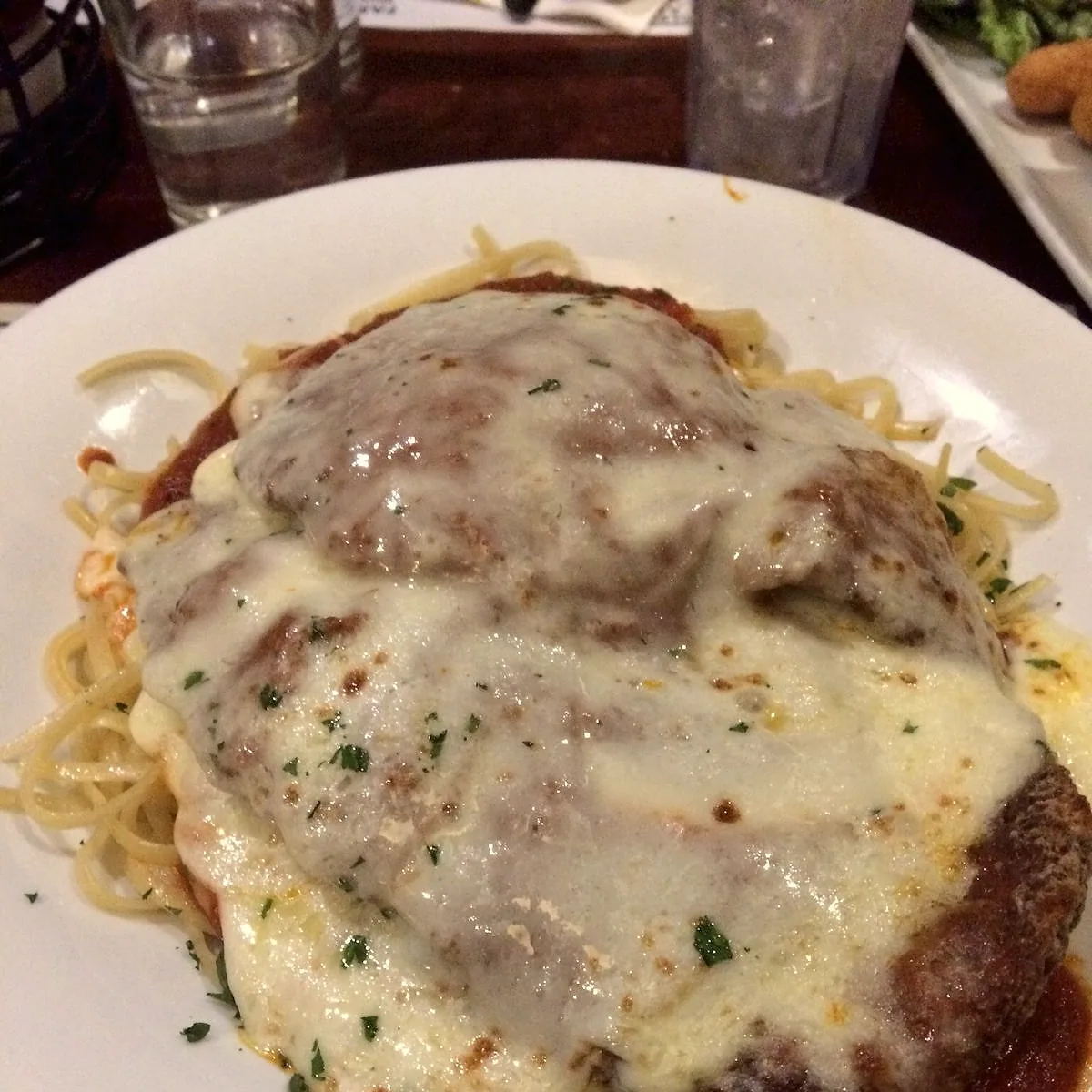

CC BY-SA 4.0. Cropped and colour-adjusted for this site.
Method
Warm the 15 ml extra-virgin olive oil and cook the 1 garlic clove (6 g) briefly until fragrant, then add the 300 g tinned tomatoes and 1 g oregano. Simmer for the remainder of 15m, until slightly thickened, and season with half the 4 g fine sea salt.
Season the 340 g boneless, skinless chicken breast with the remaining salt. Dredge each piece in the 40 g plain flour, dip in the 1 egg (50 g), then coat evenly in the 65 g dried breadcrumbs.
Heat the 100 ml vegetable oil in a wide pan over a medium-high heat and fry the cutlets for 8m, turning once, until deep golden and cooked through. Drain on a rack.
Frying the cutlets before the sauce goes anywhere near them is what keeps the crust crisp under the bake. A crumb coating added straight to raw chicken in the sauce would turn to paste.
Spoon a little of the sauce into a baking dish, lay the cutlets on top, cover with the remaining sauce, then the 100 g fresh mozzarella and the 20 g Parmigiano-Reggiano.
Bake at 200 °C for 15m, until the cheese has melted and turned golden in patches. Scatter over the 4 g fresh basil before serving.
Common pitfallBaking too long after the crust is already set just dries the chicken out. The oven time here is only enough to melt the cheese and heat the sauce through; the chicken is already cooked from frying.
Chicken parmesan has no real equivalent in Italy, where the dish it is named for (parmigiana, or more fully melanzane alla parmigiana) is built from fried aubergine layered with tomato and cheese, not meat at all [1]. It took shape among Italian immigrants in the United States in the early twentieth century, with one of the earliest known chicken parmesan recipes appearing in the 1940s [1].
The substitution is usually explained by what was on offer in the new country rather than in the old one. In much of Italy, chicken had historically been a comparatively expensive meat set aside for special occasions, while American meat markets sold it cheaply and in quantity. That was the reverse of the situation immigrants had left [1]. The breaded cutlet itself is usually traced to a separate borrowing, a fusion of the aubergine parmigiana's tomato-and-cheese construction with the breaded, fried cutlet style: cotoletta in Italian cooking, schnitzel among the German communities many Italian immigrants lived alongside [1].
The result keeps the shape of its Italian namesake (a fried, breaded piece finished under tomato and melted cheese) while being built from an entirely different main ingredient. It belongs to American red-sauce cooking rather than to Italy, and is treated that way here.
Sources
- Chicken parmesan, WikipediaOn the dish's American origin and its relationship to melanzane alla parmigiana and Italian cotoletta.