Caribbean · Breakfast
Ackee and Saltfish
Salt cod, soaked and flaked, folded gently through sautéed onion, tomato and scotch bonnet with soft, buttery ackee.
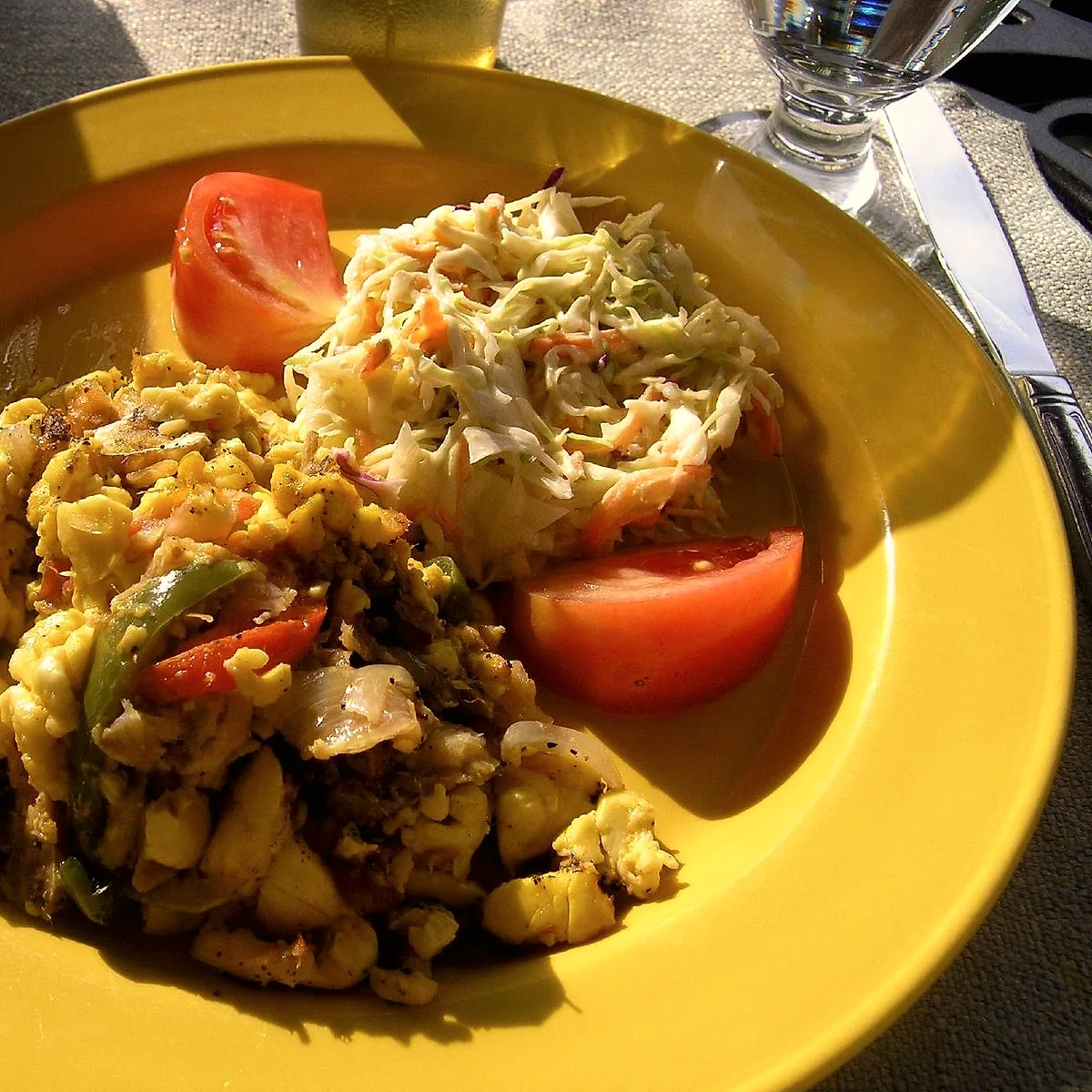

CC BY 2.0. Cropped and colour-adjusted for this site.
Method
Cover the 300 g salt cod with cold water and leave to soak for 8h, changing the water several times, to draw out the curing salt.
Common pitfallSkimping on the soak leaves the fish too salty to eat comfortably. Several changes of cold water over a long soak draw out enough salt without needing to simmer it away later.
Drain the saltfish, cover with fresh water, and poach at a bare simmer for 15m, until it flakes easily. Drain, remove any skin and bones, and flake into large pieces.
Heat the 30 g vegetable oil in a wide pan and fry the 100 g red onion, 2 garlic cloves (10 g), 100 g ripe tomatoes, 5 g scotch bonnet and 2 g fresh thyme for 8m, until the onion has softened and the tomato has broken down.
Add the flaked saltfish to the pan and toss through the aromatics. Fold in the 400 g canned ackee gently, along with the 1 spring onion (15 g) and 2 g ground black pepper, warming everything through for 8m without breaking up the ackee. Discard the whole scotch bonnet before serving.
The ackee goes in last and is folded rather than stirred hard, because the cooked arils are already soft and break down into mush under vigorous handling.
Neither half of Jamaica's national dish is native to Jamaica. Ackee (Blighia sapida) is a West African fruit, most closely tied to Ghana, and its name comes from the Twi word ankye [2]. It is generally said to have reached Jamaica before 1725, and a more specific account places its arrival around 1778, brought most likely aboard a slave ship and purchased there specifically as a food source for enslaved people [1][2]. That a fruit used mostly for medicine and industrial purposes in parts of West Africa became, in Jamaica, a national foodstuff is itself part of the dish's odder history.
Salt cod's journey there is better documented and no less tied to slavery. Newfoundland and Nova Scotia supplied cured, salted cod to Caribbean plantations as a cheap, long-lasting protein for enslaved labourers, while the better cuts of the same catch went to European markets: a trade relationship that outlasted slavery itself and left saltfish established as a Caribbean pantry staple long after [1][2].
What is not resolved is how the two ended up on the same plate. Both ingredients have a documented route into Jamaica, but food writers examining the dish's history describe the specific pairing of ackee with saltfish as a genuine mystery, with no record fixing when or by whom the combination was first made [2]. What is certain is what it became afterward: a dish assembled from the leftovers of two different arms of the Atlantic slave economy, now cooked as an everyday breakfast and claimed, without argument, as Jamaica's own.
Sources
- Ackee and saltfish, WikipediaCovers ackee's West African, specifically Ghanaian, origin and its documented arrival in Jamaica, alongside salt cod's role as a cheap protein source under slavery.
- Jamaica's National Dish Is an Immigrant to Its Own Shores, SaveurIndependent food-journalism account with a specific 1778 arrival date for ackee, the Twi etymology of its name, and the Newfoundland–Nova Scotia salt cod trade to the Caribbean.