American · Main Course
Pot Roast
Beef chuck seared hard, then braised low and slow with root vegetables until it falls apart under a fork.
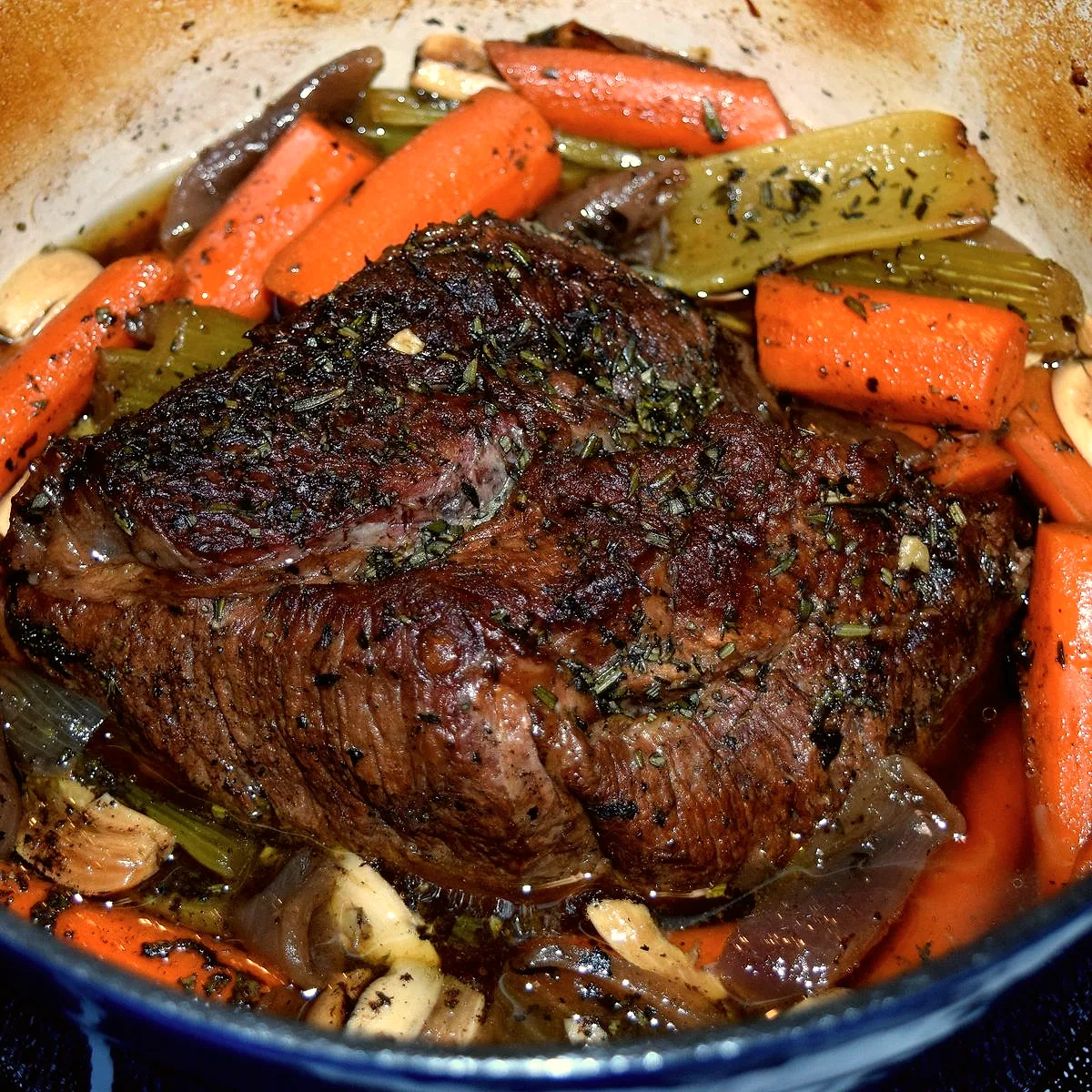

CC BY-SA 4.0. Cropped and colour-adjusted for this site.
Method
Season the 1.4 kg chuck with half the 12 g fine sea salt and the 3 g ground black pepper, then dust it all over with the 30 g plain flour, patting off the excess.
Heat the 30 ml vegetable oil in a heavy pot over a high heat and sear the beef for 12m, turning to brown every side. Remove and set aside.
A hard sear before the liquid goes in builds a deep, browned crust on the meat that the braise itself cannot produce; a roast lowered straight into liquid never develops the same flavour.
Lower the heat and cook the 300 g yellow onion, the 200 g carrot, the 150 g celery and the 3 garlic cloves (15 g) for 8m, stirring, until softened. Stir in the 40 g tomato purée and cook briefly.
Dissolve the 15 g beef bouillon powder in the 700 ml water and pour it over the vegetables. Return the beef to the pot along with the 4 g fresh thyme and the 2 bay leaves (0.4 g), bring to a bare simmer, cover and transfer to a low oven at 150 °C for 2h 30m.
Tuck the 500 g potato and the 200 g carrot into the liquid around the beef, seasoning with the remaining salt.
Common pitfallAdding the potatoes and the larger carrot chunks at the start of the braise leaves them broken down and waterlogged by the time the beef is tender. They go in only for the final stretch.
Cover and return to the oven for a further 45m, until the beef is fork-tender and the vegetables are cooked through.
Lift the beef onto a board and rest for 15m, loosely tented, before carving.
Slice the beef against the grain and serve with the vegetables and the braising liquid spooned over as a gravy.
Braising a tough cut of meat slowly in a covered pot is not an American invention; the technique reaches back to French dishes such as boeuf à la mode, a marinated, pot-braised beef recorded in François Pierre de la Varenne's French cookbook as early as 1651 [2]. What became "Yankee pot roast" is that method adapted to New England kitchens that mostly lacked proper ovens, where a version of the same dish was cooked over an open hearth in a large covered pot rather than roasted [3].
A separate strand arrived later and independently. Jewish immigrants from Hungary, Austria and Russia brought their own slow-braised beef dishes, known in Yiddish as gedempte fleisch, and these traditions folded into the same category of long-cooked, pot-braised beef once established in American home cooking [1]. The dish now called pot roast in the United States is better understood as several separate European braising traditions converging on the same technique (meat seared, then simmered slowly in a covered pot with vegetables and a little liquid until it surrenders) than as a single dish with one lineage.
That convergence is also why there is no single fixed recipe for it. The vegetables, the liquid and the seasoning vary by household and by which tradition a family's pot roast happens to descend from; the searing and the long, low braise are the only parts everyone agrees on.
Sources
- Pot Roast Then & Now: A Tale of Jewish Mothers and Daughters, The ForwardOn gedempte fleisch and the Eastern European Jewish immigrant tradition of slow-braised pot roast in America.
- À la Mode, CooksInfoOn boeuf à la mode's appearance in François Pierre de la Varenne's 1651 French cookbook, the marinated, braised beef dish behind the technique.
- Cooking and Dining in 18th Century America, Craven HallOn colonial households cooking over open hearths, including a version of Beef à la Mode prepared in a large covered pot.