Caribbean · Side
Moros y Cristianos
Black beans and white rice cooked together in one pot over a garlic-and-pepper sofrito, until the rice takes on the beans' colour and flavour throughout.
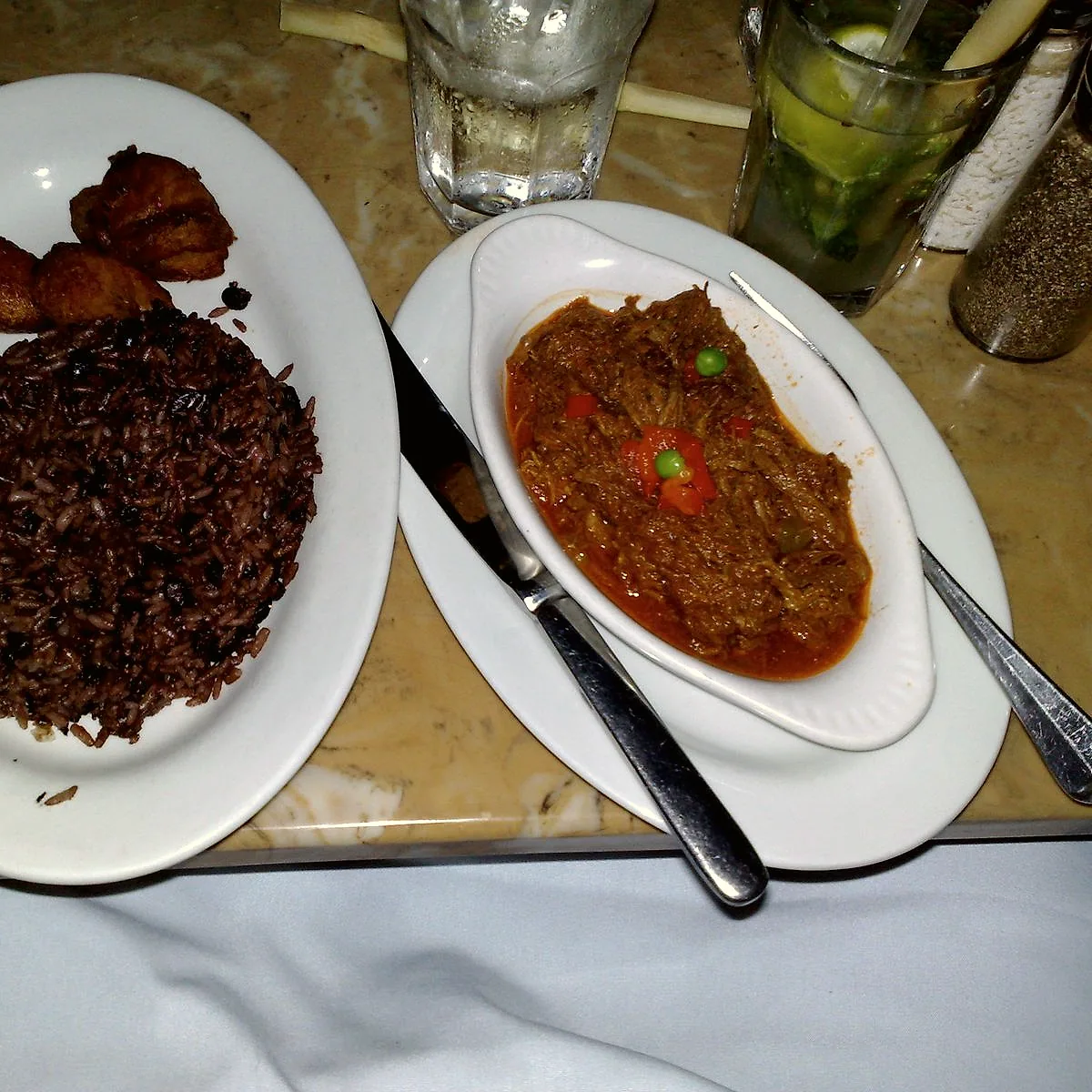

CC BY 2.0. Cropped and colour-adjusted for this site.
Method
Soak the 200 g dried black beans in plenty of cold water for 8h, then drain.
Simmer the soaked beans in the 900 ml water for 50m, until tender, topping up with water as needed to keep them covered. Do not drain.
Heat the 30 ml extra-virgin olive oil in a wide pot over a medium heat and cook the 80 g white onion, 70 g green pepper and 2 ½ garlic cloves (12 g) for 8m, until softened.
Add the cooked beans and their liquid to the sofrito along with the 3 g ground cumin, 2 g oregano, 2 bay leaves (0.4 g), 6 g fine sea salt and 1 g ground black pepper, and bring to a boil. Stir in the 300 g basmati rice, cover, reduce the heat to its lowest setting and cook undisturbed for 20m, until the liquid is absorbed and the rice is tender.
Cooking the rice directly in the bean liquid, rather than in plain water with the beans stirred in afterward, is what turns every grain the same grey-brown and carries the beans' flavour all the way through the pot.
Take the pot off the heat and leave it covered for 10m before fluffing with a fork and removing the bay leaf.
Moros y Cristianos wears its name as a piece of medieval Spanish history rather than a description of its ingredients. Arab Muslim rule of the Iberian Peninsula, which began in the early eighth century, and the centuries-long Reconquista that ended it in the fifteenth, are what the name refers to: the black beans standing for the Moors, the white rice for the Christian Spaniards who eventually retook the peninsula [1] [2].
That naming convention travelled with Spanish colonists to Cuba, where it was applied to a dish of rice and beans cooked together that the settlers' descendants continued to make. In eastern Cuba the same basic dish is more often called congrí, made with red beans rather than black: a regional difference in the legume rather than in the technique, and one that leaves moros y cristianos as the name most associated with black beans and the western half of the island [1] [2]. Cuban anthropologist Fernando Ortiz traced "congrí" itself to Haitian Creole, from congo for the bean and the French riz for rice, pointing to a separate African and Haitian root for that name rather than the Spanish one behind moros y cristianos [2].
Unlike food origin stories built on a single disputed event, moros y cristianos names something broadly agreed upon: a centuries-old conflict memorialised, half-seriously, on a dinner plate two continents away.
Sources
- Moros y Cristianos (dish), WikipediaStates the name's reference to Moorish rule of the Iberian Peninsula from the eighth century and the Reconquista completed in the fifteenth, with black beans read as the Moors and white rice as the Christians, and distinguishes the dish from eastern Cuban congrí, made with red beans.
- Receta de moros y cristianos, insignia criolla, Marca CanariaIndependently corroborates the name's reference to the Spanish Reconquista, in which Christian kingdoms battled Al-Ándalus, and the black-bean/red-bean distinction between moros y cristianos and congrí, the latter citing Cuban anthropologist Fernando Ortiz on congrí's Haitian-Creole name and African roots.