Canadian · Main Course
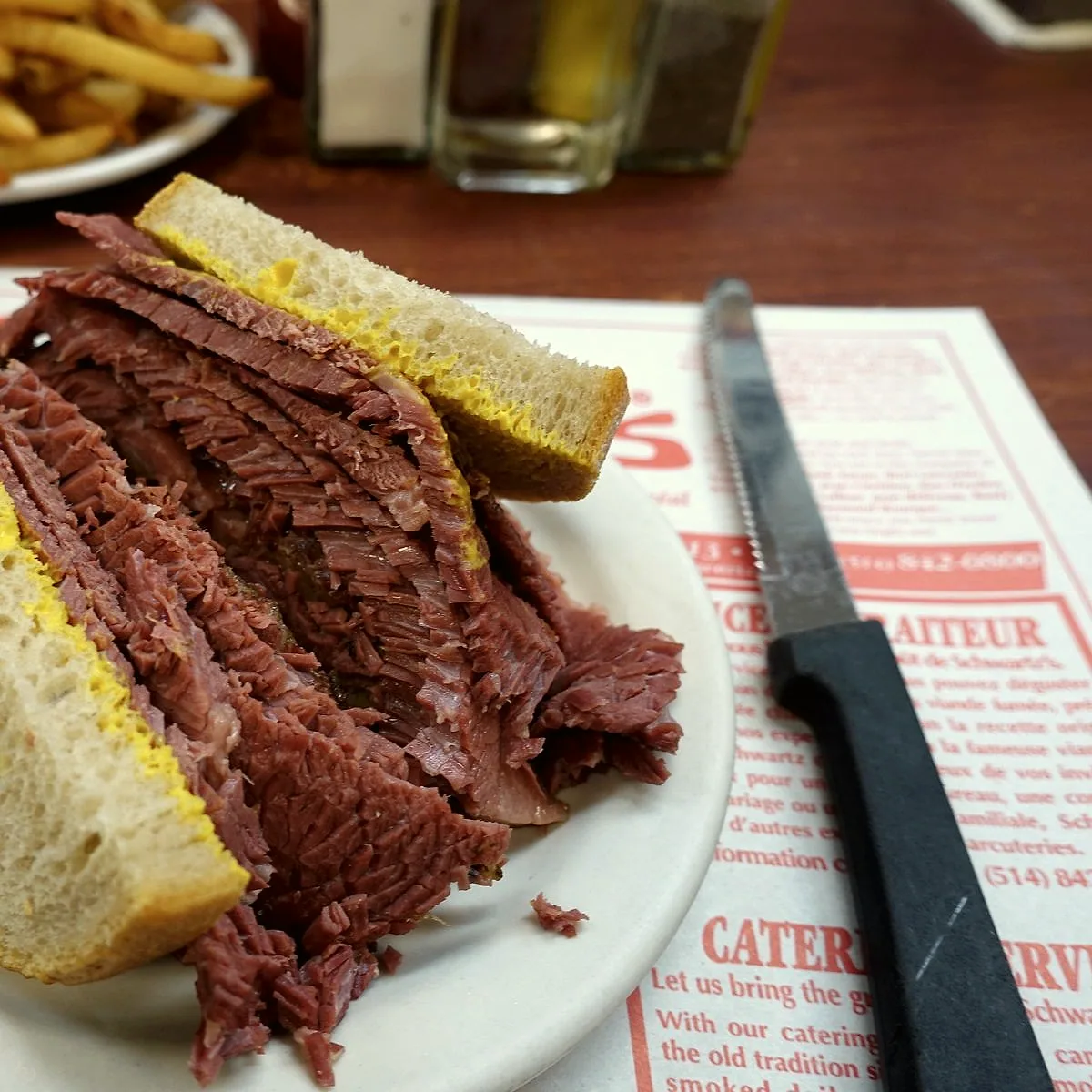
Montreal Smoked Meat
A whole beef brisket dry-cured for a week, coated in a coarse pepper and coriander crust, cold-smoked, then steamed until fork-tender.
Not the same asPastrami (The closest relative, also cured, spiced and smoked beef, but pastrami is usually cut from the navel and cured with more sugar, while Montreal smoked meat is whole brisket with a more savoury cure.)
.jpg)
CC BY 2.0. Cropped and colour-adjusted for this site.
Method
Combine the 60 g fine sea salt, the 30 g light brown sugar, the 3 garlic cloves (15 g), the 10 bay leaves (2 g), the 10 g ground black pepper and the 8 g ground coriander, and rub the mixture all over the 2 kg beef brisket.
Seal the brisket in a bag or covered container and refrigerate for 168h, turning it over once a day.
A week of dry curing gives the salt and sugar time to penetrate the full thickness of a whole brisket, not just its surface; a shorter cure seasons the outside and leaves the centre bland.
Rinse the cure off the brisket under cold water and pat completely dry.
Press the 15 g ground black pepper, the 12 g ground coriander, the 10 g mustard seeds and the 10 g smoked paprika firmly over the whole surface of the brisket.
Cold-smoke the brisket over hardwood at a low temperature of around 100 °C for 6h, until deeply coloured and smoky throughout.
Steam the brisket over simmering water for 3h, until fully tender and easily pierced with a fork.
Common pitfallSkipping the steam and eating the brisket straight from the smoker leaves it too firm to slice cleanly and too salty to eat in quantity. The steam is what finishes the cooking and drives out enough salt to make it a sandwich meat rather than a cured joint.
Rest for 15m before slicing.
Slice thinly against the grain and pile onto the 160 g rye bread with the 40 g yellow mustard.
Montreal smoked meat descends from a Romanian Jewish curing and smoking tradition, carried to the city by immigrant families who settled, from the close of the nineteenth century onward, along St Lawrence Street (known locally as The Main) after fleeing rising antisemitism in Eastern Europe [1]. The city's most famous version of the dish belongs to the delicatessen opened by Reuben Schwartz, a Romanian immigrant, on The Main on the thirty-first of December 1928 [1].
Schwartz's is rarely credited as the first, however, and the question of who actually was is genuinely unsettled. Benjamin Kravitz, a Lithuanian immigrant, opened the rival deli Bens around 1908 after customer demand for his mother's smoked meat recipe outgrew the fruit and candy store he had started with, and even a museum retrospective of Bens is careful to say he was "certainly one of the most successful" at the dish rather than its inventor, explicitly calling him "not the first" [3][2]. Several delis operated in the same few blocks through the twentieth century (Schwartz's and Bens chief among a list that also included Reuben's, Dunn's, Lester's, Snowdon Deli and Main), and rival claims to the superior sandwich remain a live argument among Montrealers rather than a settled matter of record [3][2].
What is better documented is the method that has kept Schwartz's version distinct: a whole brisket cured for ten to fourteen days, then hung and smoked in a brick smokehouse for at least a further day before being hand-sliced without mechanical tenderising or added preservatives [1]. Bens itself, once a business large enough to serve eight thousand customers a day at its 1960s peak, closed for good in December 2006, after a summer strike over pay and conditions and years of pressure from rising downtown rents and chain-restaurant competition [3], a reminder that a deli's fame is no guarantee of its survival, whatever claim it made to having started the tradition in the first place.
Sources
- Smoke House, Schwartz's, 1928, Quebec Anglophone Heritage NetworkOn Eastern European Jewish settlement along Montreal's Main, Reuben Schwartz's 1928 delicatessen, and the ten-to-fourteen-day cure and smokehouse method still used.
- Schwartz's, WikipediaOn the disputed claim between Bens and the earlier British-American Delicatessen Store, and on rival delis abandoning in-house curing in favour of bought-in meat.
- Bens: The Legendary Deli, McCord Stewart MuseumOn Benjamin Kravitz's 1908 founding of Bens, the museum's own acknowledgement that he was "not the first" to serve smoked meat in Montreal, the list of competing delis (Schwartz's, Reuben's, Dunn's, Lester's, Snowdon, Main, Ben Ash), and Bens's 2006 closure.