Caribbean · Main Course
Lechón Asado
Bone-in pork shoulder marinated overnight in mojo (sour orange, garlic, oregano and cumin) then roasted slow until the meat pulls apart and the skin cracks.
Not the same asPernil (Puerto Rico's roast pork shoulder, seasoned with a drier garlic-and-oregano adobo pressed into deep cuts in the meat rather than a wet, sour-orange-heavy mojo the pork is bathed and basted in throughout.)
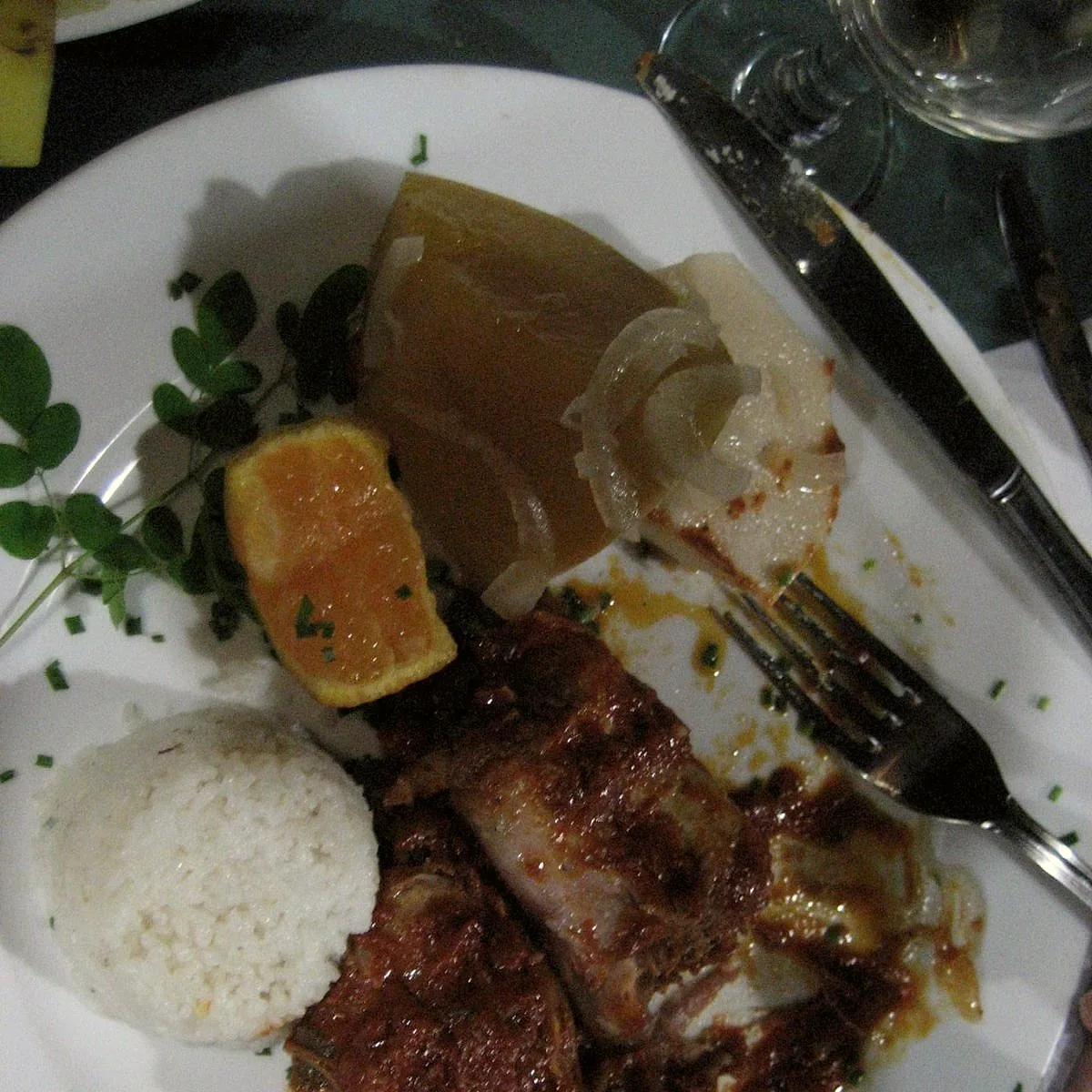
.jpg)
CC BY-SA 2.0. Cropped and colour-adjusted for this site.
Method
Blend the 250 ml sour orange, 30 ml fresh lime juice, 8 garlic cloves (40 g), 4 g oregano, 6 g ground cumin, 30 ml extra-virgin olive oil, 15 g fine sea salt and 3 g ground black pepper into the mojo.
Pierce the 2.2 kg pork shoulder all over and place it in a deep dish with the mojo and the 2 bay leaves (0.4 g), turning to coat completely. Cover and refrigerate for 18h, turning occasionally.
Common pitfallA short marinade only seasons the surface; the sour orange needs the full overnight soak to work all the way into a cut this size, which is what gives the meat its flavour through to the centre once carved.
Scatter the 100 g white onion in a roasting tray, set the pork on top skin-side up with its marinade poured around it, and roast at 150 °C for 4h, basting occasionally, until the meat is fully tender.
Raise the oven to 220 °C and roast for a further 25m, until the skin is deeply browned and crackling.
Roasting at a low temperature until the meat is fully tender, then finishing at a high heat only at the very end, renders and crisps the skin without drying out meat that is already cooked through.
Rest the pork loosely covered for 20m before carving or pulling it apart.
Lechón asado's marinade travelled further than the pig did. Mojo takes its name from the Portuguese word for sauce, carried to the Canary Islands by settlers from Madeira, and it was Canarian emigration (heavy to Cuba and the wider Spanish Caribbean over the colonial and early modern periods) that brought the sauce across the Atlantic, where it took on sour orange in place of the citrus and peppers used at home [1]. Pigs themselves were a Spanish import to an island that had none, introduced by colonisers along with the farming practices to raise them, and pork roasted whole became, over generations, the centrepiece of the Cuban Christmas table [2].
Cooking a lechón was, and largely still is, a ritual rather than a task handed to one cook. Preparation traditionally began the night before Nochebuena, when the pork was rubbed and re-rubbed with mojo until the sour orange, garlic, oregano and cumin had worked into every fold of the meat, before the whole pig or a large cut of it went onto the fire the next morning [2]. In Cuba that fire was traditionally a backyard pit; among the Cuban diaspora in the United States, the same slow roast is now as often done in La Caja China, a wooden charcoal roasting box that has become almost as much a fixture of the holiday as the pork itself.
The tradition has not run in an unbroken line. Cuba's government eliminated official Christmas festivities in 1969, and it was not until Pope John Paul II's 1997 visit to the island that December the twenty-fifth was restored as a non-working holiday [2], through which Nochebuena itself, and the lechón at its centre, continued to be marked in Cuban homes regardless of its official status.
Sources
- The History & Origins Of Canary Islands Mojo Sauce, Gran Canaria InfoTraces mojo's name to the Portuguese word for sauce and its spread from the Canary Islands to Cuba, Puerto Rico and other Spanish Caribbean islands.
- Celebration of Christmas Eve (Nochebuena) in Cuba, The Cuban HistoryDescribes Spanish colonial introduction of pig farming, the ritual of preparing and repeatedly rubbing the pork with mojo, and the 1969–1997 suspension and later restoration of official Christmas observance in Cuba.