Korean · Main Course
Mandu
A Korean dumpling of pork, tofu and garlic chives in a wheat wrapper, steamed or fried depending on the meal.
Not the same asKimchi mandu (A variant filled with fermented kimchi alongside the pork and tofu, giving a sour, spicy filling quite different from the plain version described here.)Jiaozi (The Chinese dumpling that mandu descends from. It has a thinner cold-water wrapper and a pork-and-cabbage filling with no tofu or garlic chives.)
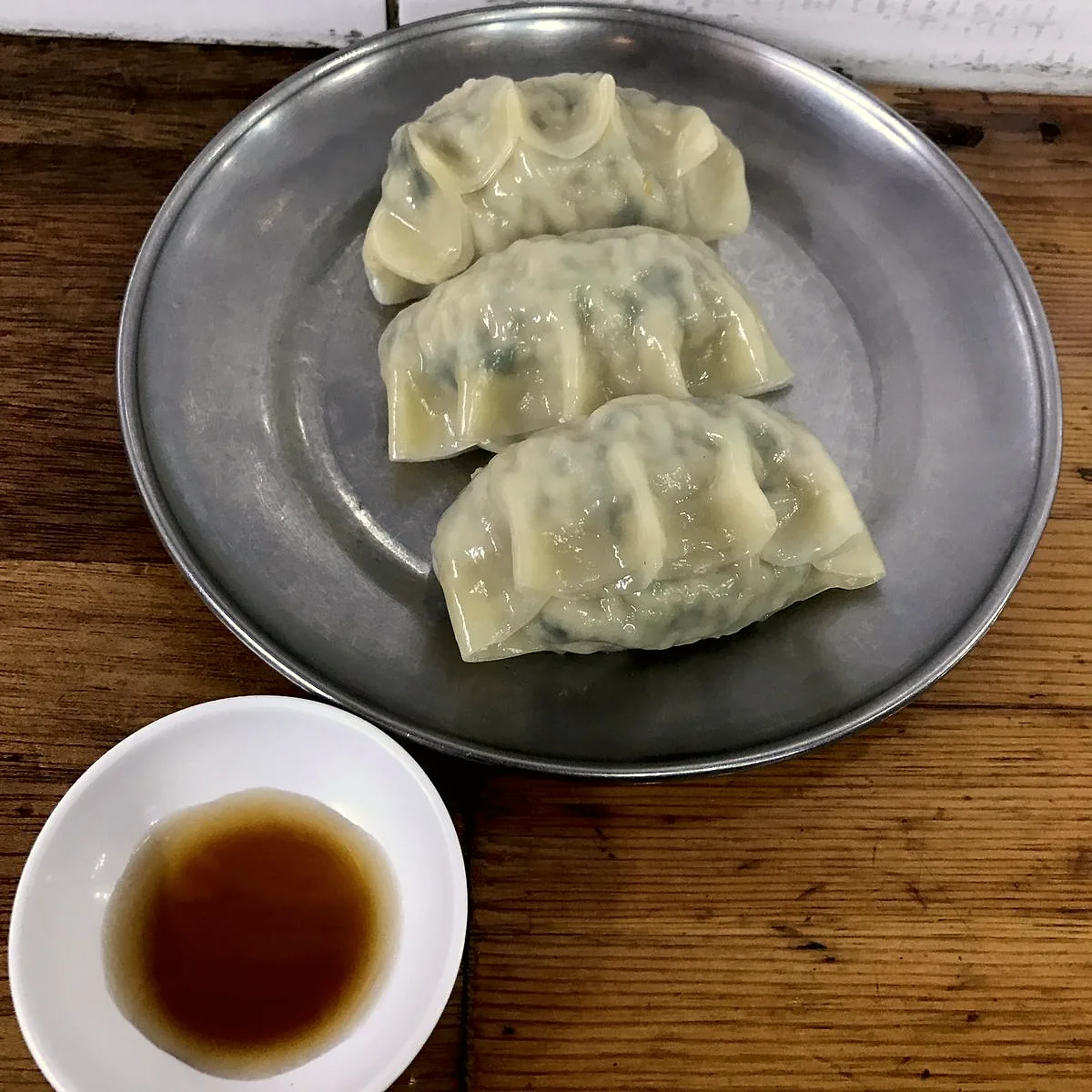

CC BY 2.0. Cropped and colour-adjusted for this site.
The same dish, adapted. Every quantity, time and figure below changes with the version.
Method
Combine the 300 g plain flour, 160 ml water and 3 g fine sea salt in a bowl and bring together into a shaggy dough, then turn it out and knead for 10m until smooth and firm.
Cover the dough and rest it for 30m at room temperature, until it has relaxed and no longer springs back when pressed.
Meanwhile, combine the 280 g pork mince, 180 g firm tofu, 200 g napa cabbage, 40 g garlic chives, 2 garlic cloves (10 g), 8 g fresh ginger, 12 ml toasted sesame oil, 15 ml light soy sauce, 1 g ground white pepper and 4 g fine sea salt in a bowl and mix by hand until evenly combined and the mixture holds together.
Pressing the tofu before it goes in matters more than it looks: a wet curd loosens the whole filling and the dumplings split at the seam as the water is driven off by the steam.
Roll the rested dough into a log and pinch off small, even pieces, keeping the rest covered. Roll each piece with the 20 g plain flour underneath into a thin round about 8 cm across, thicker at the centre than at the rim. Spoon filling into the middle of each round and pleat the edge closed into a sealed half-moon, standing it upright on its base.
Line a steamer basket so the dumplings cannot touch the metal or bamboo directly, and set them in with space between each. Steam over rapidly boiling water for 12m, until the wrappers turn glossy and slightly translucent and the filling is cooked through.
Common pitfallDumplings set straight on the metal or bamboo of a steamer stick fast and tear when lifted. A base of cabbage leaf, baking paper or an oiled plate keeps them free.
Method
Combine the 300 g plain flour, 160 ml water and 3 g fine sea salt in a bowl and bring together into a shaggy dough, then turn it out and knead for 10m until smooth and firm.
Cover the dough and rest it for 30m at room temperature, until it has relaxed and no longer springs back when pressed.
Meanwhile, combine the 280 g pork mince, 180 g firm tofu, 200 g napa cabbage, 40 g garlic chives, 2 garlic cloves (10 g), 8 g fresh ginger, 12 ml toasted sesame oil, 15 ml light soy sauce, 1 g ground white pepper and 4 g fine sea salt in a bowl and mix by hand until evenly combined and the mixture holds together.
Roll the rested dough into a log and pinch off small, even pieces, keeping the rest covered. Roll each piece with the 20 g plain flour underneath into a thin round about 8 cm across, thicker at the centre than at the rim. Spoon filling into the middle of each round and pleat the edge closed into a sealed half-moon, standing it upright on its base.
Heat the 15 ml peanut oil in a wide, lidded pan over a high heat. Stand the dumplings in, base down, packed close together, and sear for 3m until the bottoms are golden.
Common pitfallA cold pan or a low flame lets the wrappers sit in oil instead of searing, so the base turns pale and greasy rather than crisp. The pan needs to be properly hot before the dumplings go in.
Pour in the 60 ml water, cover at once and let the dumplings steam-fry for 6m, until the water has all but disappeared and the wrappers have turned from opaque to glossy.
Uncover and cook for a further 2m, letting the last of the water evaporate and the base recrisp. Loosen with a spatula and turn out base-up.
The earliest documented mention of a dumpling in Korea sits in the Goryeosa, the official history of the Goryeo dynasty, in an anecdote about a naturalised Khitan man who mixed meat with other ingredients to make dumplings for his sick father, recorded under the reign of King Myeongjong in the twelfth century [1]. The dish most people mean by mandu today, however, is usually traced to a later and more specific moment: the Mongol domination of the Goryeo court in the thirteenth and fourteenth centuries, when Mongol influence and intermarriage with Korean royalty are credited with relaxing Buddhism's restriction on eating meat and bringing meat-filled dumplings into everyday cooking [1][2].
That account is not the only one on offer. Dumplings and noodles built on wheat dough are argued to trace back much further, to Mesopotamia, spreading east over centuries along the Silk Road and leaving related dumplings (mandu's own cousins include Turkish mantı and Central Asian manti) across a wide belt of Asia well before the Mongol period specifically [1]. A Goryeo-era folk song called Ssanghwajeom, "the dumpling shop," which describes a stall run by a foreigner thought to be Central Asian, is read by some as evidence that dumpling vendors were already established in Korea independent of the Mongol court connection [1]. Which account explains mandu's arrival is not settled.
By the Joseon dynasty, mandu had spread out into regional and seasonal forms rather than staying a single dish: kimchi mandu work fermented cabbage into the pork-and-tofu filling, wang mandu are enlarged into a bun-like snack favoured in the north, and mandu-guk, dumplings simmered in a clear beef broth, became the customary dish for the Lunar New Year, its dumplings traditionally shaped to recall old brass coins [2].
Sources
- Mandu (food), WikipediaSets out the Goryeosa court record, the Yuan-dynasty introduction theory, the competing Silk Road hypothesis, and the Ssanghwajeom folk song.
- Korean Dumplings (Mandu), Taste Korean FoodCovers the Goryeo-to-Joseon timeline and the regional filling variants, including kimchi mandu and mandu-guk.