American · Main Course
Jambalaya
Chicken, andouille sausage and shrimp cooked with rice in a tomato-based trinity sauce until the rice is tender and red.
Not the same asGumbo (Gumbo is a soup-like stew, thickened with roux or okra and ladled over rice cooked separately; jambalaya cooks its rice inside the same pot as everything else, with no roux at all.)
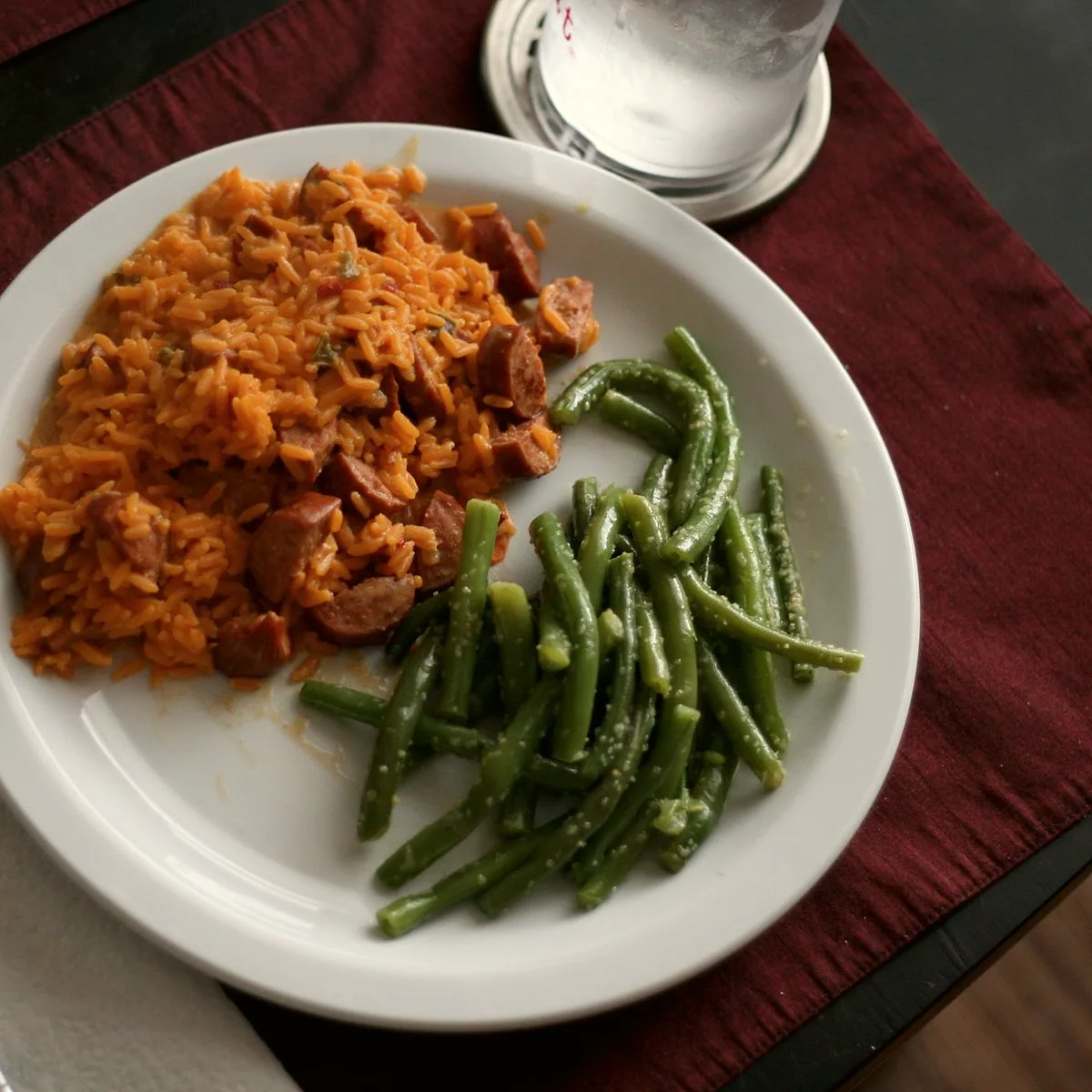

CC BY-SA 2.0. Cropped and colour-adjusted for this site.
The same dish, adapted. Every quantity, time and figure below changes with the version.
Method
Dice the 150 g white onion, 100 g celery and 100 g green pepper, mince the 3 garlic cloves (15 g), slice the 250 g andouille, and cut the 400 g chicken thigh into pieces.
Heat the 30 ml peanut oil in a large, heavy pot over a medium-high heat and brown the sausage and chicken for 10m. Lift both out and set aside.
Add the onion, celery and green pepper to the pot and cook for 8m, stirring often, until softened, adding the garlic in the last minute.
Stir in the 400 g tinned tomatoes, 300 g rice, 2 bay leaves (0.4 g), 3 g sweet paprika, 3 g ground cayenne pepper, 2 g ground black pepper and 5 g fine sea salt, and return the sausage and chicken to the pot.
Pour in the 600 ml water, bring to the boil, then cover and reduce to the lowest heat. Cook, undisturbed, for 20m.
Cooking the rice directly in the pot, rather than separately as gumbo does, is what lets it absorb the tomato and stock liquid and take on the dish's characteristic red colour and flavour.
Common pitfallLifting the lid to stir disturbs the steam the rice needs to cook evenly and risks scorching the layer against the bottom of the pot, so the pot is left undisturbed until the liquid should be fully absorbed.
Nestle the 200 g shrimp into the rice, cover again, and cook for 5m, until the shrimp are pink and the rice is tender. Discard the bay leaves before serving.
Method
Dice the 150 g white onion, 100 g celery and 100 g green pepper, mince the 3 garlic cloves (15 g), slice the 250 g andouille, and dice the 150 g tasso and 400 g chicken thigh.
Heat the 20 ml peanut oil in a large, heavy pot over a medium-high heat and brown the sausage, tasso and chicken hard for 15m, until a deep brown fond builds up on the bottom of the pot. Lift the meats out and set aside.
With no tomato in the pot, the dish's colour and most of its savour come entirely from how hard the meat is browned and the dark fond it leaves behind, which the trinity is then cooked in.
Add the onion, celery and green pepper to the pot and cook for 8m, scraping up the fond as they release their liquid, and adding the garlic in the last minute.
Stir in the 300 g rice, 2 bay leaves (0.4 g), 3 g ground cayenne pepper, 3 g ground black pepper and 5 g fine sea salt, and return the meats to the pot.
Pour in the 750 ml water, bring to the boil, then cover and reduce to the lowest heat. Cook, undisturbed, for 25m, until the rice is tender and the liquid is absorbed. Discard the bay leaves before serving.
Nobody agrees on where the word "jambalaya" comes from. The most repeated theory joins jambon, French for ham, to ya or yaya, said to mean grain in some West African languages; a second derives it instead from the Spanish jamón fused with paella; a third traces it to jambalaia, an existing word in the Provençal dialect of French for a mixed rice dish, with one culinary historian proposing a simpler link to the English "jumble" instead [1]. The dish itself is dated more confidently than its name: the earliest known recipe appears in an Alabama cookbook of 1878, and the first Louisiana version is printed in La Cuisine Creole in 1885 [1].
The dish also is not one thing but two, and the difference is not decorative. Creole jambalaya, the "red" version associated with New Orleans, builds its color and sweetness from tomatoes, cooked into the trinity of onion, celery and green pepper before the rice goes in, often alongside seafood [2]. Cajun jambalaya, the "brown" version from the rural bayou parishes settled by Acadian exiles, leaves tomatoes out entirely; its color and depth come instead from how hard the meat (usually andouille sausage and tasso ham) is browned, and from the dark fond that browning leaves on the bottom of the pot for the rice to cook in [2]. Both trace part of their method to Spanish paella, adapted in Louisiana to ingredients paella never used, which is one reason no single etymology for the name has ever won out.
Sources
- Jambalaya, 64 ParishesLouisiana Endowment for the Humanities entry weighing the competing etymologies and dating the earliest printed recipes.
- What's The Difference Between Creole And Cajun Jambalaya, Tasting TableSets out the tomato-versus-fond distinction and the separate cultural histories behind Creole and Cajun cooking in Louisiana.