Caribbean · Side
Rice and Peas
Rice and red kidney beans simmered together in coconut milk with garlic, thyme, allspice and a whole scotch bonnet. It is Jamaica's everyday side, and its Sunday dinner staple.
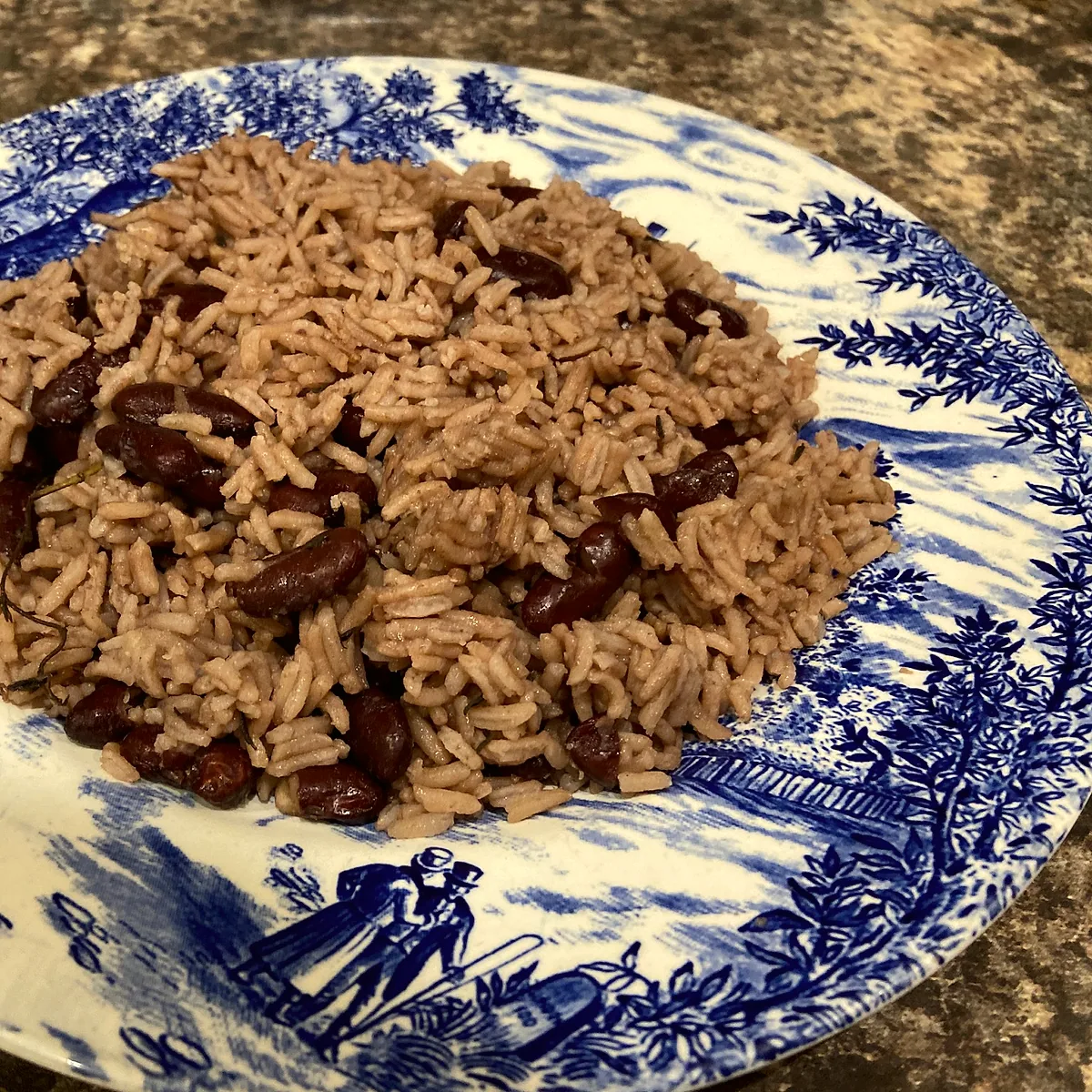

CC BY-SA 4.0. Cropped and colour-adjusted for this site.
Method
Soak the 150 g dried kidney beans in plenty of cold water for 8h, then drain.
Simmer the soaked beans in the 500 ml water for 45m, until tender, topping up with water as needed to keep them covered. Do not drain.
Add the 400 ml coconut milk, 1 ½ garlic cloves (8 g), 1 spring onion (15 g), 2 g fresh thyme, 1 g whole allspice berries, 4 g scotch bonnet, 6 g fine sea salt and 1 g ground black pepper to the beans and bring to a boil. Stir in the 300 g basmati rice, cover, reduce the heat to its lowest setting and cook undisturbed for 20m, until the liquid is absorbed and the rice is tender. Remove the scotch bonnet and spring onion.
Cooking the rice in the beans' own liquid along with the coconut milk, rather than in plain water, is what carries the beans' flavour and colour all the way through the grain.
Common pitfallA punctured or chopped scotch bonnet turns the whole pot fiercely hot rather than gently fragrant; left whole and removed at the end, it seasons without overwhelming.
Take the pot off the heat and leave it covered for 10m before fluffing the rice with a fork.
Rice and peas is Jamaica's version of a pairing repeated, with local variations, across the whole Caribbean: rice cooked together with a legume rather than served beside it. The dish's deepest roots trace to West Africa, where rice cultivation and rice-and-legume cooking were established practices before the transatlantic slave trade forced both the knowledge and the people who held it to the Caribbean. Pigeon peas (locally called gungo peas) travelled the same route and were, by most accounts, the dish's original legume in Jamaica, kept in wide use today alongside kidney beans, which have become the more common everyday choice.
The dish's nickname is the part with the least settled history. Jamaican linguist Frederic G. Cassidy recorded, in 1961, that rice and peas was already known as the "Jamaican coat of arms" [1] [2], a name treated seriously enough by food historians that it has since been the subject of its own academic chapter, though where the phrase itself first arose is not established by either account. What both sources agree on is the dish's status: not a throwaway side but the dish treated as edible shorthand for Jamaica itself.
Rice and peas keeps a strong association with Sunday dinner and with Christmas in Jamaica even as it has also moved onto everyday restaurant menus across the island.
Sources
- Rice and peas, WikipediaCites linguist Frederic G. Cassidy's 1961 documentation of rice and peas as the "Jamaican coat of arms," the role of enslaved and indentured Africans in bringing rice, pigeon peas and cowpeas to the Caribbean, and the Jamaican shift toward kidney beans.
- Jamaica Coat of Arms: Rice and Peas, Berg Publishers (in Rice and Beans: A Unique Dish in a Hundred Places, ed. Wilk and Barbosa)Historian Barry Higman's academic chapter, devoted specifically to the "Jamaica coat of arms" name for rice and peas, confirms the nickname as an established subject of scholarly food history rather than an internet-era invention.