American · Main Course
Gumbo
A dark roux, the trinity of onion, celery and pepper, chicken and smoked andouille simmered into a thick stew and served over rice.
Not the same asJambalaya (Jambalaya cooks its rice inside the pot with the other ingredients; gumbo is a soup-like stew that stays separate from the rice and is ladled over it at the table.)
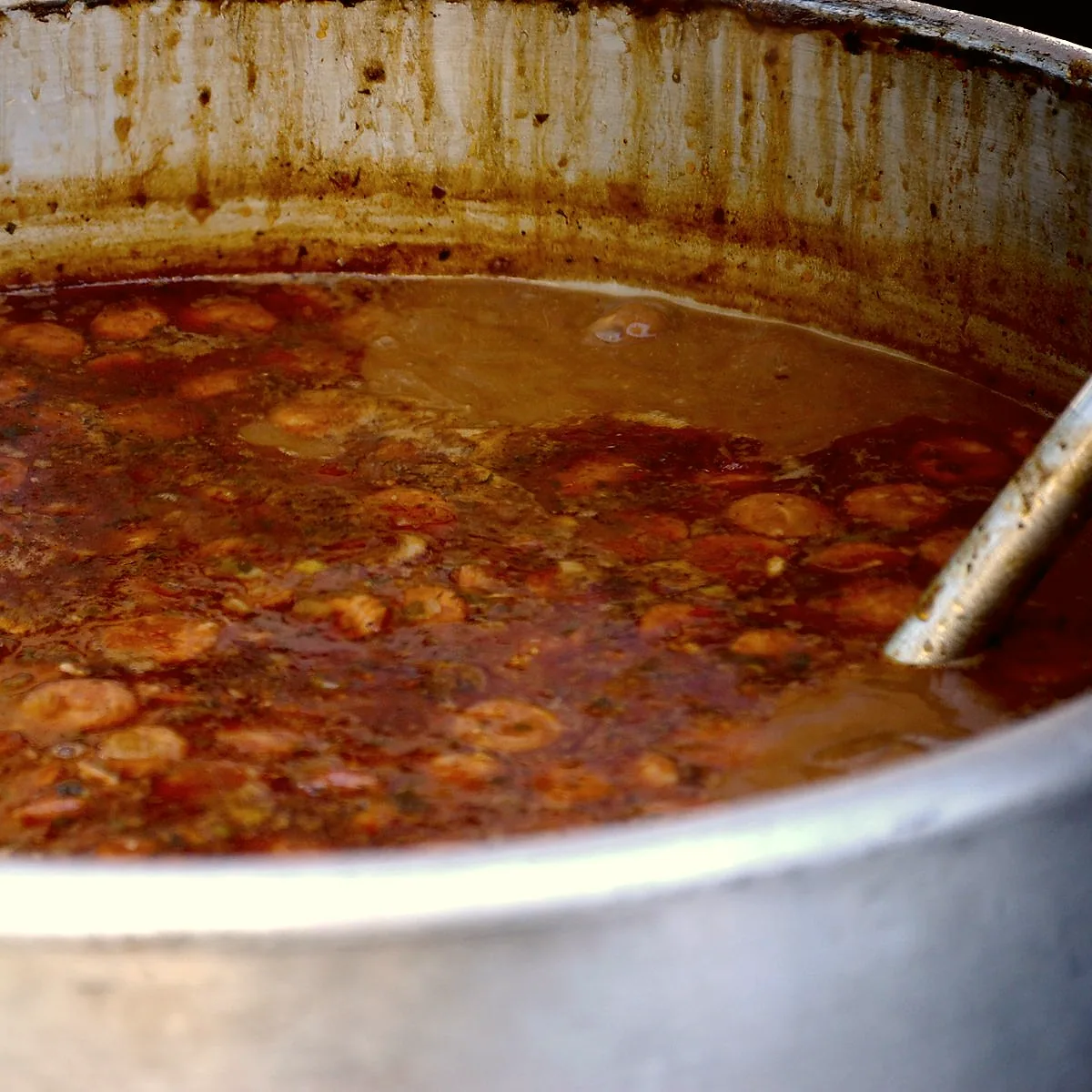

CC BY 2.0. Cropped and colour-adjusted for this site.
The same dish, adapted. Every quantity, time and figure below changes with the version.
Method
Dice the 200 g white onion, 150 g celery and 150 g green pepper, mince the 3 garlic cloves (15 g), and slice the 300 g andouille.
Heat half the 120 ml peanut oil in a large, heavy pot over a medium-high heat and brown the 800 g bone-in, skin-on chicken and sausage for 12m. Lift both out and set aside.
Add the remaining oil to the pot along with the 120 g plain flour and set over a medium-low heat. Cook, stirring constantly, for 40m, until the roux turns a deep, dark mahogany, close to the colour of melted chocolate.
The roux is cooked far past the pale, thickening stage used for a béchamel. Carried to a dark mahogany, it trades most of its thickening power for a deep, toasted flavour that is the backbone of the dish.
Add the onion, celery and green pepper to the roux and cook for 8m, stirring often, until softened, adding the garlic in the last minute.
Whisk in the 2 L water and add the 2 bay leaves (0.4 g). Return the chicken and sausage to the pot, bring to a simmer, and cook, partially covered, for 1h, until the chicken is tender and the roux has folded fully into the liquid.
While the gumbo simmers, combine the 300 g rice and 550 ml water in a covered saucepan, bring to the boil, then reduce to the lowest heat and cook for 20m, until the water is absorbed. Leave covered off the heat until serving.
Take the pot off the heat and discard the bay leaves. Stir in the 3 g ground cayenne pepper, 2 g ground black pepper, 6 g fine sea salt and 3 g filé powder. Ladle over the rice to serve.
Common pitfallFilé powder turns stringy and gluey if it boils, so it is always stirred in after the pot is off the heat rather than simmered with the rest of the gumbo.
Method
Dice the 200 g white onion, 150 g celery and 150 g green pepper, mince the 3 garlic cloves (15 g), and slice the 250 g okra.
Combine the 100 ml peanut oil and 100 g plain flour in a large, heavy pot and set over a medium-low heat. Cook, stirring constantly, for 40m, until the roux turns a deep, dark mahogany, close to the colour of melted chocolate.
Add the onion, celery, green pepper and okra to the roux and cook for 10m, stirring often, until softened, adding the garlic in the last minute.
Whisk in the 2 L water and add the 2 bay leaves (0.4 g). Bring to a simmer and cook, partially covered, for 45m, until the roux has folded fully into the liquid and the okra is tender.
While the gumbo simmers, combine the 300 g rice and 550 ml water in a covered saucepan, bring to the boil, then reduce to the lowest heat and cook for 20m, until the water is absorbed. Leave covered off the heat until serving.
Discard the bay leaves. Bring the gumbo back to a simmer and add the 400 g shrimp and 200 g cooked crab, cooking until the shrimp turn pink. Stir in the 200 g oyster and cook for one more minute, then take off the heat and season with the 3 g ground cayenne pepper, 2 g ground black pepper and 6 g fine sea salt. Ladle over the rice to serve.
Common pitfallOysters turn tough within moments of overcooking, so they go in only in the last minute, off a rolling simmer, just long enough to poach through.
Gumbo draws on at least three culinary traditions at once, and even its name is disputed. The word is most often traced to ki-ngombo or gombo, a Bantu term for okra carried to Louisiana by enslaved people from Central Africa, since early written gumbos were thickened with the vegetable the word itself names [2]. A rival claim holds that the name instead comes from the Choctaw word for filé, kombo, but that word does not appear in Choctaw dictionaries before around 1909, more than a century after "gombo" was already being recorded in Louisiana in the 1760s and 1780s, and Choctaw has no /g/ sound to begin with. The likelier reading is that Choctaw vendors adopted a version of the existing word to market ground sassafras leaves to non-Choctaw customers in New Orleans markets, rather than the word originating with them [2].
What is not in dispute is that Choctaw foodways shaped the dish itself: filé, made from dried and ground sassafras leaves, was their contribution as both a thickener and a seasoning, used as an alternative to okra rather than alongside it [1]. The dark roux that anchors most modern gumbos is a French technique, pushed far past the pale stage a French kitchen would normally stop at [1]. The historian Carl A. Brasseaux places the earliest documented references to gumbo in Louisiana around 1800, including its appearance at a New Orleans gubernatorial reception in 1803 and at an Acadian Coast gathering the following year, with the dish well enough established by 1885 to appear in multiple published Creole cookbooks [1]. The result is a dish that different households have always finished differently: with okra, with filé, or with neither, depending on which of its several ancestries a given cook leaned on.
Sources
- A Short History of Gumbo, Southern Foodways AllianceCites historian Carl A. Brasseaux on the earliest documented gumbo references, around 1800.
- Choctaw Gumbo, 64 ParishesWeighs the Bantu-origin and Choctaw-origin theories for the word "gumbo" against the documentary record, and separately credits the Choctaw contribution of filé.