American · Main Course
Fajitas
Skirt steak marinated in lime and garlic, seared hard and sliced thin against the grain, served sizzling with griddled peppers and onion and warm flour tortillas.
Also known asTacos al carbón · Texas
Not the same asChicken fajitas (A later, widely sold adaptation using chicken breast rather than skirt steak, which is the cut the dish's name and marinade were originally built around.)
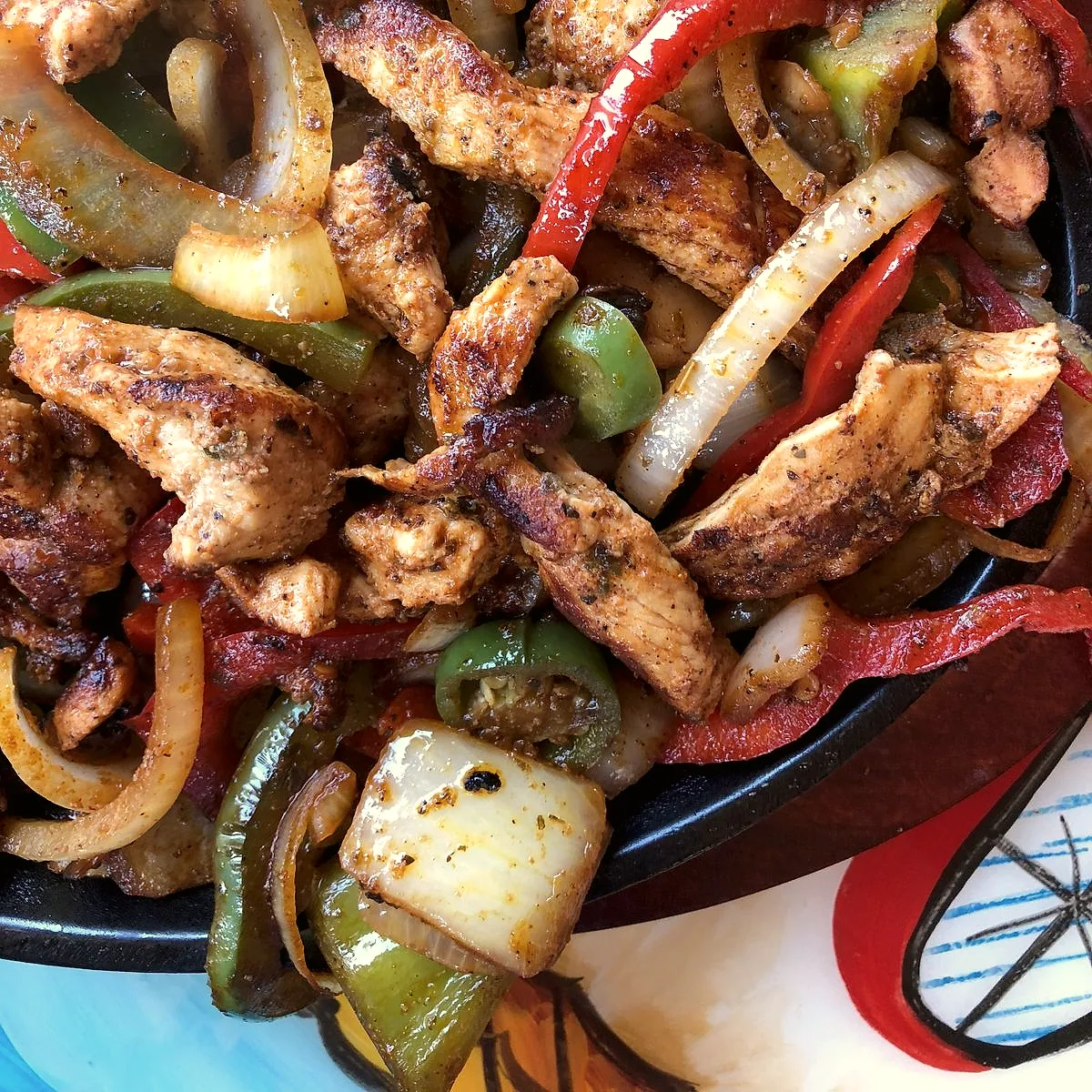

CC BY 4.0. Cropped and colour-adjusted for this site.
Method
Combine the 60 ml fresh lime juice, 2 garlic cloves (10 g), 2 g oregano, 4 g ground cumin, the 20 ml extra-virgin olive oil, the 6 g fine sea salt and the 3 g ground black pepper. Coat the 800 g skirt steak in the mixture and leave it to marinate, covered and refrigerated, for 1h.
Lift the steak from the marinade, pat it dry, and sear it in a very hot, dry pan or on a hot grill for 8m, turning once, until it is well charred outside and still pink within.
Rest the steak on a board for 5m before slicing.
While the steak rests, heat the 25 ml extra-virgin olive oil in the same pan and cook the 200 g white onion, 150 g red pepper and 150 g green pepper with the 4 g fine sea salt for 10m, until softened and lightly charred at the edges.
At the same time, warm the 6 flour tortillas (240 g) in a dry pan or directly over a flame for 5m, until soft and lightly spotted, then wrap them to keep warm.
Slice the steak thinly across the grain and serve it at once alongside the peppers, onion and warm tortillas, for diners to assemble themselves.
Common pitfallSkirt steak has long, visible muscle fibres running the length of the cut. Slicing along them rather than sharply across gives long, stringy pieces instead of tender strips.
Skirt steak is a long, thin, hard-working muscle from the cow's plate, and for most of American butchery it was treated as scrap. On the cattle ranches of South and West Texas in the 1930s, it was among the cuts given to Mexican vaqueros as part of their pay when an animal was slaughtered, alongside the hide and less desirable trimmings [1]. Cooked whole over an open fire and sliced into strips (fajitas, a diminutive of the Spanish faja, a belt or sash), it became a standard ranch-hand meal long before it was a restaurant dish, and long before the word itself reached English print, which it did no earlier than 1968 [3].
Its move into commerce is unusually well pinned down for a dish with such humble roots. In September 1969, Austin meat market manager Sonny Falcón ran what is credited as the first commercial fajita stand, at a Diez y Seis celebration in Kyle, Texas, and spent the 1970s taking it to rodeos and fairs around the state [1]. The same year, Otilia Garza took over the Round-Up Restaurant in Pharr and began giving fajitas away to favored customers before putting them on the menu; she is generally credited with the sizzling cast-iron platter, an idea she said she borrowed after being served queso flameado on hot metal in Acapulco [2].
The dish reached a national audience through Houston in the following decade, when restaurateur Ninfa Rodriguez Laurenzo built her restaurant's reputation around a version she marketed as tacos al carbón [1]. Demand grew faster than the supply of skirt steak could easily meet it, and by the mid-1980s many restaurants were substituting chicken, shrimp and other fillings under the same name. It was a shift the dish's own early historians have called ironic, since it was the cut of meat, not the marinade or the sizzle, that fajitas were originally built around [1].
Sources
- Fajita History, The Austin ChronicleCovers the ranch origins, Sonny Falcón's 1969 concession stand, and the dish's spread into restaurants.
- Low Steaks, Texas MonthlyBy John Morthland; covers Otilia Garza's Round-Up Restaurant, her sizzling-platter presentation borrowed from queso flameado served on hot metal in Acapulco, and her introduction of the condiment-laden botana plate.
- Fajita (etymology), EtymonlineDates the word's entry into English print to 1968, from Mexican Spanish "fajita," a diminutive of "faja."