American · Main Course
Chili con Carne
A thick, dark stew of beef in a sauce built from toasted, soaked dried chillies rather than a spoonful of powder, made in the Texas style with no beans and no tomato.
Also known asBowl of red · Texas
Not the same asCincinnati chili (A cinnamon-and-cocoa-spiced meat sauce ladled over spaghetti and sold by the "way". It is unrelated to Texas chili beyond the shared name and chilli seasoning.)
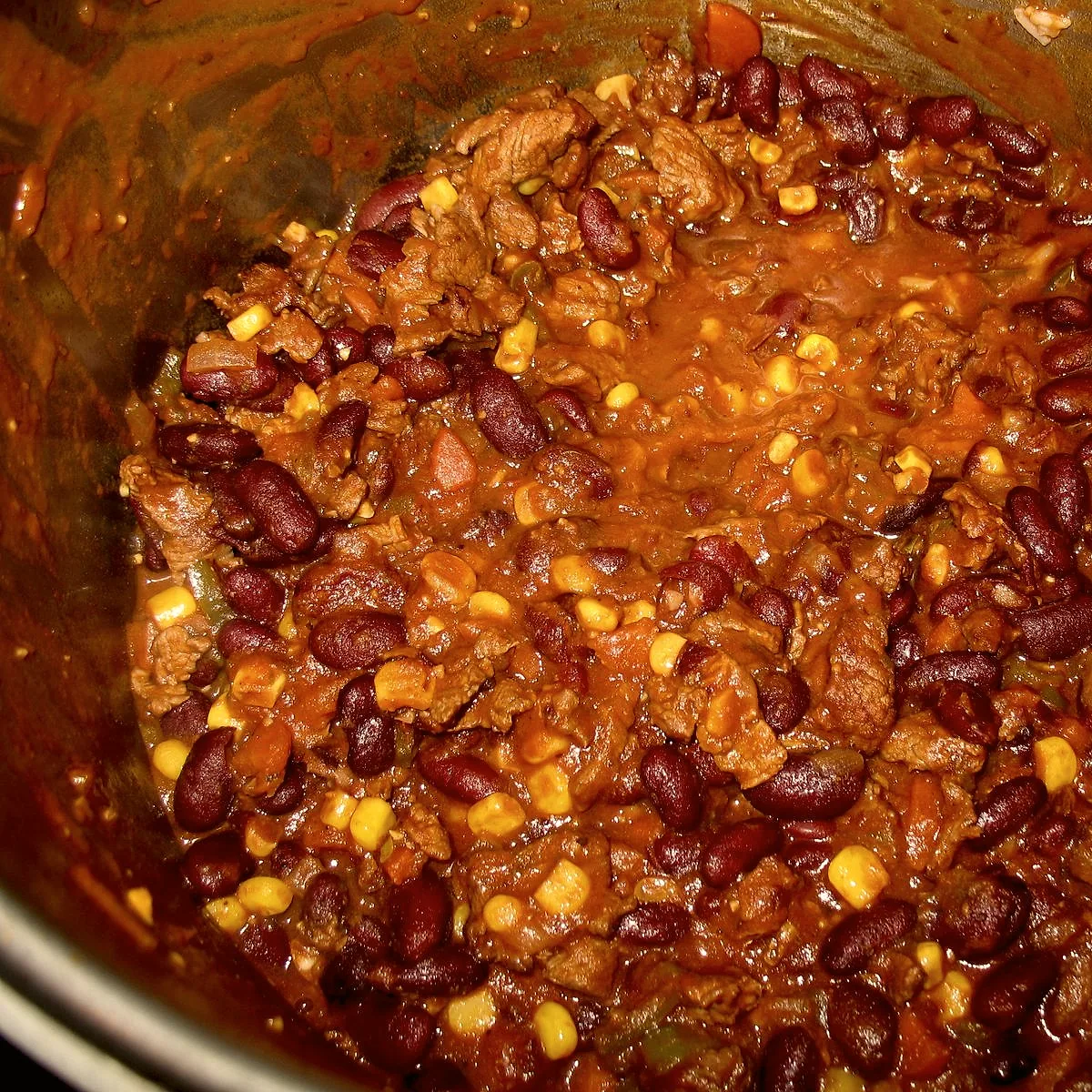

CC0. Cropped and colour-adjusted for this site.
The same dish, adapted. Every quantity, time and figure below changes with the version.
Method
Toast the 40 g ancho chillies and 5 dried guajillo chillies (25 g) in a dry pan over a medium heat for 5m, pressing them flat and turning often, until they are fragrant and slightly blistered.
Common pitfallToasting the chillies past a shade too dark turns their bitterness sharp and irreversible. They come out of the pan as soon as they smell fragrant and have blistered slightly, well short of scorching.
Cover the toasted chillies with the 500 ml water, brought to a boil, and leave them to soften for 20m.
Blend the soaked chillies with their soaking liquid, the 3 garlic cloves (15 g) and the 6 g ground cumin into a smooth, thick paste.
Toasting the dried chillies before they soak wakes up oils that plain rehydration leaves dormant, and blending them into a paste rather than adding chilli powder is what gives the stew its body without any flour or masa.
Heat the 30 ml extra-virgin olive oil in a heavy pot and brown the 1.2 kg beef mince hard over a high heat, breaking it into small pieces, for 15m. Add the 200 g yellow onion and cook until it has softened.
Stir in the chilli paste, the 15 g beef bouillon powder, the 350 ml beer and the 8 g fine sea salt, bring to a boil, then reduce to a bare simmer and cook uncovered for 2h 30m, stirring occasionally, until the fat has separated to the surface and the sauce has thickened enough to coat the back of a spoon.
Method
Heat the 20 ml extra-virgin olive oil in a heavy pot and brown the 800 g beef mince over a high heat, breaking it into small pieces, for 10m.
Add the 200 g yellow onion and 2 garlic cloves (10 g) and cook for 8m, until the onion has softened and turned translucent.
Stir in the 20 g ancho chillies, 6 g ground cumin and 10 g sweet paprika and cook for 3m, until the spices smell toasted.
Add the 200 g dried kidney beans, 400 g tinned tomatoes, 10 g beef bouillon powder, 500 ml water and 6 g fine sea salt. Bring to a full rolling boil for a few minutes, then reduce to a simmer and cook uncovered for 2h 30m, stirring occasionally and topping up with water if it gets too thick, until the beans are fully tender.
Common pitfallDried kidney beans carry a natural toxin that only a full, sustained boil destroys. The pot is brought fully to the boil before it is dropped to a simmer, and never held at a gentle heat throughout, so the beans pass safely through a hard boil early on.
Chili con carne's earliest history is murky (dried chillies and stewed meat are old enough in Mexican cooking that no single point of invention holds up), but its rise to a national dish is unusually well documented, and it runs through one place: the plazas of San Antonio. From the 1860s until the early 1940s, women remembered as the "Chili Queens" ran food stands there after dark, selling chili con carne, tamales and enchiladas to a crowd that included both locals and travelers drawn by the spectacle [1]. Visitors as well known as the writer Stephen Crane described the scene, and Military Plaza, Alamo Plaza and later Haymarket Plaza and Milam Park all hosted stands in turn as the city's markets moved [1]. The stands were shut down repeatedly by the city's health department over the decades and closed for good in the early 1940s [1].
The dish had already left San Antonio by then. A chili stand at the 1893 World's Columbian Exposition in Chicago is credited with giving many Americans outside Texas their first taste of it, well before the Chili Queens' stands closed [2]. Chili con carne was named the official state dish of Texas by the state legislature in 1977 [2].
Whether chili should contain beans is its own long-running argument rather than a historical question with an answer: the Texas competition body the Chili Appreciation Society International forbids beans in its contests outright (its own rules bar "beans, macaroni, rice, hominy, or other similar ingredients" from judged chili), and the no-bean, no-tomato version made here follows that competition standard rather than the beans-and-tomato chili more commonly cooked at home across the rest of the country [3].
Sources
- Popular Chili Queens Graced San Antonio Plazas, Journal of San Antonio (University of the Incarnate Word)Details the plazas the Chili Queens worked, notable visitors, and the stands' closure in the early 1940s.
- Texas Chili, UTSA Institute of Texan CulturesCovers the San Antonio chili stand at the 1893 World's Columbian Exposition in Chicago and chili's 1977 designation as the official Texas state dish.
- Official CASI Rules, Chili Appreciation Society International, Inc.CASI's own competition rules, stating that "beans, macaroni, rice, hominy, or other similar ingredients are not permitted" in judged chili.