Chinese · Starter
Char Siu Bao
A soft, white steamed bun leavened with both yeast and baking powder, split open at the top and filled with diced char siu in a sticky, savoury-sweet sauce.
Also known asCha siu baoChar siu bau · Hong Kong
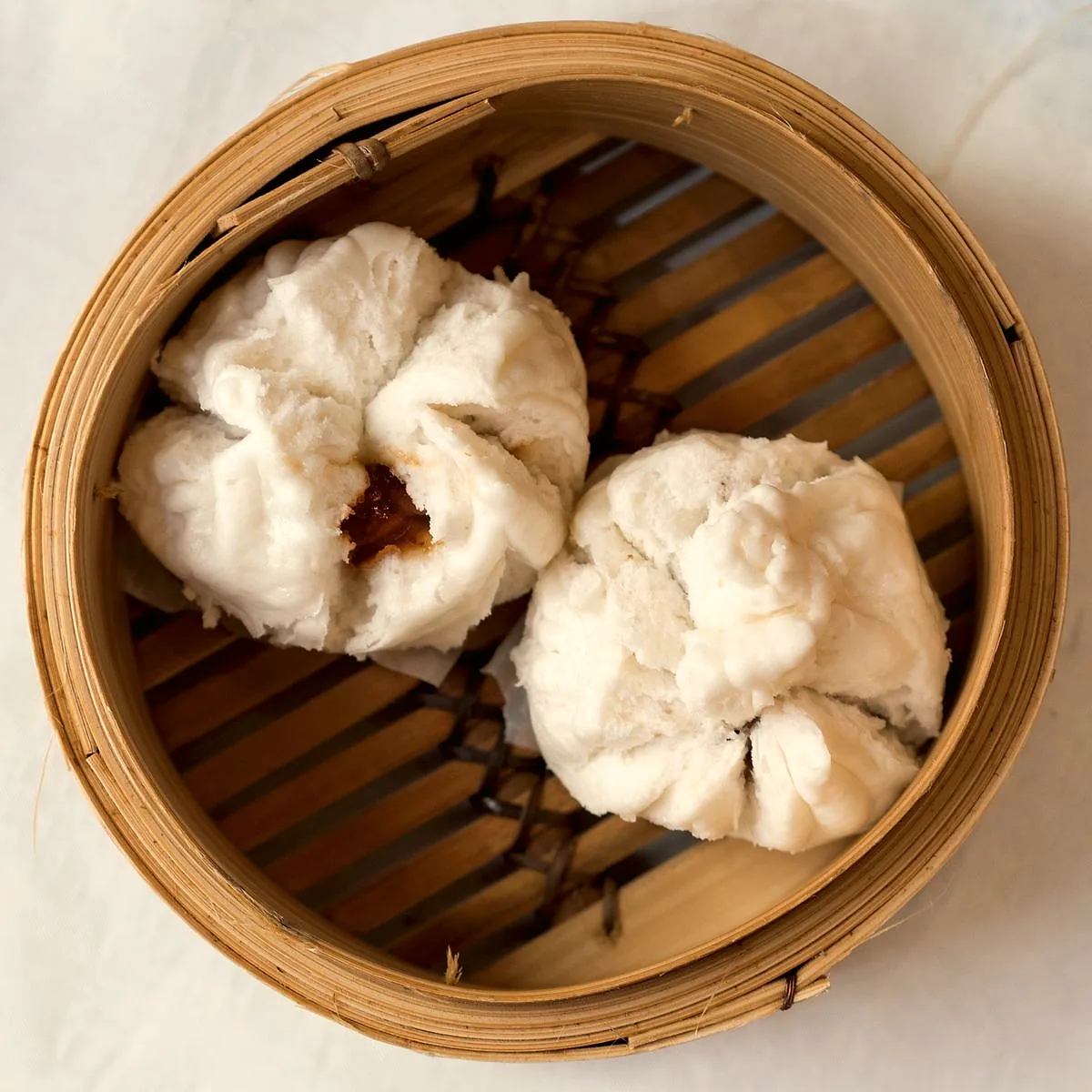

CC BY-SA 3.0. Cropped and colour-adjusted for this site.
The same dish, adapted. Every quantity, time and figure below changes with the version.
Method
Combine the 20 g hoisin sauce, 15 ml light soy sauce, 15 ml Shaoxing wine, 15 g caster sugar, 1 ½ garlic cloves (8 g) and 2 g five-spice powder in a bowl and turn the 400 g pork shoulder through it.
Cover and marinate in the refrigerator for 2h.
Stir the 6 g dried yeast into the 250 ml water and set aside for 10m, until foamy.
Combine the 480 g plain flour, 55 g caster sugar and 6 g baking powder in a large bowl. Pour in the yeast mixture and the 15 ml vegetable oil and bring together into a shaggy dough.
Turn the dough out onto the 20 g plain flour and knead for 10m, until smooth, elastic and no longer tacky.
Return the dough to the bowl, cover and leave to prove somewhere warm for 1h, until roughly doubled in size.
Meanwhile, spread the marinated pork on a lined tray and roast at 200 °C for 20m, turning once, until cooked through and lightly charred at the edges. Once cool enough to handle, dice into small pieces.
Whisk the 15 g cornflour into the 80 ml water until smooth, then combine in a pan with the 10 g hoisin sauce, 10 ml light soy sauce and 20 g oyster sauce. Bring to a simmer, stirring, until thickened and glossy. Off the heat, stir through the diced pork and the 10 ml toasted sesame oil, then leave to cool.
Knock the dough back and roll it into a log, then divide it into even pieces. Roll each piece into a round, thicker at the centre than at the rim, spoon filling into the middle, and gather the edge up around it, pleating loosely and twisting to leave a small opening at the crown rather than sealing it flat. Set each bun on a small square of baking paper.
A looser pleat left slightly open at the top, rather than sealed as tightly as a baozi, is deliberate; the crown is meant to crack open as the bun rises in the steamer, which is how a char siu bao is recognised at a glance.
Cover the shaped buns loosely and leave to prove for a further 20m, until visibly puffed.
Arrange the buns in a steamer basket with space between each to allow for expansion, and steam over gently simmering water for 12m, until well risen and the crown has cracked open. Turn off the heat and let the steam settle briefly before lifting the lid.
Common pitfallLifting the lid before the steamer has fully cooled lets a rush of cold air hit the buns, and they collapse and wrinkle on one side. Turn off the heat and let the steam settle for a minute before uncovering.
Method
Combine the 20 g hoisin sauce, 15 ml light soy sauce, 15 ml Shaoxing wine, 15 g caster sugar, 1 ½ garlic cloves (8 g) and 2 g five-spice powder in a bowl and turn the 400 g pork shoulder through it.
Cover and marinate in the refrigerator for 2h.
Stir the 6 g dried yeast into the 200 ml milk and set aside for 10m, until foamy.
Combine the 480 g bread flour, 70 g caster sugar and 4 g fine sea salt in a large bowl. Pour in the milk mixture and the 1 egg (50 g) and bring together into a shaggy dough.
Turn the dough out onto the 20 g bread flour and knead for 12m, working in the 50 g unsalted butter a little at a time, until smooth, glossy and elastic.
Return the dough to the bowl, cover and leave to prove somewhere warm for 1h 15m, until roughly doubled in size.
Meanwhile, spread the marinated pork on a lined tray and roast at 200 °C for 20m, turning once, until cooked through and lightly charred at the edges. Once cool enough to handle, dice into small pieces.
Whisk the 15 g cornflour into the 80 ml water until smooth, then combine in a pan with the 10 g hoisin sauce, 10 ml light soy sauce and 20 g oyster sauce. Bring to a simmer, stirring, until thickened and glossy. Off the heat, stir through the diced pork and the 10 ml toasted sesame oil, then leave to cool.
Knock the dough back and roll it into a log, then divide it into even pieces. Roll each piece into a round, thicker at the centre than at the rim, spoon filling into the middle, and gather the edge up around it, pinching firmly to seal completely. Set each bun seam-down on a lined tray.
Cover the shaped buns loosely and leave to prove for a further 25m, until visibly puffed.
Brush each bun with the ½ eggs (25 g) and bake at 190 °C for 16m, until deeply golden and glossy.
The egg wash is what gives the baked bun its shine and deep colour; the same enriched dough baked without it comes out matte and pale by comparison.
Char siu bao takes its name directly from its filling: diced char siu, the Cantonese roast pork, bound in a savoury-sweet sauce and folded into a bun served as part of dim sum [1] [2]. Unlike a plain mantou, the dough is deliberately left loose at the crown rather than sealed shut, so that the bun cracks open a little as it rises: the split top is how a char siu bao is told apart from other steamed buns at a glance.
The dish exists in two distinct, equally traditional forms. The steamed version uses a dough leavened with both yeast and baking powder, giving a soft, fine-textured white crumb, and was for a long time the standard offering in teahouses serving dim sum by trolley [1] [2]. The baked version uses a similar enriched dough finished with an egg-and-sugar wash instead of steam, producing a shinier, browner, breadier bun that behaves more like a bakery pastry than a dumpling [1] [2]. Both are built on the same filling, so the difference between them is entirely in the dough and the cooking method rather than in what is inside.
The two forms are not in competition so much as suited to different settings: the steamed bun belongs to the teahouse and the trolley, eaten fresh from the bamboo steamer as part of a wider dim sum spread, while the baked version suits the standalone Chinese bakery, sold individually to be eaten on the move. Chefs have continued to vary both (pairing the filling with a pineapple-bun crust, or using a premium cut of pork and a honey glaze), but the underlying pairing of char siu with a bun built specifically to hold it has stayed constant [2].
Sources
- Cha siu bao, WikipediaDescribes the yeast-and-baking-powder steamed dough, the separate baked version with its egg-and-sugar wash, and the shared char siu filling.
- The Secret Life of Char Siu Bao, #legendChef Lee Man-sing on the steamed version's traditional place in teahouse dim sum service, and on later bakery-style variations built from it.