The Post-War Boom (1946-1960)
Styrene Butadiene Rubber (SBR)
The Rubber That Kept the World Rolling
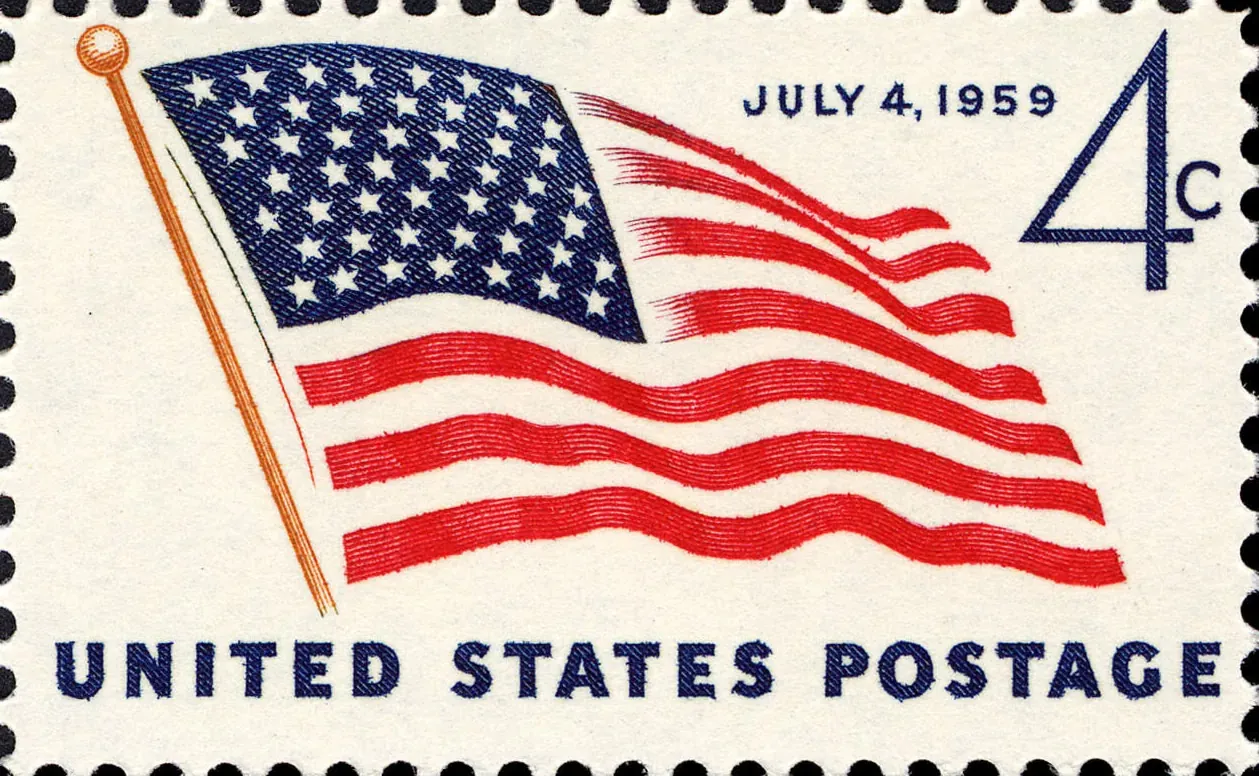
Nineteen fifty-nine was the year the United States finished filling in its own map: Alaska joined the union in January and Hawaii in August, the forty-ninth and fiftieth stars added to a flag that had not changed in shape since 1912. It was also, by general agreement among the people who design cars for a living, the single most extravagant year Detroit ever had. The 1959 Cadillac carried tailfins forty-two inches off the ground, the tallest ever fitted to a production car, on a body built for a country that had never owned more automobiles or driven them over more miles of new road. None of that chrome and legroom asked its owner to think about what the tires underneath it were actually made of. By 1959 the answer, in the overwhelming majority of American cars, was a rubber that had been invented as a wartime expedient a generation earlier and had since become simply the ordinary way a tire was built.
Plate I
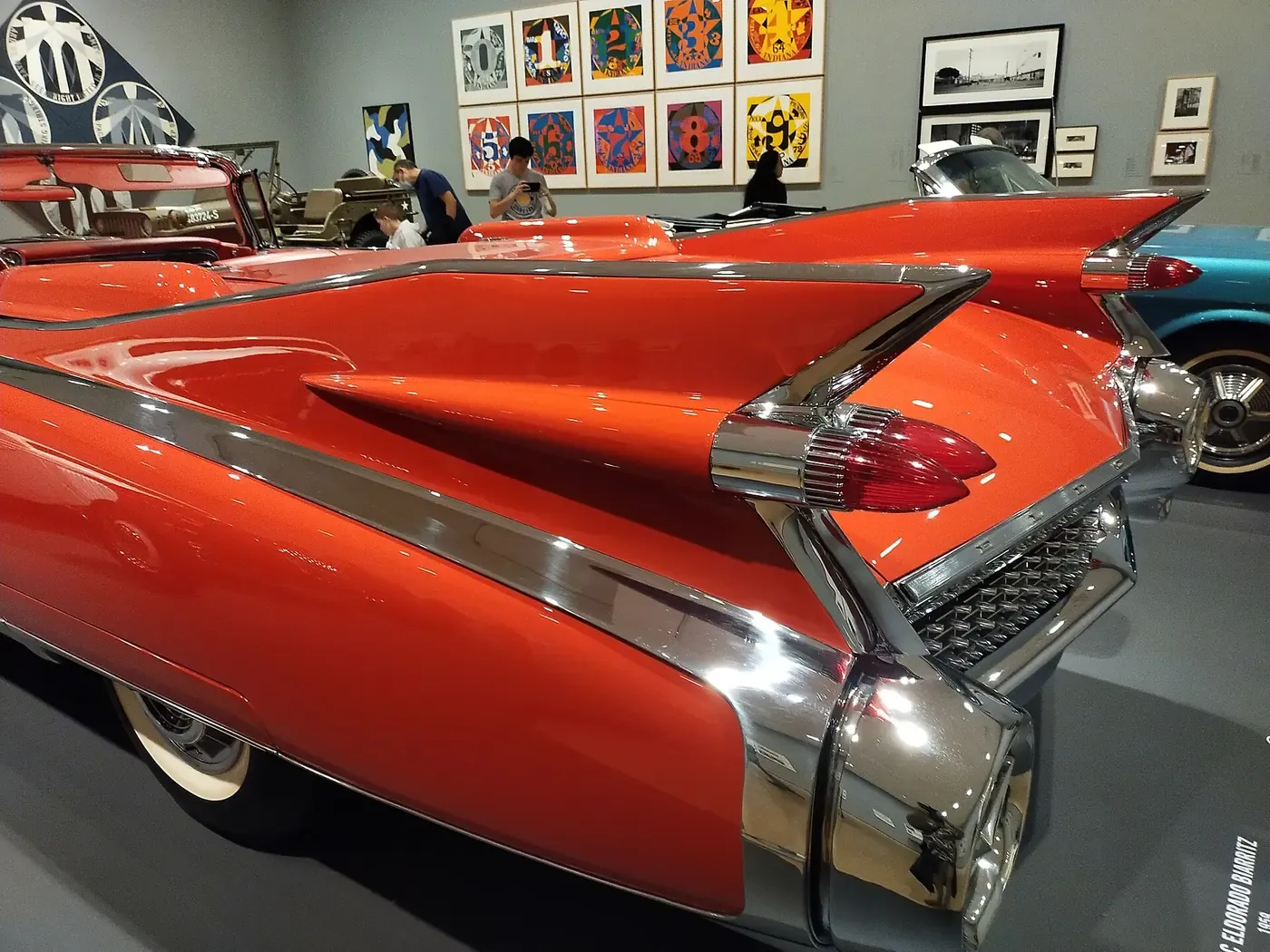

Plate II

A Rubber Invented Twice, for Two Different Reasons
The chemistry itself was three decades old by 1959. In 1929, the IG Farben chemists Walter Bock and Eduard Tschunkur, working in the same Leverkusen laboratories where colleagues were separately turning plain butadiene into Buna rubber and, a little later, into the oil-resistant Buna N covered elsewhere in this Atlas, found that copolymerising butadiene with styrene in an emulsion produced a rubber Germany called Buna S. It sat as a modest German industrial product until December 1941, when Japan’s advance through Southeast Asia cut the United States off from the Malayan and Dutch East Indies plantations that supplied nearly all of its natural rubber. Within weeks Washington had organised the largest cooperative chemical engineering effort the country had yet attempted, and its principal product was an American copy of Germany’s own decade-old invention, manufactured under the wartime code name GR-S (Government Rubber-Styrene).
What the War Left Behind
The government-built plants that made GR-S during the war were sold off to private industry through the mid-1950s, and the rubber itself simply kept being made, because it was cheaper than the natural material and, with the wartime emergency over, still perfectly suited to an ordinary tire. By the time the 1959 Cadillac left the assembly line, the industry had dropped the wartime code name in favour of a plain description of the chemistry (styrene-butadiene rubber), and it was the default material in most American tires. The country’s new Interstate Highway System, three years into construction that year, was only going to multiply how many of those tires needed making.
The Molecular Marvel
SBR alternates flexible stretches of butadiene, which give the material its elasticity, with stiffer styrene units that raise its hardness and resistance to wear. The proportion between the two is a dial rather than a fixed recipe (commercial grades run from roughly one part styrene to three of butadiene up to closer to two parts in five), and the butadiene segments themselves carry a mix of cis, trans and vinyl orientations whose balance a compounder can also adjust. Between the two levers, a single family of chemistry covers everything from a soft, springy tread compound to a much harder industrial rubber.
Properties that Pack a Punch
Like most rubbers on this Atlas, SBR sits close to water in density and never develops a true melting point, remaining uniformly amorphous through its service range. Raw and unfilled it is not especially strong, but compounded with reinforcing filler it gains real toughness and, notably, better resistance to abrasion than natural rubber manages in a comparable tread; this is the trade that made it the tire industry’s workhorse in the first place. It tolerates a modest amount of water and resists catching fire about as well as a general-purpose hydrocarbon rubber can, without the added chemical resistance a specialised elastomer offers: aromatic solvents dissolve it outright, and acids, alkalis, esters and chlorinated compounds all degrade it to some degree, so it stays out of jobs that put it in contact with fuel or strong chemicals.
Plate III

The Art and Science of SBR Production
Two distinct processes divide the market. Emulsion SBR, the direct descendant of the wartime GR-S recipe, is still made by polymerising the two monomers in a water emulsion, either “hot” at a higher temperature with a broad resulting molecular weight spread, or “cold,” which gives finer control over the polymer’s architecture and better dynamic properties in a finished tire. Solution SBR, which grew in importance in the years after 1959, is made instead in a hydrocarbon solvent using organolithium initiators under carefully excluded moisture, and gives a compounder far more precise control over the polymer’s microstructure, control that has become increasingly valuable as tire technology has chased better wet grip and lower rolling resistance.
Applications: Where the Rubber Meets the Road
Tires remain SBR’s largest market by a wide margin, still accounting for roughly half of all automobile tires produced. Away from the road it turns up in shoe soles, conveyor belting, adhesives and gaskets, and in two markets a driver would never guess: SBR latex is the single largest binder used in coated printing paper, and, more recently, it has found a role as the binder holding electrode material together inside lithium-ion batteries.
Plate IV

Looking Ahead
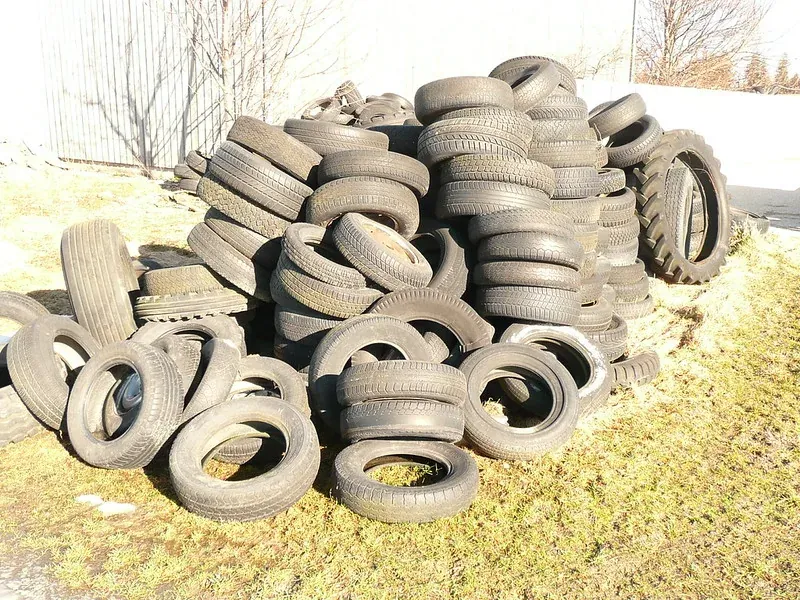
Because SBR is neither recyclable in any simple sense nor biodegradable, the same volume that made it the twentieth century’s default tire rubber is now the reason devulcanisation and reclaiming processes are under active development. This is an attempt to give a wartime-born material an end-of-life story to match the one it was given at the start.
values with [n] cite the numbered references·estimates are flagged·“not yet available” and “N/A” are honest states, not gaps
fetching the model…
Styrene Butadiene Rubber repeat unit
- Abbreviation
- SBR
- Type
- polymer family (hub)
- CAS number
- 9003-55-8
- Resin ID code
- none assigned
- Formula
- (C4H6)x·(C8H8)y[-CH2-CH=CH-CH2-]x[-CH2-CH(C6H5)-]yA statistical copolymer: the two units shown alternate irregularly along the chain in whatever ratio the recipe fixes, typically about three butadiene units to one styrene. The butadiene unit is drawn cis-1,4, though emulsion SBR contains trans and vinyl units too.
- Repeat unit (BigSMILES)
{[][$]C/C=C\C[$],[$]CC(c1ccccc1)[$][]}- IUPAC name
- —
- Synonyms
- GR-S (Government Rubber-Styrene, wartime name)
- Also known as
- GR-S
- Chemical family
- diene-rubberstyrenic
- Backbone class
- carbon-chain
- Polymerization mechanism
- free-radical
- Constitutional monomer
- Styrene1,3-Butadiene
- Polymer class
- elastomer
- Year of origin
- 1959
- Era
- The Post-War Boom (1946-1960)
- Key figures
- Walter Bock · Eduard Tschunkur
- Polymerization type
- free-radical emulsion (E-SBR) or solution (S-SBR) copolymerization
- Common monomers (feedstocks)
- styrene, 1,3-butadiene
- Catalysts
- not yet available
Originally developed before WWII in Germany by chemist Walter Bock in 1929; during WWII the U.S. Synthetic Rubber Program produced Government Rubber-Styrene (GR-S) at scale to replace inaccessible Southeast Asian natural rubber. Two production routes: emulsion polymerization (E-SBR, historically more widely used) and solution polymerization (S-SBR, growing share in tire applications). ~5.4 million tonnes processed worldwide in 2012.
- Tacticity
- Predominantly 1,4-addition in emulsion SBR: cis-1,4 9–38%, trans-1,4 53–75%, remainder vinyl (1,2-addition).
- Crystal structure
- not yet available
- Typical crystallinity
- not yet available
Molecular weight
- Number average (Mn)
- 28000–307000 g/mol[2]
- Mass average (Mw)
- 64000–313000 g/mol[2]
- Dispersity (Mw/Mn)
- 1.04–3.31[2]
| Solvent | T | M range | K | a |
|---|---|---|---|---|
| toluene[3] | 303 K | — | 0.00054 mL/g | 0.66 |
Higher styrene content yields harder, less elastic rubber; higher butadiene content enhances flexibility.
- Density
- 0.935 (0.91–0.96) g/cm³[2]20 °C.
- Melt flow index
- Not applicable
- Refractive index
- 1.545 (1.53–1.56)[2]20 °C.
- Transmittance
- not yet available
- Haze
- not yet available
- Gloss
- not yet available
- Water absorption
- 5 %[2]Equilibrium, immersed in water at 23 °C.
- Dielectric constant
- not yet available
- Dielectric strength
- not yet available
- Electrical conductivity
- not yet available
- Glass transition (Tg)
- -40 (-55–-25) °C[2]Wide range reflects styrene-content variation across SBR grades.
- Melting temperature (Tm)
- Not applicable
- Crystallization (Tc)
- Not applicable
- Heat deflection (HDT)
- Not applicable
- Decomposition onset
- 180 °C[2]Reported as 'decomposition temperature' (onset not separately specified).
- Thermal conductivity
- not yet available
- Tensile modulus
- 2.15 (2–2.3) MPa[2]Reported as Young's modulus.
- Yield strength
- 13.7 (9.4–18) MPa[2]SBR shows a measurable tensile yield point under this test, distinct from its ultimate tensile strength at break.
- Tensile strength at break
- 20.75 (13–28.5) MPa[2]Vulcanized SBR, typically compounded with reinforcing filler; a raw carbon-black-free gum vulcanizate is markedly weaker (~1.4–2.8 MPa).
- Elongation at break
- 565 (380–750) %[2]
- Impact strength (Izod)
- Not applicable
- Impact strength (Charpy)
- Not applicable
- Hardness
- 60 (30–90) Shore A[2]
- Flexural modulus
- Not applicable
- Poisson's ratio
- 0.5[2]Typical elastomer value; source notes it may vary.
- Coefficient of friction
- 2 (1.5–2.5)[2]Against polyethylene (PE/SBR interface).
- Solvent: acids
- poor[2]
- Solvent: alcohols
- good-fair[2]
- Solvent: alkalis
- poor[2]
- Solvent: aliphatic hydrocarbons
- poor[2]
- Solvent: aromatic hydrocarbons
- soluble[2]
- Solvent: esters
- poor[2]
- Solvent: greases & oils
- good-poor[2]
- Solvent: halogenated hydrocarbons
- poor[2]
- Solvent: ketones
- fair-poor[2]
- Weathering / UV
- not yet available
- Hydrolysis resistance
- Not applicable
- Flammability (UL94)
- HB[2]
- Limiting oxygen index
- not yet available
- Solubility parameter (δ)
- 17.4 MPa^0.5[2]
Gas permeability
not yet available
Polymer-solvent interaction parameter (χ)
not yet available
- Processing methods
- emulsion polymerization + compounding/vulcanizationsolution polymerization
- Drying required
- not yet determined
- Processing temperature
- not yet available
- Shrinkage rate
- not yet available
- Tiresautomobile tire tread/carcass compounds~50% of automobile tires.
- Footwear & industrialshoe components · gaskets · adhesives
- Papercoated-paper binder54% of dry binders used in coated paper (2010).
- Energy storagelithium-ion battery electrode binder
- Recyclable
- No
- Biodegradable
- No
- Degradation pathway
- not yet available
- LD50 (oral, rat)
- not yet available
- NFPA health
- 1[2]
- NFPA flammability
- 2 (1–3)[2]Range reflects variation across SBR grades/formulations.
- NFPA reactivity
- 0[2]
- Carcinogenic classification
- not listed by ACGIH, NIOSH, NTP[2]
Aquatic toxicity (48 h LC50): Daphnia magna 23 mg/L, bluegill sunfish 25.05 mg/L, fathead minnow 46.4–59.3 mg/L.
- [1]Styrene-butadieneWikipediaAccessed 2026-07-14https://en.wikipedia.org/wiki/Styrene-butadiene[wiki-sbr]
- [2]Handbook of PolymersChemTec Publishinghttps://www.worldcat.org/isbn/9781895198928[handbook-wypych-2016]
- [3]Polymer Data HandbookOxford University Presshttps://search.worldcat.org/search?q=Polymer+Data+Handbook+Mark+1999[handbook-mark-1999]
Illustrations
- Plate IA 1959 Cadillac Eldorado Biarritz, its tailfins the tallest ever fitted to a production car: the flamboyant end of a decade whose tires had quietly gone synthetic.Wikimedia Commons
- Plate IIA commemorative stamp marking the forty-nine-star flag, issued the same year the country it represented was paving more of itself than ever before.Wikimedia Commons
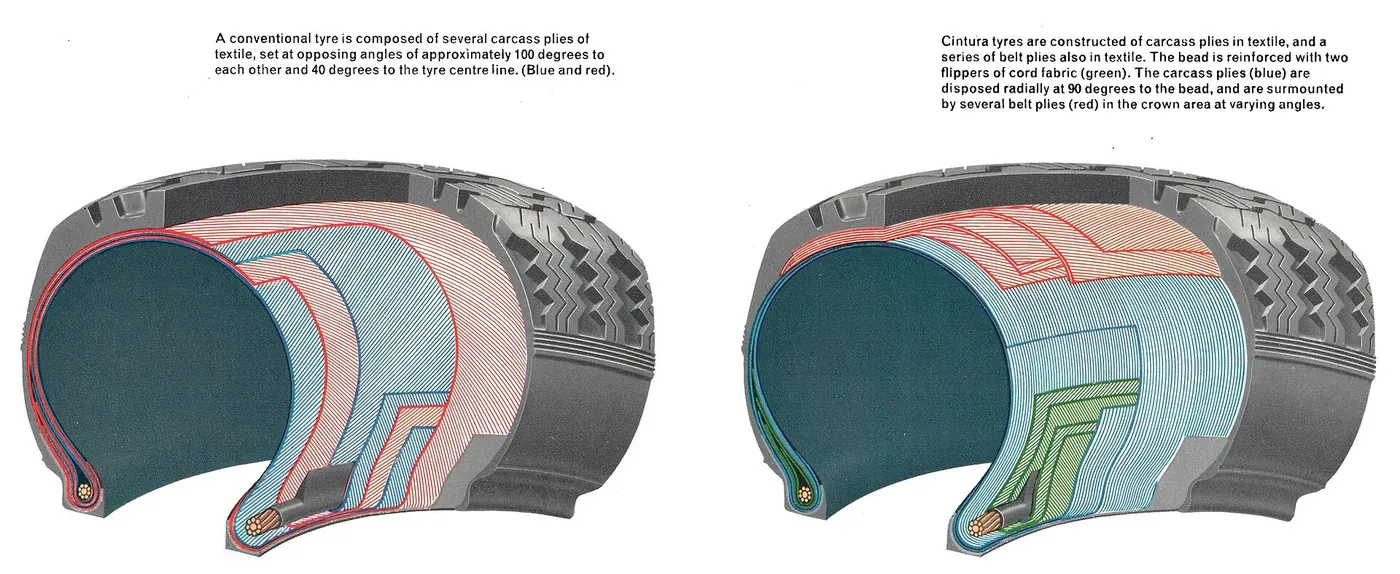
- Plate IIIA 1964 comparison of conventional and radial tyre construction: a reminder that the rubber compound sits inside a specific engineered structure of plies and belts, not just a block of tread.Wikimedia Commons
- Plate IVA stockpile of worn tires: the scale a single rubber, invented for a war that ended in 1945, now operates at in ordinary peacetime traffic.Wikimedia Commons