The Wartime Innovation Period (1939-1945)
Styrene-Acrylonitrile (SAN)
The Clear, Tough Cousin That Paved the Way
On 7 December 1941, Japanese aircraft sank or damaged eight battleships at Pearl Harbor, and the United States entered the war it had spent two years supplying from the sidelines. The consequences reached the rest of the world within weeks. Japanese forces swept down through Malaya and the Dutch East Indies, and by the time Singapore fell in February 1942, the United States had lost something like nine-tenths of its natural rubber supply, the material behind every tire, hose, and gasket in the country, almost none of which grew on American soil.
Plate I
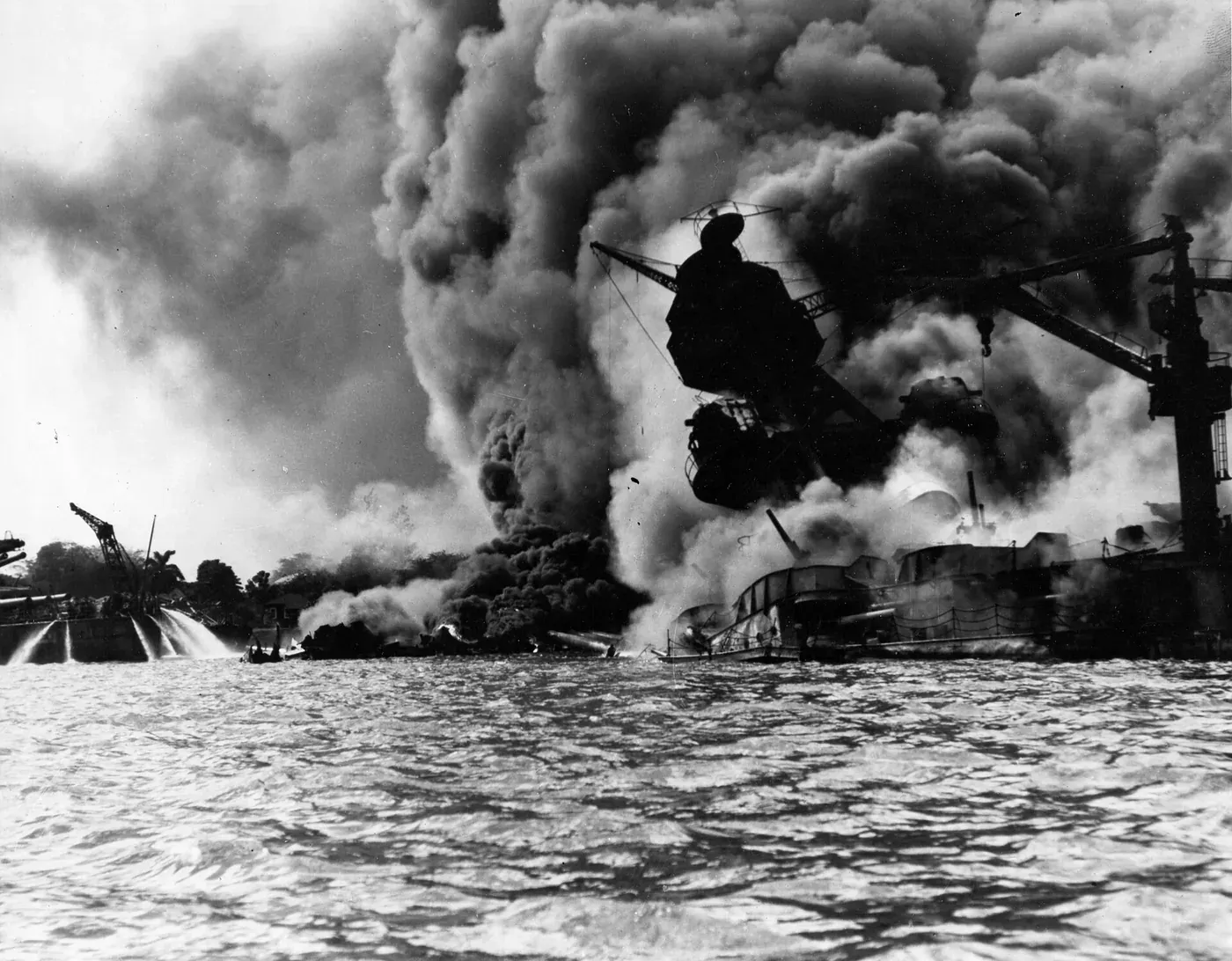

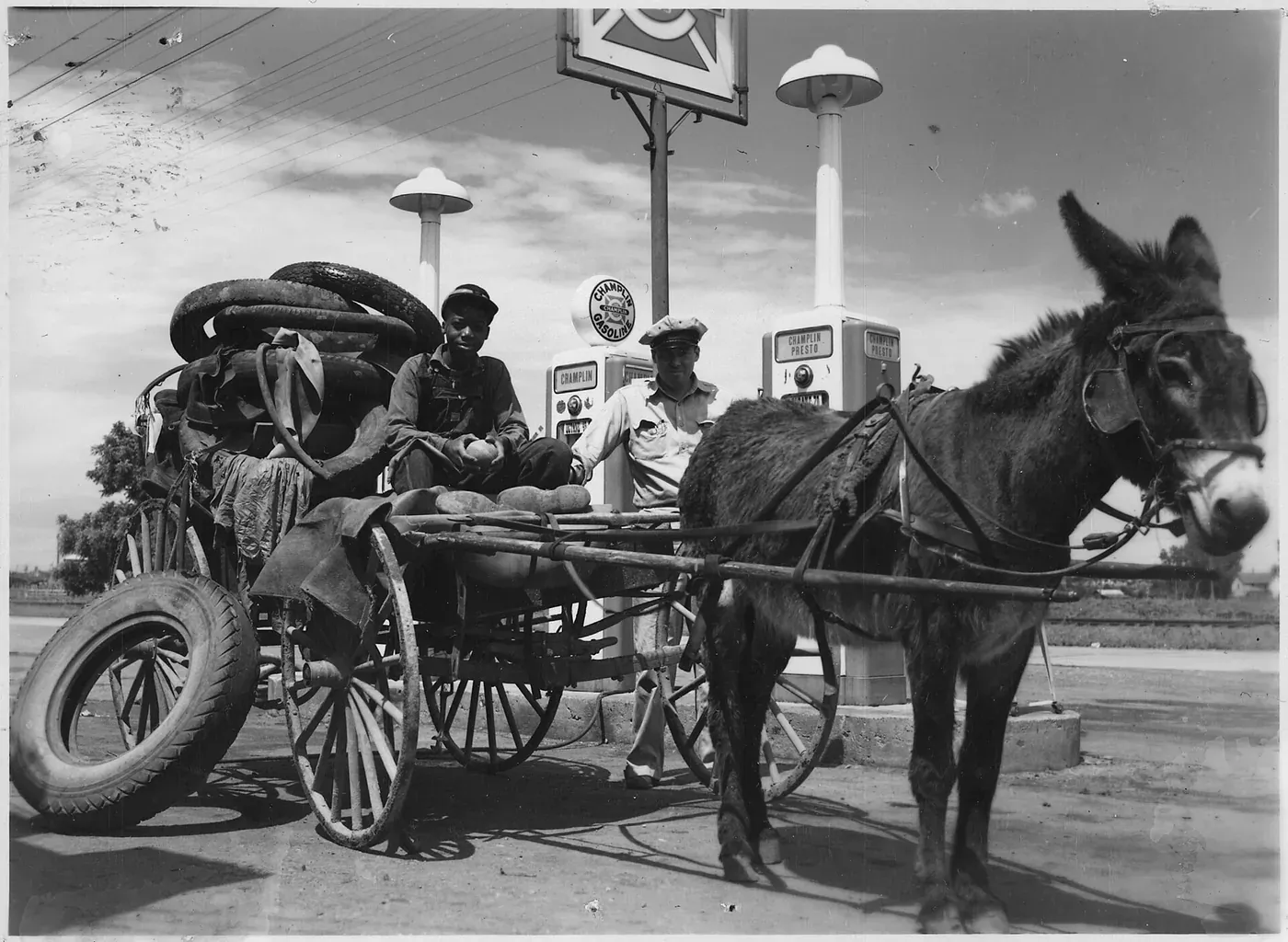
Washington had already seen the shortage coming. A government rubber-stockpiling agency had been created in 1940, and by 1941 it was underwriting a crash effort to build a synthetic rubber industry that barely existed in the United States at all. On the home front that meant scrap drives: every worn tire, hose, and rubber boot was suddenly worth collecting, down to whatever a farmer could load onto a cart.
Plate II

Behind the scrap drives sat a much bigger industrial push. In 1941, B.F. Goodrich was already turning out sheets of a homegrown synthetic rubber called Ameripol at its Akron plant, and the rest of the rubber industry was racing to scale up variants of its own, including one built from butadiene and a nitrogen-bearing chemical called acrylonitrile, which until then had barely been made in the United States at industrial volume. The war didn’t just demand rubber. It demanded that America build, almost overnight, a domestic supply of chemicals it had previously had little reason to produce at scale.
Plate III
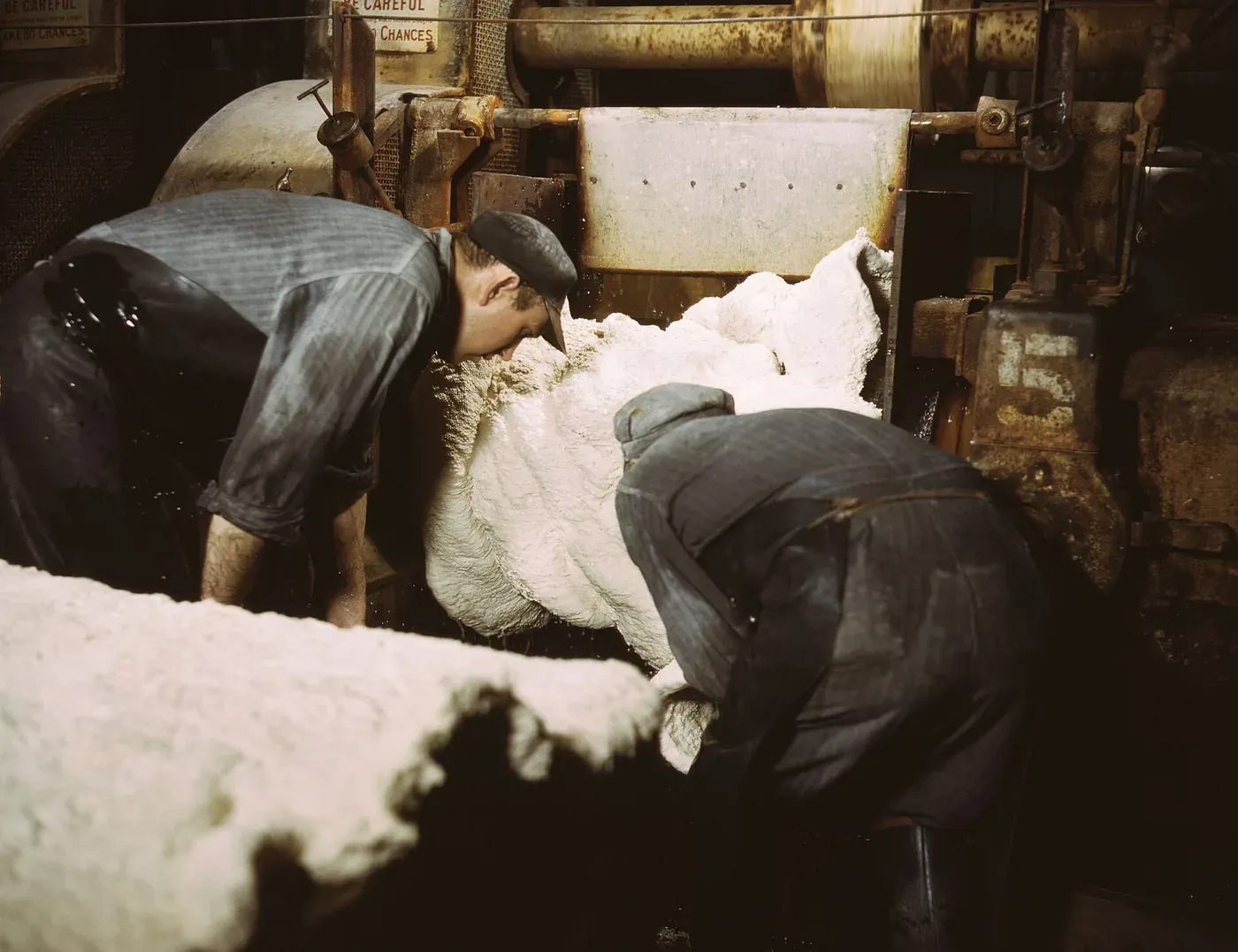

Plate IV
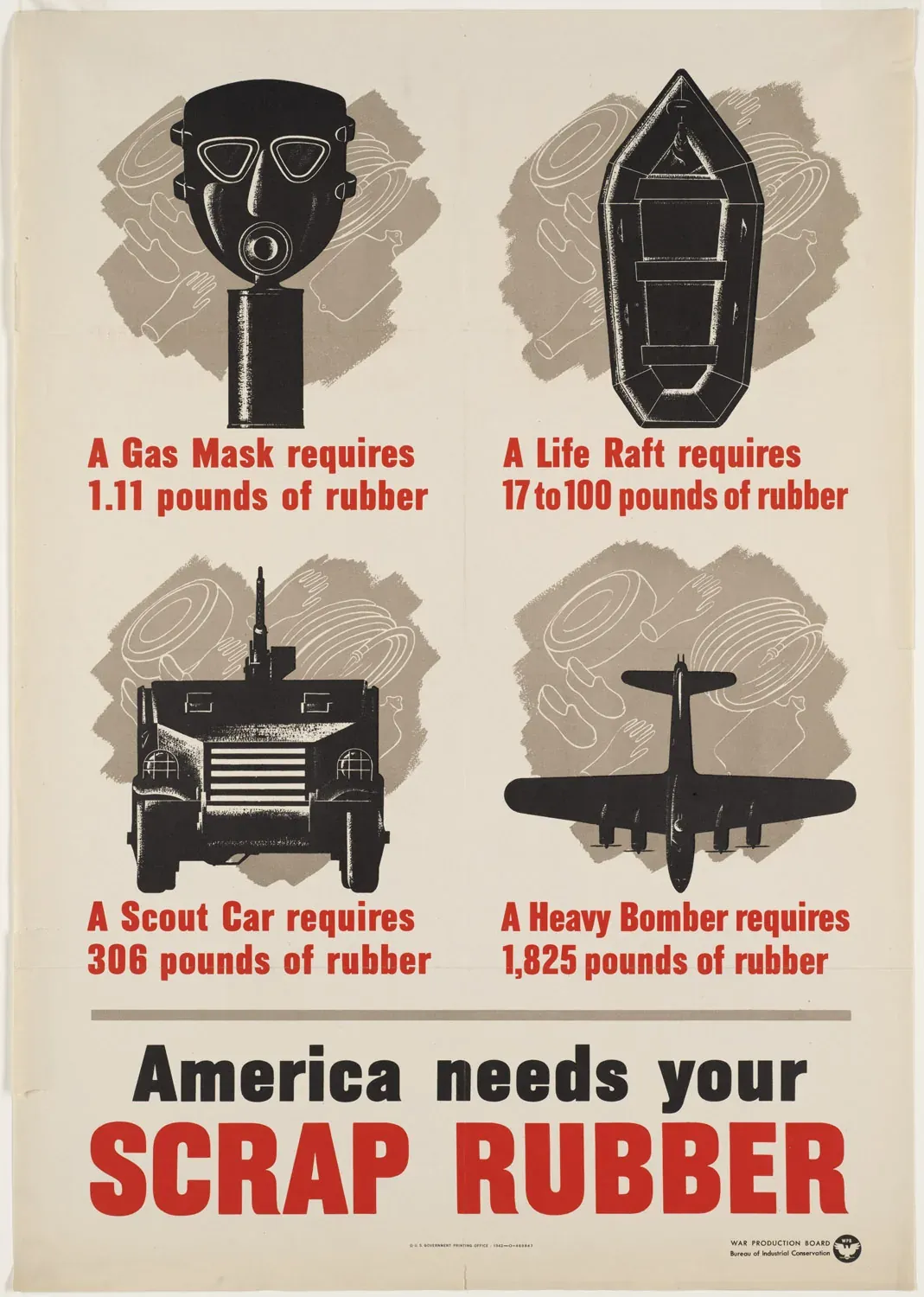

Acrylonitrile suddenly being cheap and abundant is the reason SAN exists. Somewhere in that same wartime chemistry, a researcher tried copolymerizing acrylonitrile with styrene and left out the butadiene that would have made it a rubber. What came out was not elastic at all: it was a hard, clear plastic, tougher and more heat-resistant than styrene alone. Styrene-acrylonitrile (SAN) reached the patent literature and small-scale commercial production in the early 1940s, a direct byproduct of a crisis that had nothing to do with plastics at all.
A Polar Partner
SAN is a random copolymer, typically around three-quarters styrene to one-quarter acrylonitrile, the two monomers strung together along a single amorphous chain with no regular pattern to the sequence. The styrene units contribute the clarity and easy processing familiar from plain polystyrene; the acrylonitrile units contribute something styrene alone cannot. Their polar nitrile groups attract one another strongly across neighbouring chains, pulling the whole structure tighter and making it harder for heat, stress, or a solvent to pull the chains apart. Push the acrylonitrile content higher and the material gets tougher and more chemically resistant, but also more prone to a yellow tint and harder to mold; SAN’s commercial grades sit at the balance point of that trade-off.
The improvement over polystyrene shows up directly where it matters. SAN survives a dip in boiling water that would visibly deform plain polystyrene, and it takes a sharp knock without shattering the way an unmodified polystyrene part would. It gives up very little of polystyrene’s clarity to get there; light still passes through it with barely any of the scattering that would cloud a lesser plastic. The trade is not free: SAN absorbs a little more moisture than polystyrene and remains just as unable to shrug off oils, greases, or common solvents, which still attack it about as readily as they attack its parent. What it resists far better are the mild acids and alkalis in ordinary cleaning products, which makes it useful in a kitchen or bathroom even though, like polystyrene, it has no real defense against a splash of solvent or cooking oil left standing.
From Two Monomers to a Resin
SAN is made by copolymerizing its two monomers through any of the standard routes (bulk, solution, suspension, or emulsion polymerization), each giving different control over molecular weight and how evenly the two monomers end up distributed along the chain. Because styrene and acrylonitrile do not add to a growing chain at exactly the same rate, keeping the feed composition steady through the reaction takes real care; get it wrong and the copolymer’s properties drift from batch to batch.
Commercial SAN stayed a specialty material through the 1940s; production was small and the price was high enough to confine it to applications that could justify the cost. As output scaled up and prices fell in the following decades, it settled into a durable niche: valued anywhere polystyrene’s clarity was wanted but its fragility could not be tolerated. Its most consequential role, though, turned out to be as a starting point rather than a finished product.
The Quiet Parent of a Superstar
SAN’s own applications lean on exactly the combination its chemistry provides: clear, rigid housewares and cosmetic packaging that need to survive daily handling without crazing, battery cases and appliance housings that need dimensional stability, even plastic optical fibers that put its transparency to work in a way few people ever notice. None of that made SAN famous. What did was what happened when a third monomer, butadiene rubber, was blended into the same styrene-acrylonitrile matrix: the product was ABS, the tough, glossy plastic behind LEGO bricks, car dashboards, and a great many appliance housings besides. SAN is the resin ABS is built on, and without the wartime scramble for a domestic acrylonitrile supply, neither one arrives when it did.
The Enduring Middle Ground
SAN never won the fame of its offspring or the ubiquity of the polystyrene it improved on, and it never needed to. It occupies a specific middle ground (clearer than ABS, tougher than polystyrene), and modern grades, along with weather-resistant relatives like ASA, still fill exactly that gap decades later. It is a reminder that not every advance in materials arrives with a name attached: this one arrived out of a shortage, quietly solved a problem nobody had asked it to solve, and then spent the rest of the century being the unglamorous, dependable answer to it.
values with [n] cite the numbered references·estimates are flagged·“not yet available” and “N/A” are honest states, not gaps
fetching the model…
Styrene-Acrylonitrile repeat unit
- Abbreviation
- SAN
- Type
- polymer family (hub)
- CAS number
- 9003-54-7
- Resin ID code
- none assigned
- Formula
- (C8H8)x·(C3H3N)y[-CH2-CH(C6H5)-]x[-CH2-CH(CN)-]yA statistical (random) copolymer, typically 70–80% styrene by weight; the two brackets show the two monomer units and their approximate ratio, not a block sequence, since the two are mixed at random along the chain.
- Repeat unit (BigSMILES)
{[][$]CC(c1ccccc1)[$],[$]CC(C#N)[$][]}- IUPAC name
- —
- Synonyms
- —
- Also known as
- —
- Backbone class
- carbon-chain
- Polymerization mechanism
- free-radical
- Constitutional monomer
- StyreneAcrylonitrile
- Polymer class
- thermoplastic
- Year of origin
- 1941
- Era
- The Wartime Innovation Period (1939-1945)
- Key figures
- —
- Polymerization type
- free-radical chain-growth copolymerization
- Common monomers (feedstocks)
- styrene, acrylonitrile
- Catalysts
- not yet available
Random copolymerization of styrene (70–80 wt%) and acrylonitrile (20–30 wt%). Higher acrylonitrile content improves mechanical strength and chemical resistance but introduces a yellowish tint. SAN itself later became the base resin for ABS, when polybutadiene rubber particles (10–20 micrometers) are dispersed/grafted into it to add toughness.
- Tacticity
- not yet available
- Crystal structure
- not yet available
- Typical crystallinity
- 0 %estimate[1]Amorphous, transparent random copolymer.
Molecular weight
- Number average (Mn)
- not yet available
- Mass average (Mw)
- 175000 (165000–185000) g/mol[2]
- Dispersity (Mw/Mn)
- not yet available
Mark-Houwink constants
not yet available
Brittle relative to rubber-toughened ABS, which is precisely why ABS was later developed by adding polybutadiene to a SAN-like matrix.
- Density
- 1.08 (1.07–1.09) g/cm³[2]20 °C.
- Melt flow index
- 7.5 g/10min[2]230 °C/3.8 kg.
- Refractive index
- 1.57[2]20 °C.
- Transmittance
- 88.5 (85–92) %[2]
- Haze
- not yet available
- Gloss
- not yet available
- Water absorption
- 0.3 (0.25–0.35) %[2]Equilibrium, immersed in water at 23 °C.
- Dielectric constant
- 2.85 (2.7–3)[2]100 Hz to 1 MHz.
- Dielectric strength
- not yet available
- Electrical conductivity
- [2]Upper bound; reciprocal of reported volume resistivity (>1×10¹³ Ω·m).
- Glass transition (Tg)
- 107.5 (103–112) °C[2]Experimental range; giving SAN boiling-water resistance that plain polystyrene lacks.
- Melting temperature (Tm)
- Not applicableAmorphous; no true melting point.
- Crystallization (Tc)
- Not applicable
- Heat deflection (HDT)
- 95 (86–104) °C[2]1.8 MPa.
- Decomposition onset
- 260 °C[2]Reported as 'decomposition temperature' (onset not separately specified).
- Thermal conductivity
- not yet available
- Tensile modulus
- 3750 (3600–3900) MPa[2]
- Yield strength
- Not applicableRigid, brittle copolymer with no distinct yield region reported (low elongation at break, 2.5–4%); see tensile_strength_at_break.
- Tensile strength at break
- 70 (61–79) MPa[2]Source reports unqualified 'tensile strength'.
- Elongation at break
- 3.25 (2.5–4) %[2]
- Impact strength (Izod)
- 25.35 (24–26.7) J/m[3]ASTM D256Two named commercial grades (Lustran-35, Tyril-880).
- Impact strength (Charpy)
- 2 (1.5–2.5) kJ/m²[2]Notched, 23 °C.
- Hardness
- not yet available
- Flexural modulus
- not yet available
- Poisson's ratio
- 0.366[2]
- Coefficient of friction
- not yet available
- Solvent: acids
- good[2]
- Solvent: alcohols
- good[2]
- Solvent: alkalis
- very good[2]
- Solvent: aliphatic hydrocarbons
- good[2]
- Solvent: aromatic hydrocarbons
- poor[2]
- Solvent: esters
- poor[2]
- Solvent: greases & oils
- poor[2]
- Solvent: halogenated hydrocarbons
- poor[2]
- Solvent: ketones
- poor[2]
- Weathering / UV
- not yet available
- Hydrolysis resistance
- Resistant to boiling water (unlike plain polystyrene)[1]
- Flammability (UL94)
- HB[2]1.6/0.8 mm specimen thickness.
- Limiting oxygen index
- 18 %[2]
- Solubility parameter (δ)
- not yet available
Gas permeability
not yet available
Polymer-solvent interaction parameter (χ)
not yet available
- Food & consumerfood containers · water bottles · kitchenware · cosmetic jars
- Electronicscomputer product housings · battery cases
- Opticalplastic optical fibers
- Recyclable
- Yes
- Biodegradable
- No
- Degradation pathway
- not yet available
- LD50 (oral, rat)
- 1800 mg/kg[2]
- NFPA health
- 0[2]HMIS rating, 0–4 scale.
- NFPA flammability
- 1[2]HMIS rating, 0–4 scale.
- NFPA reactivity
- 0[2]HMIS rating, 0–4 scale.
- Carcinogenic classification
- not listed by ACGIH, NIOSH, NTP[2]
Skin (rabbit) LD50: 2,000 mg/kg. Aquatic toxicity (48 h LC50): Daphnia magna 13 mg/L, bluegill sunfish 28 mg/L, fathead minnow 10 mg/L.
- [1]Styrene-acrylonitrile resinWikipediaAccessed 2026-07-14https://en.wikipedia.org/wiki/Styrene-acrylonitrile_resin[wiki-san-resin]
- [2]Handbook of PolymersChemTec Publishinghttps://www.worldcat.org/isbn/9781895198928[handbook-wypych-2016]
- [3]Polymer Data HandbookOxford University Presshttps://search.worldcat.org/search?q=Polymer+Data+Handbook+Mark+1999[handbook-mark-1999]
Illustrations
- Plate IPearl Harbor, 7 December 1941. Within ten weeks, Japan's advance through Southeast Asia would cut off nearly all of America's natural rubber.Wikimedia Commons
- Plate IIOld tires collected for a wartime scrap rubber drive: the shortage reached rural roads as well as city streets.Wikimedia Commons
- Plate IIISynthetic rubber coming off the rolling mill at B.F. Goodrich's Akron plant in 1941, part of the wartime buildup that made acrylonitrile a bulk American chemical for the first time.Wikimedia Commons
- Plate IVA 1942 War Production Board poster spelling out, item by item, just how much of the war effort ran on rubber. That shortage pushed acrylonitrile into bulk American production in the first place.Wikimedia Commons