The Wartime Innovation Period (1939-1945)
Acrylonitrile Butadiene Rubber (NBR)
The Oil-Resistant Wonder
At dawn on 6 June 1944, landing craft began putting Sherman tanks ashore on the Normandy beaches, the opening hours of the largest amphibious invasion ever attempted. Every vehicle in that armada (tanks, trucks, landing craft, the aircraft flying cover above them) depended on fuel lines, seals and self-sealing tank linings that had to survive constant contact with petrol and oil without swelling, cracking or leaking. Natural rubber fails at exactly that job; oil is one of the few things it cannot shrug off. The material that could was not a wartime invention. It had been sitting in German patent filings since 1930.
Plate I
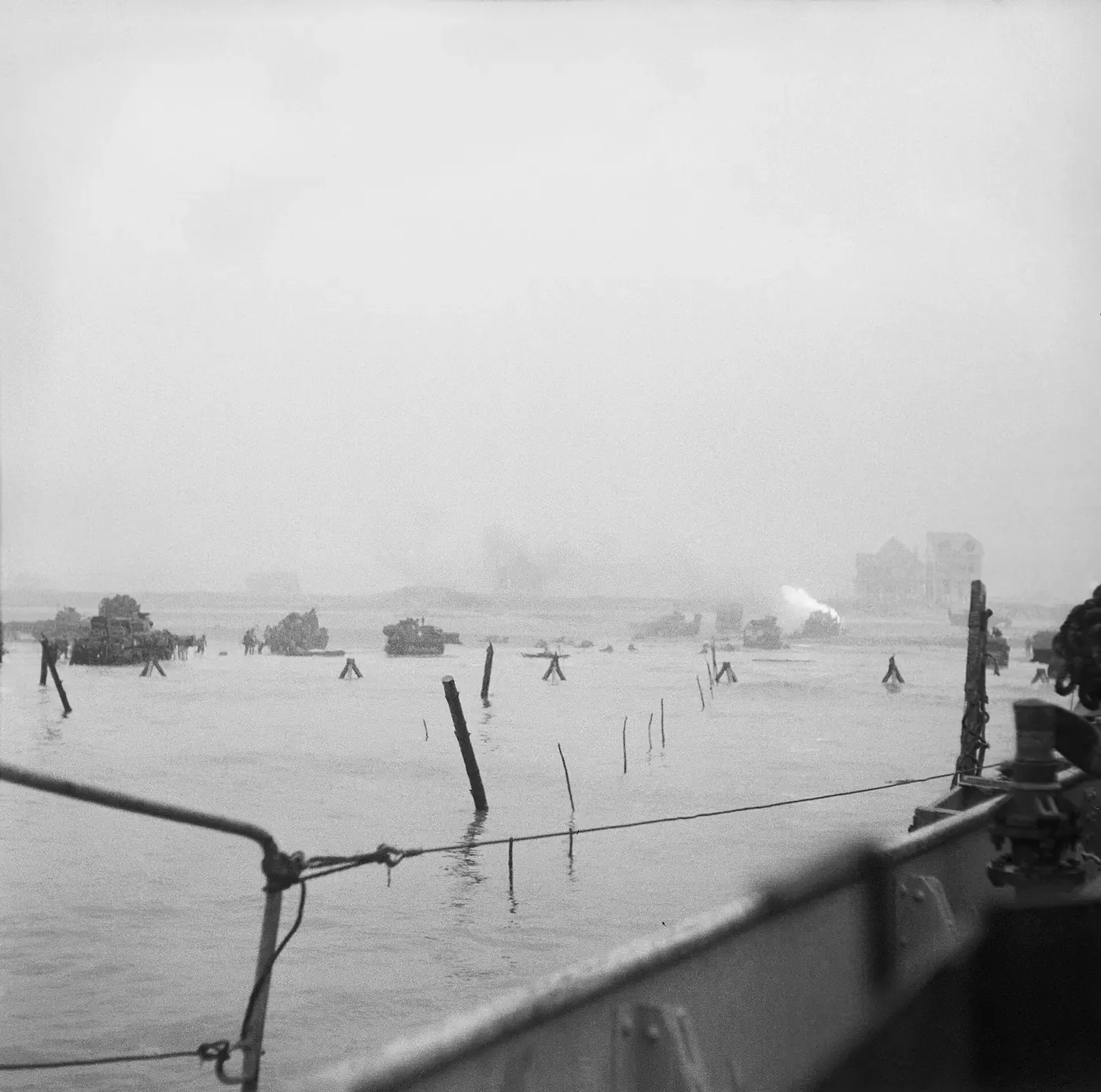

An Invention Fourteen Years Late to Its Own War
Acrylonitrile butadiene rubber was developed around 1930 by the chemists Erich Konrad and Eduard Tschunkur at IG Farben, the same German chemical combine whose Leverkusen laboratories were, around the same years, turning sodium-catalysed butadiene into the general-purpose synthetic rubber called Buna. Tschunkur was no stranger to that parallel effort either; a few years later he and his colleague Walter Bock would use the same emulsion chemistry to make Buna S, the styrene-modified rubber covered elsewhere in this Atlas. Copolymerising butadiene with a second monomer, acrylonitrile, produced something the plain material could not offer: a rubber that tolerated oil. Germany sold it under the trade name Perbunan and put it into commercial production within a few years. It was a second synthetic rubber, alongside Buna itself, that left the country needing almost nothing from a rubber tree.
American companies, including B.F. Goodrich and Goodyear, had licensed or reverse-engineered versions of the German chemistry before the United States ever entered the war, but it took the government’s own wartime synthetic-rubber programme to turn that early foothold into an industry. Alongside the much larger general-purpose effort that produced GR-S, a separate line (GR-N, Government Rubber-Nitrile) scaled up the oil-resistant copolymer at plants across Akron and the Gulf Coast. By 1944, American factories had spent two full years learning to manufacture, at a scale Germany itself had never reached, a rubber their own country had not invented.
Plate II
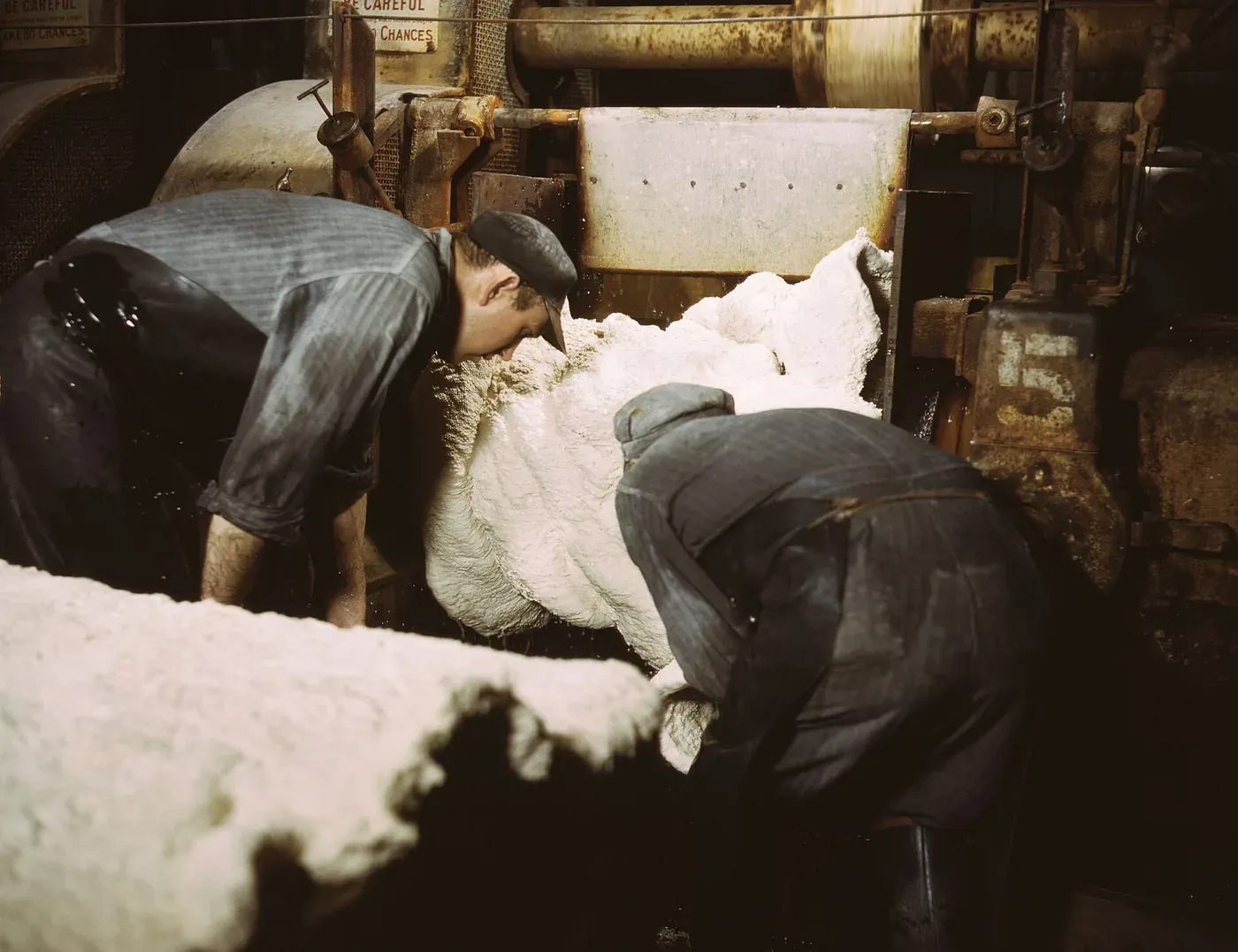

The Molecular Tango
NBR’s backbone alternates two very different kinds of unit: stretches of butadiene, which give the chain its flexibility and rubbery recoil, and units carrying a nitrile group, whose polarity is what lets the rubber resist swelling in fuel and oil. The ratio between the two is not fixed (commercial grades run from around one part acrylonitrile in six up to roughly one in two), and it is the single most important choice a compounder makes: more acrylonitrile buys sharply better oil resistance at the cost of flexibility in the cold, and less buys the opposite.
Properties That Power Industry
NBR sits close to water in density and never develops a true crystalline melting point, behaving instead as a uniformly amorphous rubber across its service range. On its own, unfilled, it is a fairly modest material (most of the strength people associate with it comes from the carbon black and other reinforcement compounded in before use), but it stretches to several times its original length and springs back reliably. Its real distinction is chemical: it holds up well against mineral and vegetable oils, fuels, dilute and concentrated acids, alkalis and plain aliphatic hydrocarbons, which is precisely the combination natural rubber and general-purpose synthetics lack. It is considerably less happy around aromatic hydrocarbons, esters, ketones and chlorinated solvents, so the choice of grade still has to match the chemical it will actually meet in service.
Crafting the Perfect Blend
Commercial NBR is made by emulsion copolymerisation, run either “hot,” at a somewhat higher temperature with traditional initiators, or “cold,” closer to the temperature of a refrigerator, for a more tightly controlled polymer architecture. Butadiene and acrylonitrile are dispersed in water with an emulsifier and a free-radical initiator, and the reaction is deliberately stopped well short of full conversion before the unreacted monomer is recovered and the latex coagulated into the crumb rubber that reaches a compounder.
Plate III
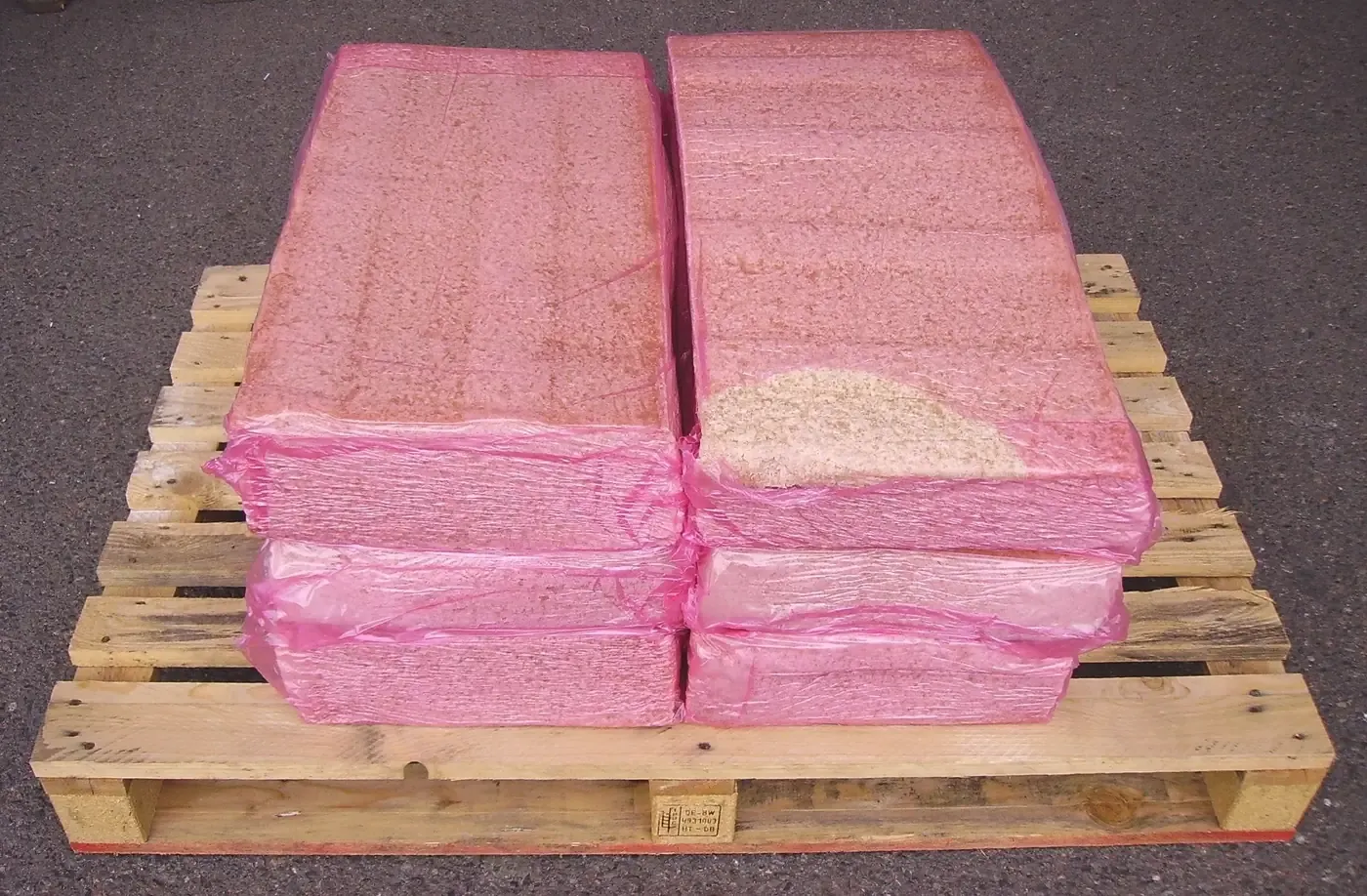

From there, standard rubber processing (milling with carbon black and plasticisers, then sulfur vulcanisation under heat) turns the raw copolymer into a finished seal, hose or glove.
Plate IV
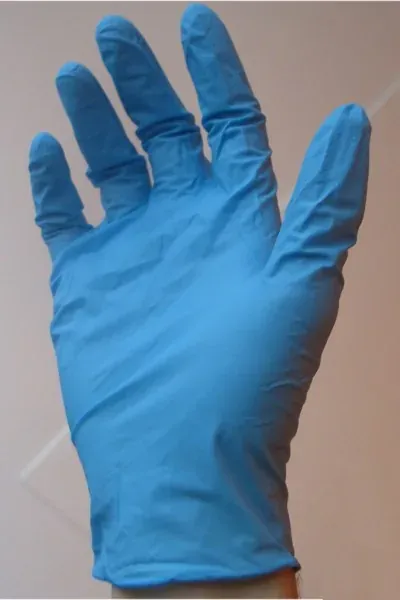

From Wartime Crisis to Peacetime Progress
NBR’s post-war career has mostly been spent under the hood: fuel and oil hoses, seals, gaskets and transmission belting throughout the automotive industry, wherever a rubber component sits in constant contact with petroleum products. Away from the engine bay, the same oil and solvent resistance made it a natural fit for printing rollers, conveyor belting and diving suits, and its resistance to punctures and many industrial chemicals has made it the default material for disposable gloves in laboratories, hospitals and food service. Today’s formulations reach further still, into biodiesel-tolerant seals and the wider temperature range demanded by electric-vehicle battery systems. This is a direct continuation of the same oil-resistance problem the material was built to solve, in a country that did not invent it, fourteen years after it first existed.
values with [n] cite the numbered references·estimates are flagged·“not yet available” and “N/A” are honest states, not gaps
fetching the model…
Acrylonitrile Butadiene Rubber repeat unit
- Abbreviation
- NBR
- Type
- polymer family (hub)
- CAS number
- 9003-18-3
- Resin ID code
- none assigned
- Formula
- (C4H6)x·(C3H3N)y[-CH2-CH=CH-CH2-]x[-CH2-CH(CN)-]yA statistical copolymer. Acrylonitrile content, commonly 18–50%, is the dial that trades oil resistance against low-temperature flexibility, so no single ratio represents the class.
- Repeat unit (BigSMILES)
{[][$]C/C=C\C[$],[$]CC(C#N)[$][]}- IUPAC name
- —
- Synonyms
- nitrile rubber; Buna-N; nitrile butadiene rubber
- Also known as
- nitrile rubberBuna-N
- Chemical family
- diene-rubberacrylic
- Backbone class
- carbon-chain
- Polymerization mechanism
- free-radical
- Constitutional monomer
- Acrylonitrile1,3-Butadiene
- Polymer class
- elastomer
- Year of origin
- 1944
- Era
- The Wartime Innovation Period (1939-1945)
- Key figures
- Erich Konrad · Eduard Tschunkur
- Polymerization type
- free-radical emulsion copolymerization
- Common monomers (feedstocks)
- acrylonitrile, 1,3-butadiene
- Catalysts
- radical activators/persulfate-type initiators
Developed in 1931 at BASF and Bayer, with commercial German production from 1935. Produced via emulsion polymerization at 30–40°C ('hot' NBR) or 5–15°C ('cold' NBR): emulsifier, acrylonitrile, butadiene, radical activators, and catalyst combined in water; reaction is halted at ~70% conversion by termination agents, followed by monomer recovery and coagulation into crumb rubber.
- Tacticity
- Butadiene-segment microstructure approximately 78% trans-1,4, 12% cis-1,4, 10% 1,2-vinyl.
- Crystal structure
- not yet available
- Typical crystallinity
- 0 %[2]amorphous
Molecular weight
- Number average (Mn)
- 66500 (58000–75000) g/mol[2]Source prints the lower bound as '58,00'; recorded as 58,000 assuming a dropped digit.
- Mass average (Mw)
- 399500 (199000–600000) g/mol[2]
- Dispersity (Mw/Mn)
- 4 (2–6)[2]
Mark-Houwink constants
not yet available
Higher acrylonitrile (ACN) content improves solvent/oil resistance but reduces low-temperature flexibility; lower ACN content gives the opposite trade-off.
Tg decreases with lower ACN content.
- Density
- 0.965 (0.92–1.01) g/cm³[2]Unfilled gum stock, 20 °C; varies with acrylonitrile content.
- Melt flow index
- Not applicable
- Refractive index
- not yet available
- Transmittance
- not yet available
- Haze
- not yet available
- Gloss
- not yet available
- Water absorption
- not yet available
- Dielectric constant
- not yet available
- Dielectric strength
- not yet available
- Electrical conductivity
- not yet available
- Glass transition (Tg)
- -35 (-60–-10) °C[2]Wide range reflects acrylonitrile content 15–51%; Tg rises with increasing ACN content.
- Melting temperature (Tm)
- Not applicable
- Crystallization (Tc)
- Not applicable
- Heat deflection (HDT)
- Not applicable
- Decomposition onset
- 200 °C[2]>200 °C; onset marked by hardening from crosslinking rather than mass loss.
- Thermal conductivity
- not yet available
- Tensile modulus
- 3.5 (2–5) MPa[2]Reported as Young's modulus, unfilled gum stock. Wypych separately lists an unqualified 'tensile modulus' of 20.1–29.4 MPa, likely a higher-strain secant value for a different formulation.
- Yield strength
- Not applicableElastomers like NBR typically don't show a distinct yield region before break; see tensile_strength_at_break.
- Tensile strength at break
- 4.8 (3.1–6.5) MPa[2]Unfilled (pure rubber) gum vulcanizate; carbon-black-filled compounds test substantially higher (13–20 MPa).
- Elongation at break
- 450 (300–600) %[2]
- Impact strength (Izod)
- Not applicable
- Impact strength (Charpy)
- Not applicable
- Hardness
- 60 (25–95) Shore A[2]
- Flexural modulus
- Not applicable
- Poisson's ratio
- not yet available
- Coefficient of friction
- not yet available
- Solvent: mineral_and_vegetable_oils
- Good resistance[1]
- Solvent: fuel
- Good resistance[1]
- Solvent: benzene
- Good resistance[1]
- Solvent: dilute acids
- very good[2]
- Solvent: concentrated acids
- very good[2]
- Solvent: alcohols
- good[2]
- Solvent: alkalis
- very good[2]
- Solvent: aliphatic hydrocarbons
- good[2]
- Solvent: aromatic hydrocarbons
- poor[2]
- Solvent: esters
- poor[2]
- Solvent: greases & oils
- good[2]
- Solvent: halogenated hydrocarbons
- poor[2]
- Solvent: ketones
- poor[2]
- Weathering / UV
- not yet available
- Hydrolysis resistance
- Not applicable
- Flammability (UL94)
- not yet available
- Limiting oxygen index
- not yet available
- Solubility parameter (δ)
- 19.64 (17.9–21.38) MPa^0.5[2]
Gas permeability
- N₂
- 1.77 × 10⁻¹⁴–1.89 × 10⁻¹³ cm³(STP)·cm/(cm²·s·Pa)[2]25 °C; decreases with increasing acrylonitrile content.
- O₂
- 7.21 × 10⁻¹⁴–1.44 × 10⁻¹² cm³(STP)·cm/(cm²·s·Pa)[2]25 °C; decreases with increasing acrylonitrile content.
Polymer-solvent interaction parameter (χ)
not yet available
- Processing methods
- emulsion polymerization + compounding/vulcanization
- Drying required
- not yet determined
- Processing temperature
- 35 (30–40) °C[1]'Hot' NBR polymerization temperature; 'cold' NBR uses 5–15°C.
- Shrinkage rate
- not yet available
- Automotivefuel and oil hoses · seals and O-rings · transmission belts
- Medical & PPEdisposable protective gloves
- Aerospacecomponents requiring temperature stability
- Othersynthetic leather
- Recyclable
- No
- Biodegradable
- No
- Degradation pathway
- not yet available
Operating temperature range reported as -40 to 108°C.
- [1]Nitrile rubberWikipediaAccessed 2026-07-14https://en.wikipedia.org/wiki/Nitrile_rubber[wiki-nbr]
- [2]Handbook of PolymersChemTec Publishinghttps://www.worldcat.org/isbn/9781895198928[handbook-wypych-2016]
Illustrations
- Plate ISherman tanks going ashore on Sword Beach, Normandy, 6 June 1944. This was a landing that ran on fuel systems and seals built from a rubber invented in Germany fourteen years earlier.Wikimedia Commons
- Plate IIWorkers feed newly milled synthetic rubber through rollers at the B.F. Goodrich plant in Akron, Ohio, 1941. The plant was one of the same wartime plants that would scale up oil-resistant nitrile rubber for the invasion fleet three years later.Wikimedia Commons
- Plate IIIRaw NBR delivered as wrapped bales of crumb rubber. It is the coagulated latex, still unvulcanised, that a compounder mills with carbon black before it becomes a finished seal or hose.Wikimedia Commons
- Plate IVA modern disposable nitrile glove. It is made of the same oil- and chemical-resistant copolymer that once sealed wartime fuel tanks, and is now standard in laboratories and hospitals precisely because it tolerates so much of what a latex glove cannot.Wikimedia Commons