The Birth of Synthetic Polymers (1907-1938): The Bakelite Revolution
Polychloroprene (CR)
The Rubber That Defied the Great Depression
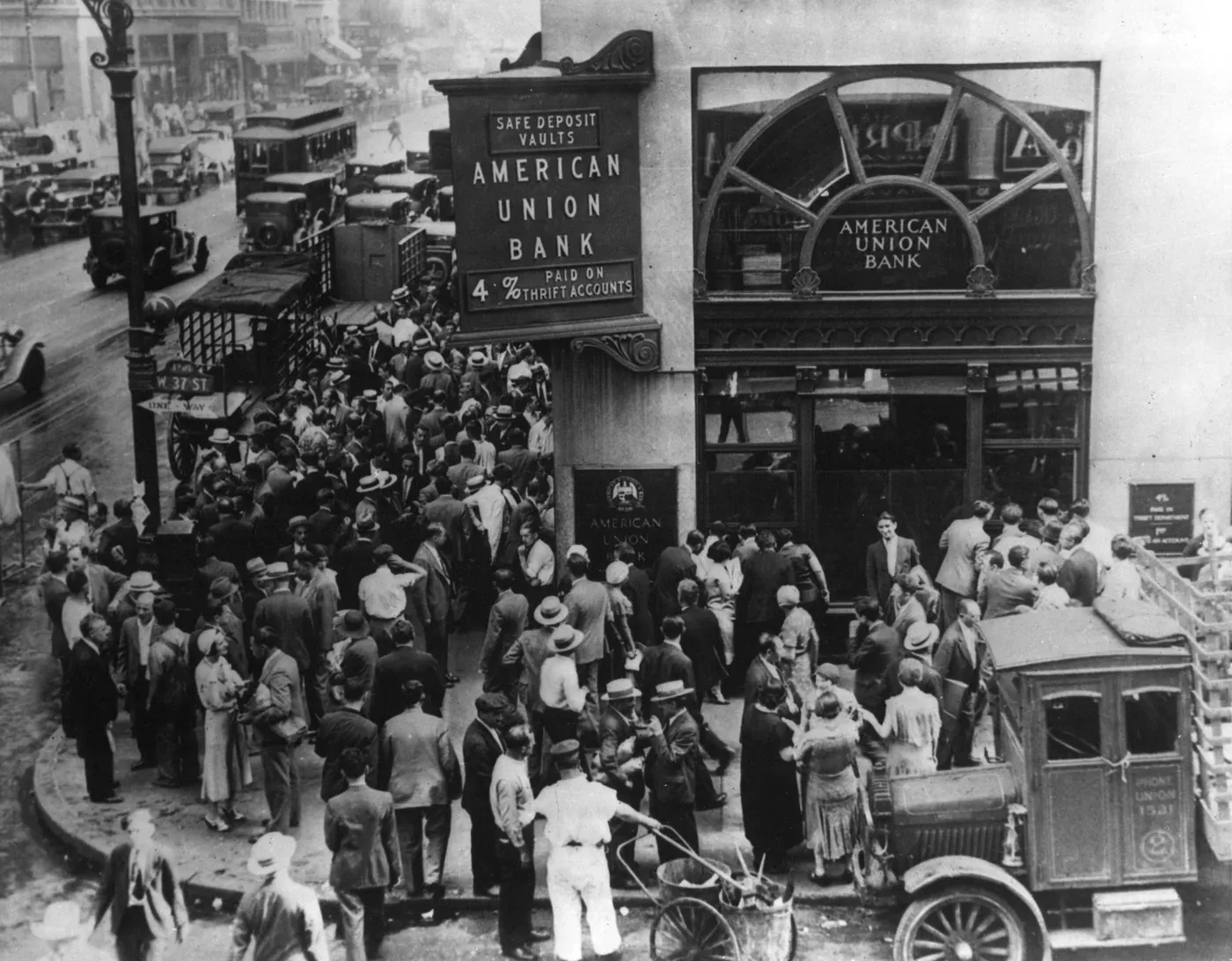
By the spring of 1931, New York had just finished building the tallest structure on Earth. The Empire State Building topped out that April and opened its doors on 1 May, a monument to prosperity raised, improbably, in the depths of an economy that had been shrinking for a year and a half. Two months later, on 30 June, one of the banks that might have financed a building like it (the American Union Bank on 42nd Street) closed its doors for good, its depositors crowded onto the sidewalk outside trying to get their savings out before it was too late. The same year could produce both: a skyscraper built on borrowed optimism, and a bank run that showed exactly how little of that optimism was left.
Plate I
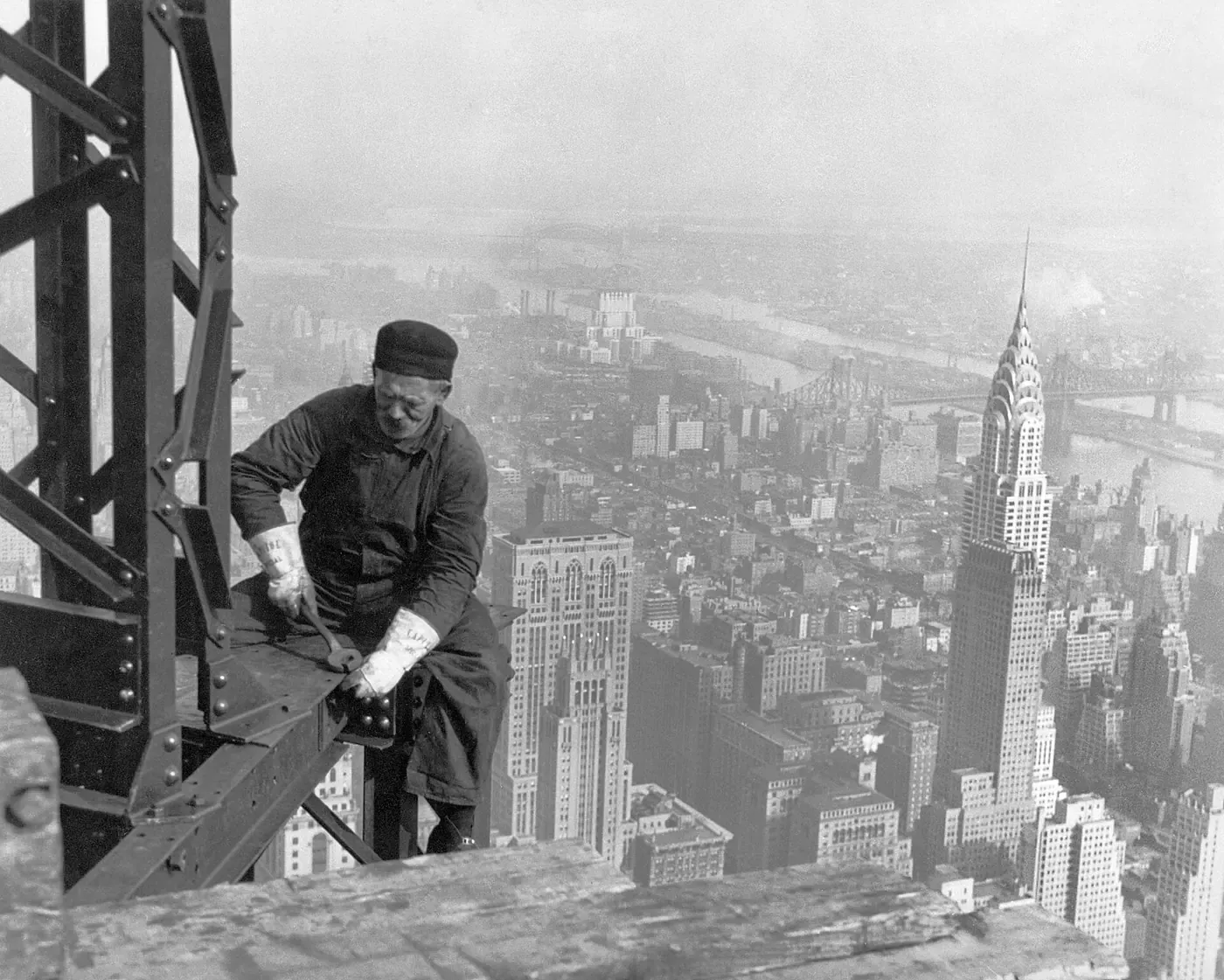

Plate II

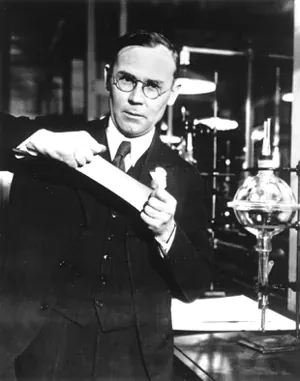
DuPont, unlike the American Union Bank, had cash it did not urgently need, and in 1927 it had used some of that cash to do something almost no American company had tried before: fund a chemistry programme with no product in mind, on the theory that fundamental research would eventually pay for itself. Wallace Carothers, a young Harvard instructor with no interest in industry at all, was hired to run part of that programme. Within a few years it would produce two commercially transformative materials in quick succession: this one, and the synthetic fibre that follows it on this Atlas.
The Discovery: From a Dangerous Compound to a Useful One
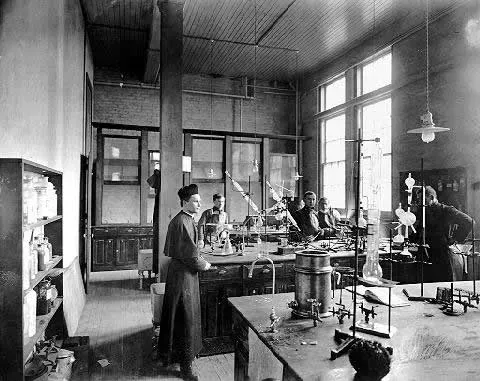
Carothers’ group was building on the work of Father Julius Nieuwland, a priest and chemistry professor at Notre Dame who had found a copper-chloride catalyst that could join two or three acetylene molecules end to end into vinylacetylene and divinylacetylene. DuPont’s research director, Elmer Bolton, had noticed that divinylacetylene had an alarming habit: it could detonate on impact. He asked Nieuwland to collaborate with Carothers’ team to find a safer relative of the same chemistry that might still be useful.
Plate III

In March 1930, Carothers assigned a young chemist named Arnold Collins to prepare a very pure sample of divinylacetylene. While distilling the products of the reaction, Collins collected a small amount of an unidentified liquid and set it aside in a stoppered test tube. A few days later he found it had congealed on its own into a clear, solid mass, and when he worked the mass loose from the glass, it bounced. The liquid was chloroprene, and it had polymerised into a rubber without being asked to. DuPont spent the following year turning that accident into a commercial product, and introduced it on 2 November 1931 under the trade name DuPrene.
Plate IV

The Molecular Marvel: Understanding Polychloroprene
Chloroprene is butadiene with one hydrogen swapped for a chlorine atom, and that single substitution changes the polymer’s chemistry as much as its name suggests. Once joined into a chain, most of the repeat units line up in the same trans orientation, which lets the material crystallise when it is stretched in much the way natural rubber does. This is a self-reinforcing trick that gives unfilled polychloroprene real strength on its own. The chlorine atom carried on each unit does the rest of the work: it makes the backbone more polar than a plain hydrocarbon rubber, which is exactly why polychloroprene shrugs off ozone, sunlight and many chemicals that quietly degrade natural rubber and polybutadiene over time.
Properties: What the Material Actually Does
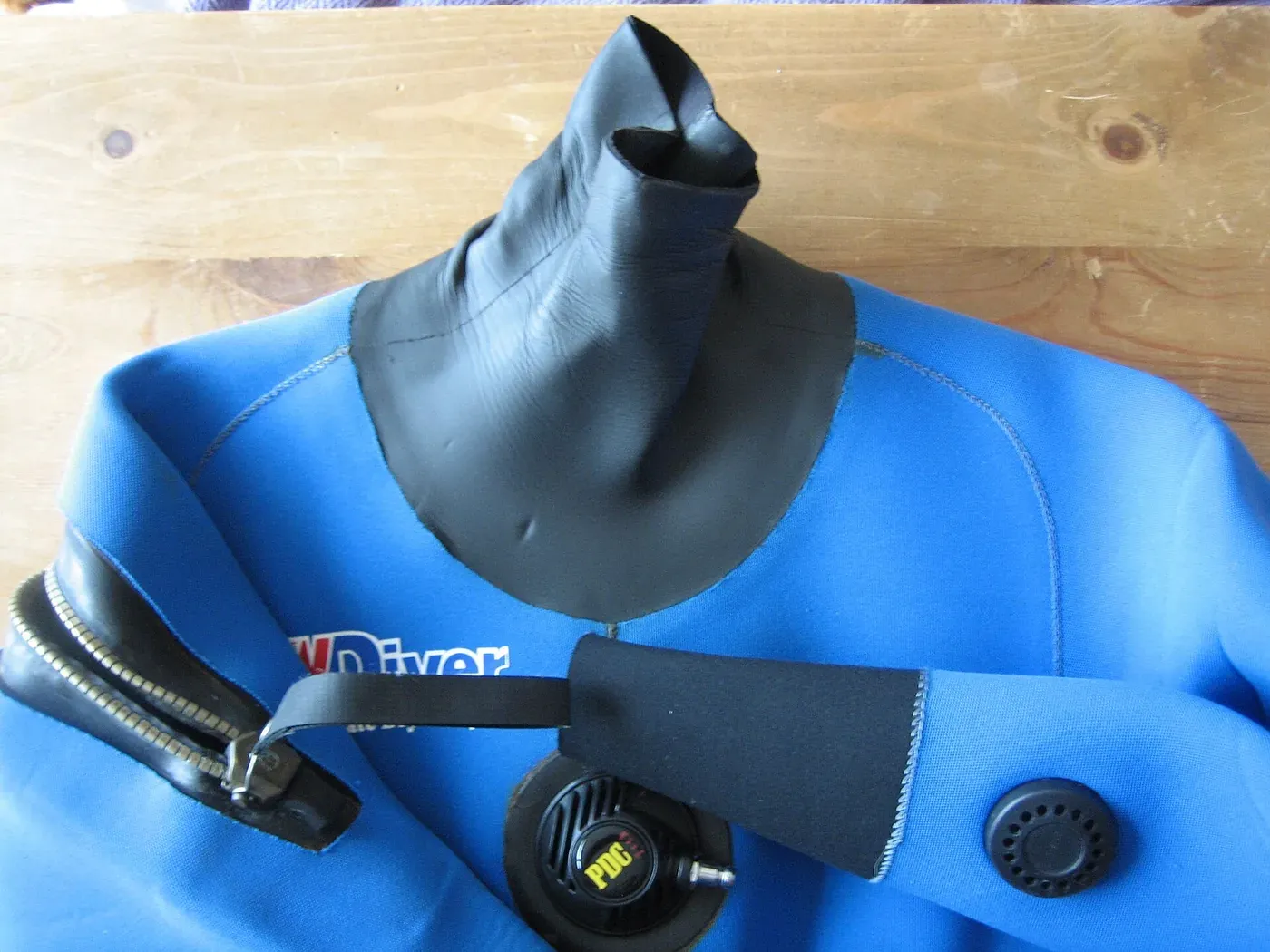
Polychloroprene is dense enough to sink rather than float, a small giveaway that chlorine, not just carbon and hydrogen, is doing a lot of the work in its backbone. It resists ignition unusually well for a rubber and barely takes on water even after prolonged soaking, which is part of why it became the default material for wetsuits and drysuits rather than staying a curiosity. Its resistance to acids, alkalis and plain aliphatic solvents is genuinely good, and its tolerance of ozone and general weathering set it apart from every rubber that came before it. Its resistance to oils and greases, though, is more modest than its reputation suggests: a plain grade of polychloroprene is not the material to reach for around a fuel line, and aromatic solvents and ketones degrade it only fairly at best.
Plate V

Manufacturing: The Art of Molecular Architecture
Commercial production still runs on the same basic chemistry DuPont settled on in the 1930s: chloroprene monomer, made today from butadiene rather than acetylene, is polymerised in a water emulsion using a free-radical initiator at a mild temperature and a controlled pH. The reaction is deliberately stopped short of completion, and the resulting latex is coagulated, washed and dried into the crumb or sheet form that goes to a rubber compounder. Small changes to that recipe (a different modifier, a different stopping point) produce grades with quite different processing behaviour, which is why polychloroprene is sold as a family of related products rather than one uniform material.
Applications: From Deep Seas to Automotive Engine Bays
Polychloroprene’s ozone and weather resistance made it the obvious choice for products that live outdoors or underwater: wetsuits and drysuits, roofing and window seals, and the flexible boots that protect exposed machine joints from the weather. Its balance of flexibility and chemical stability carries it into automotive timing belts and hoses and industrial gaskets, and its resistance to flame made it an early choice for cable jacketing in places natural rubber could not be trusted.
Grades: One Polymer, Several Personalities
Commercial polychloroprene is not sold as a single product. Sulfur-modified grades crystallise fast and are favoured for adhesives and contact cements; mercaptan-modified grades process more predictably and hold up better to heat, which suits automotive parts; and slower-crystallising grades are chosen wherever a longer working window and good tack matter more than speed. Specialised variants exist for extrusion and for the sustained flexing a diving suit demands, each a variation on the same chlorine-substituted backbone Collins isolated by accident in 1930.
The Legacy Continues
Polychloroprene was the first commercially successful synthetic rubber made in the United States, and it proved something the Depression-era economy badly needed proof of: that an industrial research laboratory, given time and money and no fixed target, could still produce something the whole economy would end up depending on.
values with [n] cite the numbered references·estimates are flagged·“not yet available” and “N/A” are honest states, not gaps
fetching the model…
Polychloroprene repeat unit
A minor component of commercial neoprene; the trans form dominates and is what allows the polymer to crystallise on stretching.
- Abbreviation
- CR
- Type
- polymer family (hub)
- CAS number
- 9010-98-4
- Resin ID code
- none assigned
- Formula
- (C4H5Cl)n[-CH2-C(Cl)=CH-CH2-]nThe trans-1,4 unit is shown, the microstructure that dominates commercial neoprene.
- Repeat unit (BigSMILES)
{[][$]C/C(Cl)=C/C[$][]}- IUPAC name
- Poly(2-chlorobuta-1,3-diene)
- Synonyms
- Neoprene; DuPrene (original trade name)
- Also known as
- NeopreneDuPrene
- Chemical family
- diene-rubber
- Backbone class
- carbon-chain
- Polymerization mechanism
- free-radical
- Constitutional monomer
- Chloroprene
- Polymer class
- elastomer
- Year of origin
- 1931
- Era
- The Birth of Synthetic Polymers (1907-1938): The Bakelite Revolution
- Key figures
- Wallace Carothers · Arnold Collins
- Polymerization type
- free-radical emulsion polymerization
- Common monomers (feedstocks)
- chloroprene
- Catalysts
- potassium persulfate (initiator); metal oxides and thioureas (crosslinking)
Invented by DuPont scientists (with Wallace Carothers' theoretical involvement and Arnold Collins' synthesis work) on April 17, 1930; first marketed in 1931 as 'DuPrene', later renamed Neoprene. Commercial production uses free-radical emulsion polymerization of chloroprene.
- Tacticity
- Predominantly trans-1,4 addition (70–90%, the fraction decreasing at lower polymerization temperature), with minor cis-1,4 (~5–10%) and 1,2-/3,4-isomer content; head-to-head defects ~10–15%.
- Crystal structure
- Monoclinic unit cell per Wypych 2016 (a:b:c=1.325:0.763:1.415 nm for uncrosslinked macromer; 0.917:0.992:1.22 nm for crosslinked rubber); an orthorhombic unit cell (a=0.884, b=1.024, c=0.48 nm, 4 repeat units/cell) is separately reported by Mark 1999.
- Typical crystallinity
- 26 (18–34) %[2]Undergoes strain-induced crystallization similar to natural rubber.
Molecular weight
- Density
- 1.235 (1.22–1.25) g/cm³[2]20 °C, solid form; foam grades 0.1–0.3 g/cm³
- Melt flow index
- Not applicable
- Refractive index
- 1.555 (1.552–1.558)[2]20 °C
- Transmittance
- not yet available
- Haze
- not yet available
- Gloss
- not yet available
- Water absorption
- 0.9 %[2]equilibrium, 23 °C water immersion
- Dielectric constant
- 7 (5–9)[2]100 Hz to 1 MHz
- Dielectric strength
- not yet available
- Electrical conductivity
- not yet available
- Glass transition (Tg)
- -35.5 (-46–-25) °C[2]predominantly trans-1,4; cis-1,4 form: -20 °C
- Melting temperature (Tm)
- 45–92 °C[2]DSC; cis-1,4 form ~70 °C, trans-1,4 form 80–115 °C
- Crystallization (Tc)
- not yet available
- Heat deflection (HDT)
- Not applicable
- Decomposition onset
- [2]>200 °C
- Thermal conductivity
- 0.17 (0.15–0.19) W/(m·K)[2]20 °C
- Tensile modulus
- 6.136 MPa[1]Young's modulus.
- Yield strength
- 0.57 MPa[2]reported tensile stress at yield; no distinct yield point in most CR grades, but the handbook gives this measured value. See tensile_strength_at_break for ultimate strength.
- Tensile strength at break
- 15.6 (10.3–20.9) MPa[2]
- Elongation at break
- 600 (380–955) %[2]
- Impact strength (Izod)
- Not applicable
- Impact strength (Charpy)
- Not applicable
- Hardness
- 63.5 (42–85) Shore A[2]Durometer, formulation-dependent.
- Flexural modulus
- Not applicable
- Poisson's ratio
- not yet available
- Coefficient of friction
- not yet available
- Solvent: oils_and_greases
- poor[2]handbook rates greases & oils resistance as poor, correcting an earlier inferred estimate
- Solvent: acids
- good[2]dilute and concentrated
- Solvent: alcohols
- good[2]
- Solvent: alkalis
- good[2]
- Solvent: aliphatic hydrocarbons
- good[2]
- Solvent: aromatic hydrocarbons
- fair to poor[2]
- Solvent: esters
- fair to poor[2]
- Solvent: ketones
- fair to poor[2]
- Weathering / UV
- Good weathering/ozone resistance relative to general-purpose diene rubbersestimate[1]
- Hydrolysis resistance
- Not applicable
- Flammability (UL94)
- not yet available
- Limiting oxygen index
- 37.5 (28–47) %[2]unfilled; flame-retarded grades reach 46–59%
- Solubility parameter (δ)
- 18.365 (17.6–19.13) MPa^0.5[2]exp.; calc.=16.59–19.19
Gas permeability
not yet available
Polymer-solvent interaction parameter (χ)
not yet available
- Processing methods
- emulsion polymerization + compounding/vulcanizationfoam expansion (wetsuit-grade)
- Drying required
- not yet determined
- Processing temperature
- 70 (40–100) °C[2]40–100 °C extrusion; 50–100 °C sheet calendering
- Shrinkage rate
- not yet available
- Marine & sportswetsuits and drysuits
- Industrialgaskets · hoses · corrosion-resistant coatings
- Medicalgloves · orthopaedic braces
- Constructionadhesive bases · fire-door weather stripping
- Recyclable
- No
- Biodegradable
- No
- Degradation pathway
- not yet available
- [1]PolychloropreneWikipediaAccessed 2026-07-14https://en.wikipedia.org/wiki/Polychloroprene[wiki-polychloroprene]
- [2]Handbook of PolymersChemTec Publishinghttps://www.worldcat.org/isbn/9781895198928[handbook-wypych-2016]
- [3]Polymer Data HandbookOxford University Presshttps://search.worldcat.org/search?q=Polymer+Data+Handbook+Mark+1999[handbook-mark-1999]
Illustrations
- Plate IA structural worker on the Empire State Building's frame, photographed by Lewis Hine during construction, an act of pure economic confidence rising directly out of the Depression's first year.Wikimedia Commons
- Plate IIDepositors gathered outside the American Union Bank on the day it failed, 30 June 1931. This was the same year, a few miles south, that a DuPont laboratory quietly finished commercialising a genuinely new material.Wikimedia Commons
- Plate IIIFather Julius Nieuwland, whose acetylene chemistry, and whose explosive by-product, set DuPont's search for a safer relative in motion.Wikimedia Commons
- Plate IVWallace Carothers in his DuPont laboratory, the same research group, and the same year, that gave chloroprene its polymer and, soon after, gave the world nylon.Wikimedia Commons
- Plate VNeoprene seals on a modern diving drysuit. They rely on the low water absorption and weather resistance that made this material a natural fit for the sea, decades before recreational diving existed to need it.Wikimedia Commons