The Specialty Polymers Age (1980-1999)
Polylactic Acid (PLA)
Nature's Answer to the Plastic Crisis
By 1982, American corn had become too good at being corn. A decade of “fencerow to fencerow” planting, encouraged by Washington to feed a booming export market, had left grain elevators overflowing just as that export market collapsed: the Soviet Union, embargoed after its invasion of Afghanistan, had gone looking elsewhere for grain, and it never fully came back. Corn that had sold for what felt like real money in the mid-1970s was fetching barely two dollars a bushel. Farmland bought on the strength of those earlier prices was now worth a third less than the debt still owed against it, and across the Midwest that arithmetic was starting to foreclose on entire families.
Plate I
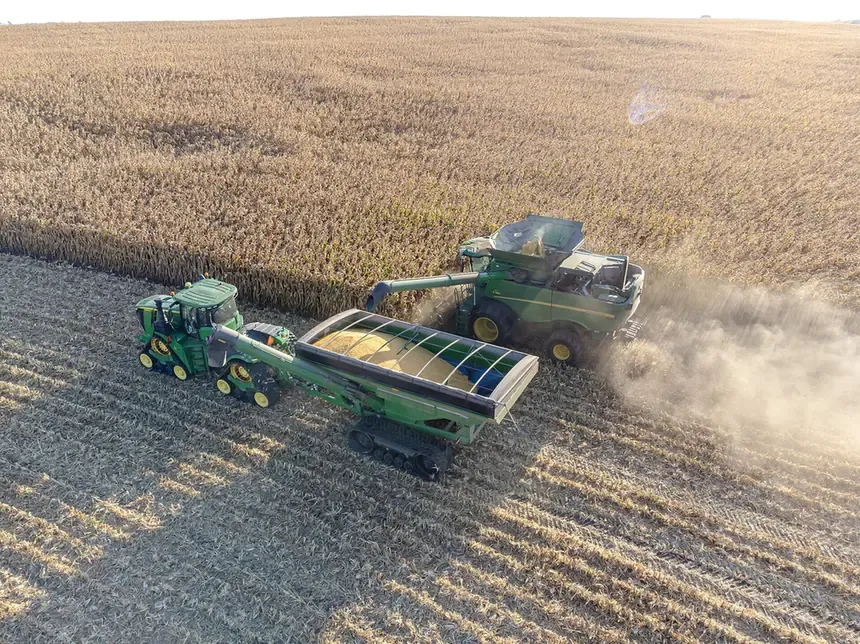

None of this was a chemistry problem, but it created one worth solving: what else could a bushel of corn become, besides livestock feed or a export contract nobody wanted anymore? The chemistry itself was not new. Wallace Carothers, the DuPont chemist better known for inventing nylon, had polymerised lactic acid (the same acid fermentation produces in soured milk, and in a runner’s muscles) into a plastic as early as 1932, and DuPont patented a production method not long after. It went nowhere, because nobody in the 1930s or the 1950s needed a plastic made from farm sugar badly enough to solve the hard part: getting the molecular weight high enough, cheaply enough, for the polymer to hold together as anything more than a laboratory curiosity. What 1982 supplied was not a new reaction. It was a reason.
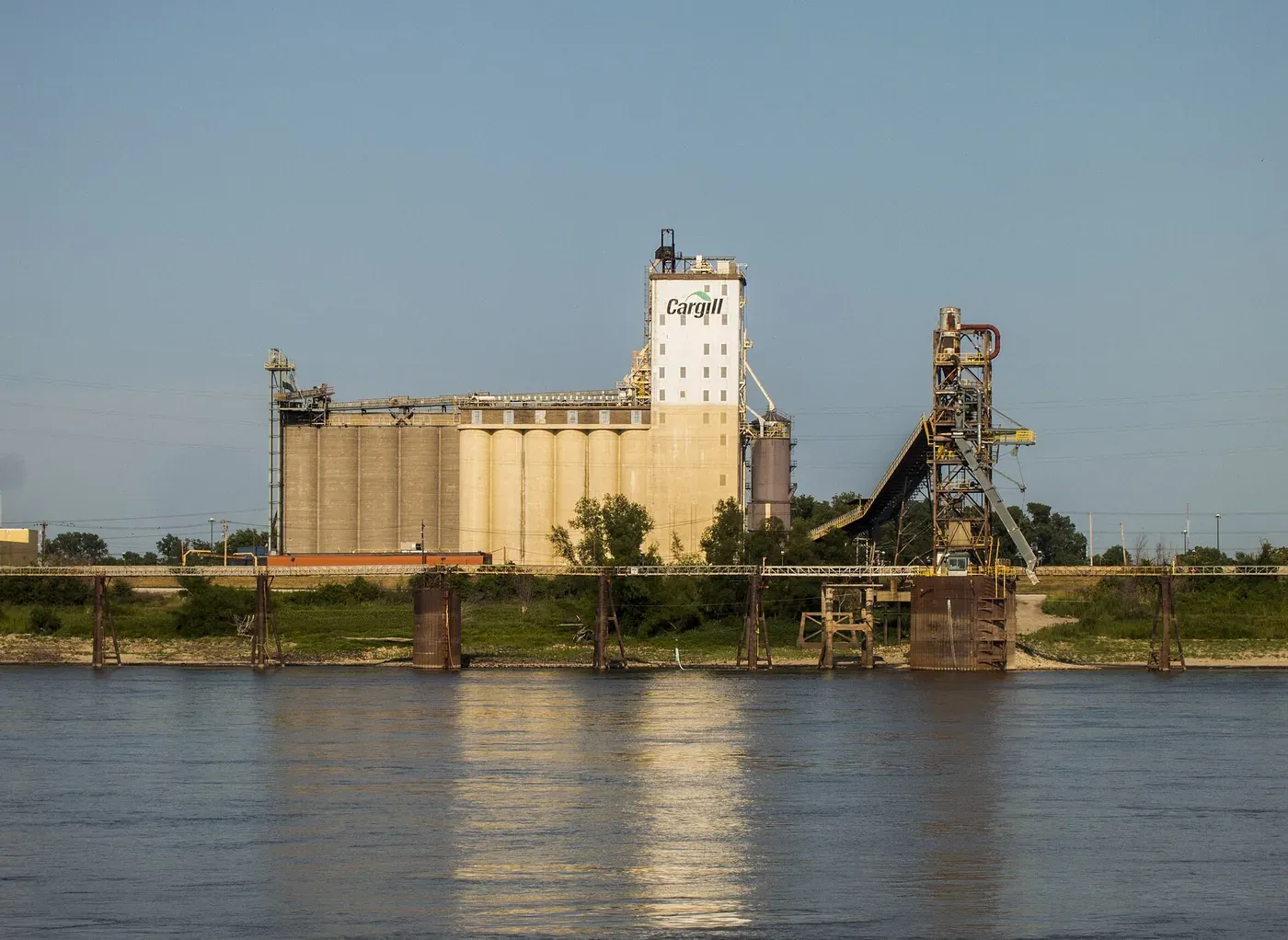
That reason belonged, in the years that followed, to agribusiness rather than to a chemistry department. Grain companies that had spent a generation moving corn from field to ship now had every incentive to look for a use that didn’t depend on someone else wanting to buy a bushel of it, and Cargill (one of the country’s largest handlers of that surplus grain) was exactly positioned to go looking.
Plate II

A Slow Second Act
It took the better part of two decades for that incentive to become a product. Patrick Gruber, a young chemist, joined Cargill in 1988 with the loose assignment of finding new uses for corn sugars, and (according to a story the company still tells) made his first usable batch of high-molecular-weight polylactic acid at home, on his own kitchen stove. The industrial version of that kitchen chemistry was ring-opening polymerisation: rather than trying to link lactic acid molecules end to end directly, which stalls out at low molecular weight, the process first converts them into a cyclic dimer called lactide, then snaps that ring open into a growing chain under a tin catalyst. It was the piece Carothers’ generation never solved cheaply, and solving it is what finally made corn-based plastic an industrial material rather than a curiosity.
Cargill formalised the effort as a joint venture with Dow Chemical in 1997, opened a dedicated production plant in Blair, Nebraska, in 2001, and eventually took full ownership of what became NatureWorks, now jointly held with the Thai energy and chemicals group PTT Global Chemical. The Blair plant alone now turns out on the order of 150,000 tonnes of PLA resin a year, sold under the brand name Ingeo, which makes PLA the only bioplastic on this Atlas to have genuinely reached commodity scale: a plastic sold not by the kilogram to a specialty buyer but by the tanker-load, priced to compete with the petroleum plastics it was invented to answer.
Plate III

What Corn Sugar Becomes
The route from field to resin runs through fermentation before it ever reaches a reactor. Corn starch is broken down into glucose, and bacteria (much as they do in a vat of yogurt or a barrel of silage) convert that glucose into lactic acid. Purifying and drying the acid, then cyclising it into lactide and running the ring-opening polymerisation, is where the actual polymer chemistry happens, typically under vacuum with a tin-based catalyst at a temperature well above where the resin will ever be used. What comes out is a polymer whose chains coil into a loose helix, and whose behaviour depends heavily on a detail invisible in the formula: lactic acid comes in left- and right-handed mirror-image forms, and the ratio between them in the finished lactide (controlled during fermentation and purification) governs how readily the chains can pack into crystals, which in turn governs how heat-resistant the finished plastic will be.
Properties: Corn’s Best Impression of a Commodity Plastic
PLA sits slightly denser than water, which is one reason it behaves so differently from ocean plastic litter: rather than drifting on the surface, it sinks. It softens at a temperature comfortably above a warm room but well below boiling water, which is why a PLA cup left in a hot car will droop long before a polyethylene one does, and it holds a genuinely high melting point above that, high enough that the plain resin decomposes chemically before it would ever boil away. Mechanically, it behaves like a moderately stiff, moderately strong commodity plastic: strong enough for rigid packaging and cutlery, but a material that snaps cleanly under sudden strain rather than stretching, with almost none of the give that makes polyethylene forgiving. It resists oils and greases reasonably well but is vulnerable to alcohols, aromatic solvents and ketones, and unmodified PLA is no more resistant to catching fire than the conventional plastics it displaces; nothing about being corn-derived makes it fire-safe.
The property that actually matters to PLA’s whole reason for existing is how it disappears, and here the honest story is more qualified than the marketing usually allows. PLA breaks down by hydrolysis (water attacking the ester bonds in the chain), but only at a practical rate once the temperature climbs well above what any backyard compost heap reaches; it is built for an industrial composting facility, not a garden bin, and left in most soil or fresh water it behaves far more like an ordinary plastic than its “biodegradable” label implies. In the ocean specifically, PLA does not meaningfully outperform conventional plastic litter. This is a genuine limitation on the claim, and one worth being honest about precisely because so much of PLA’s identity rests on being the plastic that goes away.
Applications: A Bioplastic That Actually Scaled
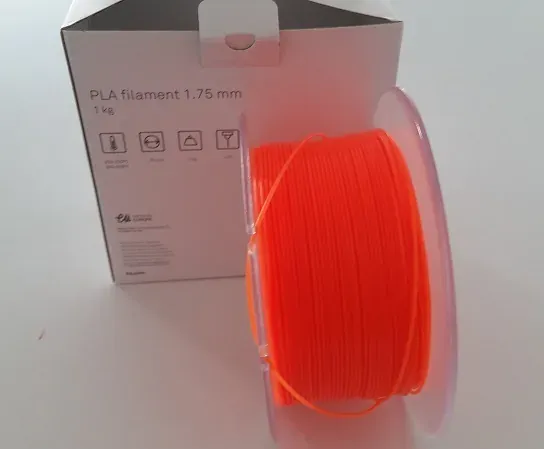
Packaging accounts for the majority of PLA produced: cups, clamshells, films and cutlery that trade the durability of polyethylene for compostability under the right industrial conditions. It is also, by a wide margin, the most common material fed into desktop 3D printers, prized there less for any environmental credential than for the practical fact that it prints at comparatively low temperatures with little warping, which makes it forgiving for hobbyists and unheated print rooms alike.
Plate IV

Medicine, curiously, got there first and never left: surgical sutures, bone anchors and resorbable implants made from PLA or its lactide relatives were already established before the Blair plant existed, exploiting the same hydrolysis that later became PLA’s environmental selling point, just on the timescale of a healing wound rather than a compost pile.
Looking Forward
PLA’s real achievement was never the chemistry: Carothers had proven that in 1932. It was proving, fifty years and one farm crisis later, that a plastic could be grown rather than drilled for, and sold at a price that let it compete on the open market rather than surviving as a boutique alternative. Current research keeps pushing at PLA’s two weak points, heat resistance and brittleness, in the hope of moving it out of disposable packaging and into products meant to last.
values with [n] cite the numbered references·estimates are flagged·“not yet available” and “N/A” are honest states, not gaps
fetching the model…
Polylactic Acid repeat unit
- Abbreviation
- PLA
- Type
- polymer family (hub)
- CAS number
- 26100-51-6
- Resin ID code
- 7
- Formula
- (C3H4O2)n[-O-CH(CH3)-CO-]nThe L unit is shown. Commercial PLA is made from L-lactide, D-lactide or their mixtures, and the L:D ratio governs how crystalline, and how heat-resistant, the material is.
- Repeat unit (BigSMILES)
{[][>]O[C@@H](C)C(=O)[<][]}- IUPAC name
- Poly(2-hydroxypropanoic acid)
- Synonyms
- polylactide
- Also known as
- polylactide
- Chemical family
- biodegradable-polyesterpolyester
- Backbone class
- heterochain
- Polymerization mechanism
- ring-opening-polymerization
- Constitutional monomer
- Lactic acidLactide
- Polymer class
- thermoplastic
- Year of origin
- 1982
- Era
- The Specialty Polymers Age (1980-1999)
- Key figures
- Wallace Carothers · Patrick Gruber · NatureWorks
- Events referenced
- 1982 collapse in U.S. corn prices and farmland values (1980s farm crisis) · 1980 U.S. grain embargo against the Soviet Union
- Polymerization type
- ring-opening polymerization (of lactide)
- Common monomers (feedstocks)
- lactic acid (fermented from corn, cassava, sugarcane starch), lactide
- Catalysts
- tin(II) ethylhexanoate
The most common industrial route is ring-opening polymerization of lactide using metal catalysts such as tin ethylhexanoate; direct condensation of lactic acid under vacuum is an alternative route, and zeolite-catalyzed synthesis is an emerging method.
- Tacticity
- not yet available
- Crystal structure
- not yet available
- Typical crystallinity
- 20–47 %[2]Depends on the L-/D-lactide stereochemical ratio; PLLA can be semi-crystalline, PDLLA is amorphous. Reported as 25–70% for L-PLA specifically (65% in fiber form, 10–20% in film); 20–44% by WAXD.
Molecular weight
- Density
- 1.25 (1.21–1.29) g/cm³[2]20 °C
- Melt flow index
- 16.5 (3–30) g/10min[2]230 °C / 3.8 kg
- Refractive index
- 1.4 (1.35–1.45)[2]20 °C
- Transmittance
- 2.2 %[2]
- Haze
- not yet available
- Gloss
- not yet available
- Water absorption
- 0.5 %[2]equilibrium, immersion in water, 23 °C
- Dielectric constant
- not yet available
- Dielectric strength
- not yet available
- Electrical conductivity
- not yet available
- Glass transition (Tg)
- 65 (55–75) °C[2]Range reflects L-/D-lactide ratio: amorphous D,L-PLA runs toward the low end, semi-crystalline L-PLA toward the high end.
- Melting temperature (Tm)
- 171 (164–178) °C[2]DSC. 180–184 °C reported for L-PLA specifically; lower range for mixed-stereochemistry grades.
- Crystallization (Tc)
- not yet available
- Heat deflection (HDT)
- not yet available
- Decomposition onset
- 245 (235–255) °C[3]L-PLA, Mw (0.5–3)×10⁵; reported as 508–528 K. D,L-PLA reported as 528 K (255 °C).
- Thermal conductivity
- not yet available
- Tensile modulus
- 9350 (2700–16000) MPa[2]Wide range reflects stereochemistry/crystallinity/molecular weight variation. A narrower 3,700–4,100 MPa is also reported under 'Young's modulus' in the same source.
- Yield strength
- 71.3 (65.6–77) MPa[2]Tensile stress at yield.
- Tensile strength at break
- 62 (52–72) MPa[2]General grade; 27–41 MPa reported for D,L-PLA, 55–82 MPa for L-PLA.
- Elongation at break
- 5 (4–6) %[2]General grade; 3–10% reported for D,L-PLA, 5–10% for L-PLA.
- Impact strength (Izod)
- 18.8 (13–24.6) J/m[2]notched, 23 °C
- Impact strength (Charpy)
- not yet available
- Hardness
- not yet available
- Flexural modulus
- 2400 (1000–3800) MPa[2]
- Poisson's ratio
- not yet available
- Coefficient of friction
- not yet available
- Solvent: water
- Insoluble[1]
- Solvent: alcohols
- poor[2]
- Solvent: aromatic hydrocarbons
- poor[2]
- Solvent: esters
- poor[2]
- Solvent: greases & oils
- good[2]
- Solvent: halogenated hydrocarbons
- poor[2]
- Solvent: ketones
- poor[2]
- Weathering / UV
- not yet available
- Hydrolysis resistance
- Degrades via hydrolysis to lactic acid under industrial composting conditions (58°C minimum)[1]
- Flammability (UL94)
- not yet available
- Limiting oxygen index
- 19 %[2]Unmodified grade; 23–26% with flame retardant additives.
- Solubility parameter (δ)
- 20 (19–21) MPa^0.5[2]exp.=19.0–21.0; calc.=19.2–20.3
Gas permeability
not yet available
Polymer-solvent interaction parameter (χ)
not yet available
- Processing methods
- FDM 3D printing filamentinjection moldingfilm extrusion
- Drying required
- Yes
- Processing temperature
- 237.5 (220–255) °C[2]Extrusion; 280–300 °C for fiber spinning.
- Shrinkage rate
- not yet available
- 3D printingmost widely used FDM filament material
- Packagingflexible and rigid packaging~65% of PLA production.
- Medicalsurgical sutures · bone anchors · resorbable implants (degrade over 6 months-2 years)
- Recyclable
- Yes
- Biodegradable
- Yes
- Degradation pathway
- Hydrolysis to lactic acid; requires industrial composting conditions (58°C minimum) for effective degradation within a practical timeframe.
Does not fully disintegrate under normal marine conditions and degrades at rates comparable to conventional plastics in ocean environments. This is a real limitation on its 'biodegradable' marketing when it ends up as marine litter rather than industrial compost.
- [1]Polylactic acidWikipediaAccessed 2026-07-14https://en.wikipedia.org/wiki/Polylactic_acid[wiki-pla]
- [2]Handbook of PolymersChemTec Publishinghttps://www.worldcat.org/isbn/9781895198928[handbook-wypych-2016]
- [3]Polymer Data HandbookOxford University Presshttps://search.worldcat.org/search?q=Polymer+Data+Handbook+Mark+1999[handbook-mark-1999]
Illustrations
- Plate ICorn coming off the field. By 1982 the United States was harvesting far more of it than the world's markets wanted to buy.Wikimedia Commons
- Plate IIA Cargill grain elevator on the Mississippi. The same company that moved the corn surplus by rail and barge would later fund the research that turned some of it into plastic.Wikimedia Commons
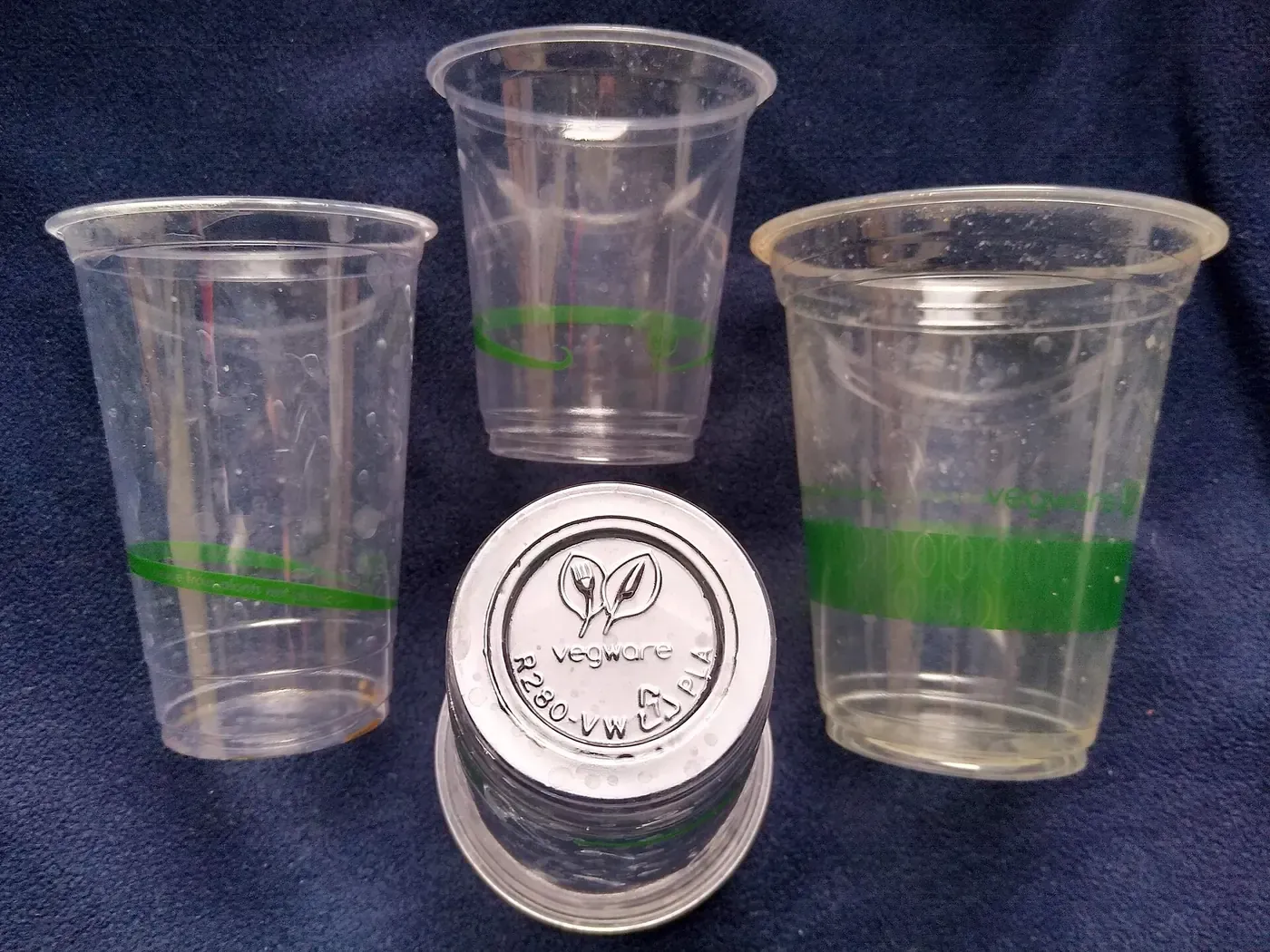
- Plate IIIPLA drinking cups, stamped with the resin code that tells a composting facility what it is holding.Wikimedia Commons
- Plate IVPLA sold as filament, the form in which most people encounter it today, corn's least likely destination in 1982.Wikimedia Commons