The Engineering Polymers Era (1961-1979)
Polyamideimide (PAI)
The Polymer That Rewired Electronics
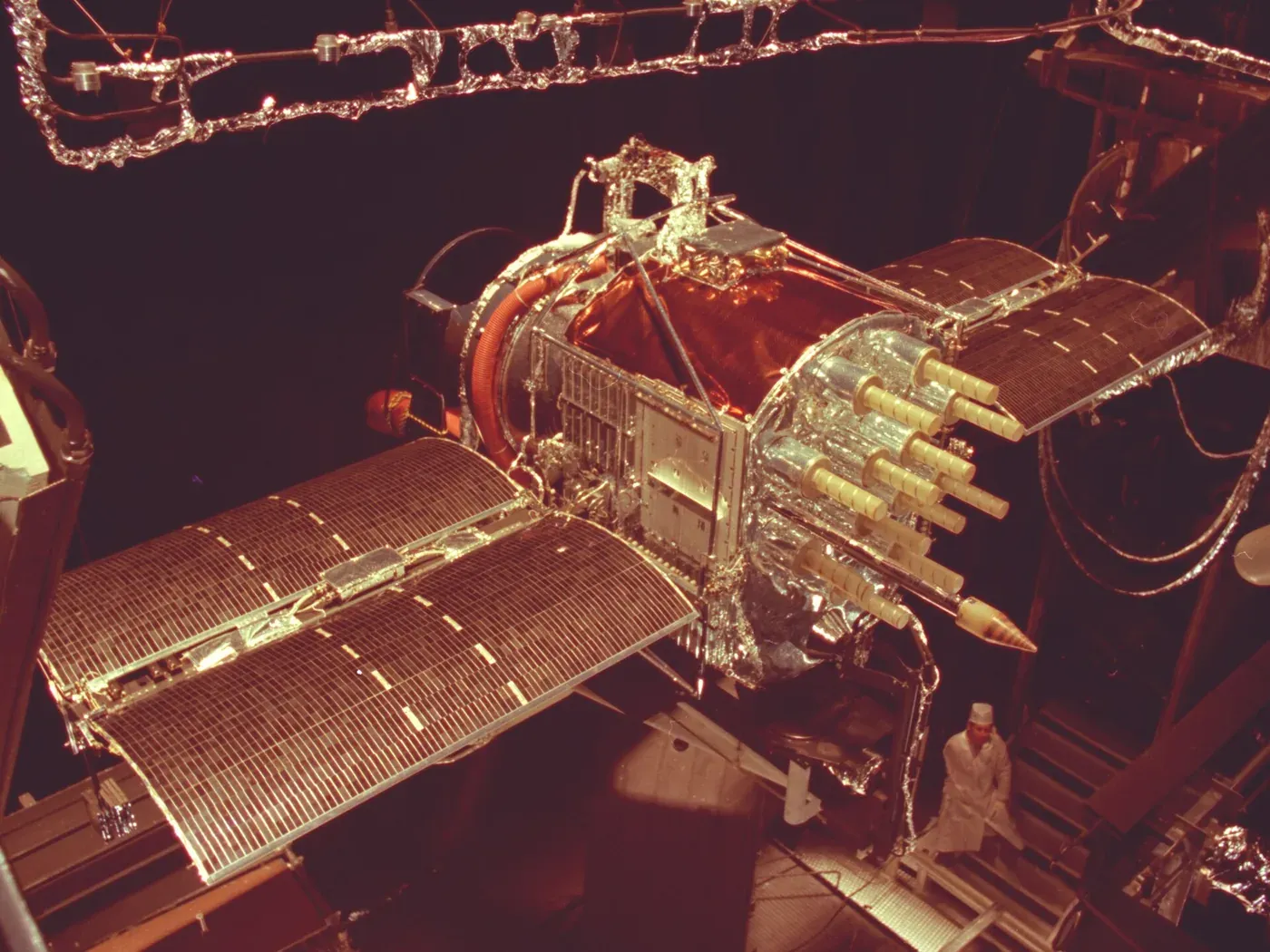
On 22 February 1978, an Atlas rocket lifted off from Vandenberg Air Force Base in California carrying Navstar 1, the first satellite of what would become the Global Positioning System. It had spent the previous year suspended inside a space-simulation chamber at the Arnold Engineering Development Center, wrapped in foil and cycled through every combination of vacuum, heat and cold its engineers could devise, because a satellite that failed after reaching orbit could not be brought home for repair.
Plate I
.jpg)
Nine hundred miles away in Chicago that same year, Illinois Bell and AT&T ran the first public trial of a cellular telephone network, packing enough radio equipment into a car-mounted handset and a citywide grid of towers to let a moving caller pass from one radio cell to the next without the call dropping. A satellite and a phone network were, in their own ways, chasing the same problem: how to pack more electronics into less space and keep all of it running as the heat built up.
Plate II


One of the materials quietly making that possible by 1978 had begun, seventeen years earlier, as the answer to a much smaller question at an oil company in Illinois.
Nylon’s Toughness, Polyimide’s Nerve
DuPont chemists had experimented with combining amide and imide chemistry in a single polymer chain in the mid-1950s, without turning it into a product. Standard Oil of Indiana’s chemical arm, soon renamed Amoco Chemicals, picked the idea back up around 1961, aimed at a specific, stubborn problem nobody else had solved: an insulating enamel for the copper wire wound inside electric motors and generators, one that could keep working at temperatures that would soften or crack an ordinary nylon or polyester wire coating. Amoco registered the resulting resin family as Torlon. Wire enamel was the first product; by the time the market for compact, heat-stressed electronics was expanding through the 1970s, Amoco had grown the same chemistry into an injection-moldable engineering plastic as well.
Plate III

Combining Two Different Kinds of Backbone
PAI’s chain alternates two kinds of link: an amide bond, the same kind of linkage that gives nylon its ability to flex and absorb a sudden load, and an imide ring, the same rigid, heat-stubborn five-membered knot that makes an aromatic polyimide refuse to soften. Aromatic rings connect the two. Put both link types in the same backbone and the polymer inherits a share of each parent’s temperament: markedly tougher and easier to process than a pure aromatic polyimide, and far more heat-resistant than nylon could ever manage on its own. It is not a blend of two separate polymers, the way Noryl combines PPO and polystyrene; it is one chain, built from the start with both kinds of link in it.
A Polymer That Bends Before It Breaks
That hybrid backbone shows up directly in how PAI behaves, and it sets the material apart from most of the rigid aromatic engineering plastics in this atlas. Unfilled Torlon is denser than water but far lighter than the metals it substitutes for in demanding parts, and it carries an unusually high strength for its weight among unreinforced thermoplastics: stiff and strong enough to compete with light metal alloys in a structural part. Unlike a fully rigid aromatic polyimide or a brittle, highly crystalline resin, it will take a real amount of stretch before it fails, closer in that respect to a tough nylon than to glass. It shrugs off almost every class of organic solvent, oil and grease without a mark, and holds up well against dilute acids too, though strong concentrated acids and alkalis remain a genuine weak point. It is hard to ignite and self-extinguishes once a flame source is removed, and months of accelerated outdoor-weathering exposure barely change its strength or flexibility at all. That is an unusually good showing for a plastic this heat-resistant. On temperature, it holds its shape under load at well over twice the temperature of boiling water, and does not have an ordinary melting point to speak of in service: it simply keeps performing, hotter than nearly anything else on the shelf, until it is pushed to genuine extremes.
Two Steps, Two Kinds of Chemistry
Making PAI mirrors the structure it produces. Aromatic diisocyanate and trimellitic anhydride react first, at a moderate temperature, forming an intermediate polyamic acid: soft, soluble chemistry not unlike the first stage of making an aromatic polyimide. Heating the intermediate further closes the imide rings, locking the rigid, heat-resistant half of the structure into place while the amide links formed in the first stage remain free to flex. Controlling that two-stage reaction carefully is what lets Amoco, and later Solvay, sell Torlon as a true engineering resin rather than only as a coating: the material can be shaped while it is still amide-flexible and only becomes fully heat-stable afterward.
From Motor Windings to Racetrack Engines
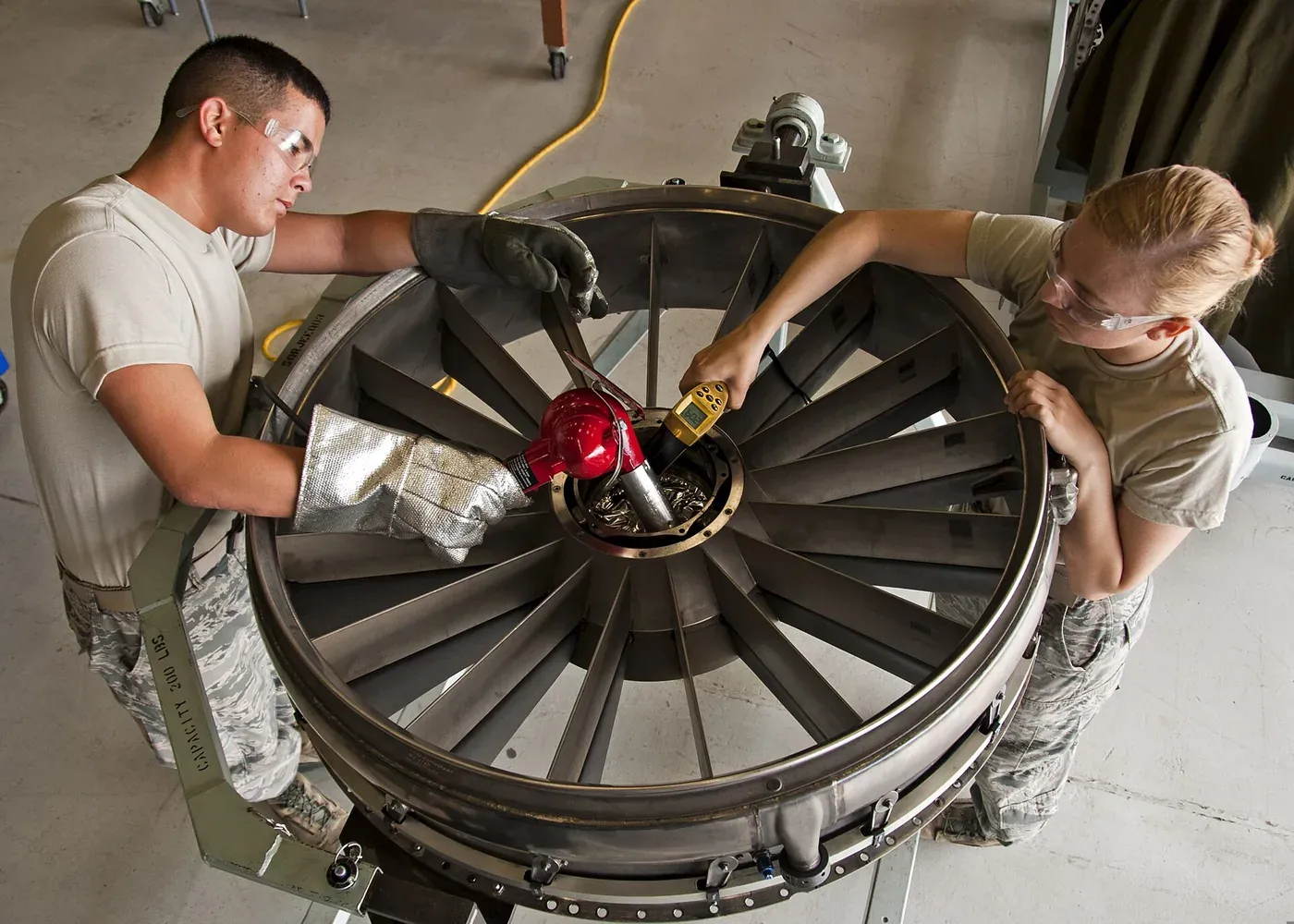
Magnet wire enamel remained Torlon’s signature application through the 1970s and beyond, insulating the windings inside compact, high-output motors and generators that would cook an ordinary coating. Its wear resistance and dimensional stability carried it into precision-machined bearings, bushings and seals for aircraft and industrial machinery, work where a part has to hold its exact tolerance under friction and heat for years without lubrication failing it. Decades later, in 1984, Amoco itself built a working race engine with pistons, valve parts and other components machined from Torlon, which went on to complete six races over two seasons. That was a rolling demonstration of a material developed, originally, to insulate a motor winding rather than survive inside one.
Plate IV

values with [n] cite the numbered references·estimates are flagged·“not yet available” and “N/A” are honest states, not gaps
fetching the model…
Polyamideimide repeat unit
- Abbreviation
- PAI
- Type
- polymer family (hub)
- CAS number
- None (heterogeneous class or not assigned)
- Resin ID code
- none assigned
- Formula
- (C22H14N2O3)n[-N(CO)2-C6H3-CO-NH-C6H4-CH2-C6H4-]nEach repeat carries both an imide ring and an amide link: the imide for thermal stability, the amide for enough chain mobility to be processable.
- Repeat unit (BigSMILES)
{[][>]N1C(=O)c2ccc(cc2C1=O)C(=O)Nc1ccc(cc1)Cc1ccc(cc1)[<][]}- IUPAC name
- —
- Synonyms
- Torlon
- Also known as
- Torlon
- Chemical family
- polyimide
- Backbone class
- heterochain
- Polymerization mechanism
- step-growth-condensation
- Constitutional monomer
- Trimellitic anhydrideDiisocyanate
- Polymer class
- thermoplastic
- Year of origin
- 1978
- Era
- The Engineering Polymers Era (1961-1979)
- Key figures
- Amoco Chemicals
- Events referenced
- First Navstar GPS satellite launched (22 February 1978) · First public trial of a cellular telephone network, Chicago (1978)
- Polymerization type
- step-growth condensation
- Common monomers (feedstocks)
- trimellitic anhydride, diisocyanates
- Catalysts
- not yet available
Prepared from isocyanates and trimellitic anhydride (TMA). Solvay Specialty Polymers is a prominent producer, marketed under the trademark Torlon.
- Tacticity
- not yet available
- Crystal structure
- not yet available
- Typical crystallinity
- 0 %estimate[1]Amorphous.
Molecular weight
- Number average (Mn)
- 18400–86000 g/mol[2]
- Mass average (Mw)
- 20100–220000 g/mol[2]
- Dispersity (Mw/Mn)
- 1.74–2.56[2]
Mark-Houwink constants
not yet available
Combined amide and imide linkages give PAI an unusually high strength-to-weight ratio among unreinforced thermoplastics.
Tg is highly sensitive to the aromatic diamine used in synthesis: reported values for trimellitic-anhydride-derived amide-imides span roughly 206–326 °C, while commercial Torlon itself clusters around 260–285 °C depending on test method.
- Density
- 1.38–1.42 g/cm³[2]unfilled; Mark reports 1.380 g/cm³ for unfilled Torlon 4000T (ASTM D792)
- Melt flow index
- not yet available
- Refractive index
- 1.656[2]
- Transmittance
- not yet available
- Haze
- not yet available
- Gloss
- not yet available
- Water absorption
- 0.33 %[2]equilibrium in water immersion, 23 °C, unfilled
- Dielectric constant
- 3.9–4.2[2]100 Hz-1 MHz, unfilled; Mark reports 4.0 at 1 MHz for unfilled Torlon 4000T
- Dielectric strength
- 17.3–23 kV/mm[2]unfilled; Wypych 23 kV/mm, Mark 17.3 kV/mm for Torlon 4000T (ASTM D149)
- Electrical conductivity
- 3.33 × 10⁻¹⁴ S/m[3]reciprocal of volume resistivity (3.0×10¹³ Ω·m), unfilled Torlon 4000T
- Glass transition (Tg)
- 206–326 °C[2]wide range reflects different amide-imide backbone chemistries; commercial Torlon itself is reported at 260–285 °C (533–558 K, Mark) across different test methods
- Melting temperature (Tm)
- 357 °C[2]DSC. PAI/Torlon is generally regarded as amorphous, but Wypych reports a measured melting endotherm at this temperature.
- Crystallization (Tc)
- Not applicable
- Heat deflection (HDT)
- 252–278 °C[2]ASTM D6481.8 MPa; Wypych reports 278 °C, Mark reports 252–260 °C for unfilled Torlon 4000T
- Decomposition onset
- not yet available
- Thermal conductivity
- 0.24 W/(m·K)[3]ASTM C177unfilled Torlon 4000T
- Tensile modulus
- 4480–5200 MPa[2]unfilled; Wypych 4,480–4,900 MPa, Mark 5,200 MPa for Torlon 4000T (ASTM D638)
- Yield strength
- not yet available
- Tensile strength at break
- 117.2–192 MPa[2]unfilled; Wypych 147–192 MPa, Mark reports 117.2 MPa for Torlon 4000T (ASTM D638, break)
- Elongation at break
- 10–35 %[2]unfilled; Wypych 15–35%, Mark 10–18% for Torlon 4000T (ASTM D638)
- Impact strength (Izod)
- 136–144 J/m[2]notched, 23 °C, unfilled; Wypych 138–144 J/m, Mark 136 J/m for Torlon 4000T (ASTM D256)
- Impact strength (Charpy)
- not yet available
- Hardness
- 78–127 Rockwell E[2]unfilled; Wypych 86–127, Mark 78 for Torlon 4000T (ASTM D785)
- Flexural modulus
- 3590–5030 MPa[2]unfilled; Wypych 3,620–5,030 MPa, Mark 3,590 MPa for Torlon 4000T (ASTM D790)
- Poisson's ratio
- 0.45[2]
- Coefficient of friction
- not yet available
- Solvent: dilute acids
- excellent[2]
- Solvent: concentrated acids
- poor[2]
- Solvent: alcohols
- excellent to poor[2]varies by specific alcohol
- Solvent: alkalis
- poor[2]
- Solvent: aliphatic hydrocarbons
- excellent[2]
- Solvent: aromatic hydrocarbons
- excellent[2]
- Solvent: esters
- excellent[2]
- Solvent: greases & oils
- excellent[2]
- Solvent: halogenated hydrocarbons
- excellent[2]
- Solvent: ketones
- excellent[2]
- Weathering / UV
- good: 93% tensile strength retention and 100% elongation retention after 10,000 h carbon-arc Weather-O-Meter exposure[2]
- Hydrolysis resistance
- not yet available
- Flammability (UL94)
- V-0[2]unfilled and lightly filled (TiO2/fluorocarbon) grades both rate V-0
- Limiting oxygen index
- 39.5–45 %[2]unfilled
- Solubility parameter (δ)
- not yet available
Gas permeability
not yet available
Polymer-solvent interaction parameter (χ)
not yet available
- Electricalmagnet wire enamel
- Industrialmolded or machined precision articles · decorative coatings
- Emerginggas separation membranes
- Recyclable
- No
- Biodegradable
- No
- Degradation pathway
- not yet available
- [1]Polyamide-imideWikipediaAccessed 2026-07-14https://en.wikipedia.org/wiki/Polyamide-imide[wiki-pai]
- [2]Handbook of PolymersChemTec Publishinghttps://www.worldcat.org/isbn/9781895198928[handbook-wypych-2016]
- [3]Polymer Data HandbookOxford University Presshttps://search.worldcat.org/search?q=Polymer+Data+Handbook+Mark+1999[handbook-mark-1999]
Illustrations
- Plate IA full-scale GPS satellite undergoing environmental testing in 1977, ahead of the first Navstar launch in February 1978. The testing proved it could survive extremes no repair crew could ever reach.Wikimedia Commons
- Plate IIA car-mounted mobile radio telephone of the kind Illinois Bell and AT&T's 1978 Chicago trial relied on, before cellular networks shrank the equipment enough to fit a pocket.Wikimedia Commons
- Plate IIIAn Amoco filling station, photographed in 1979: the public face of the same company whose chemicals division, far from any gas pump, had spent nearly two decades turning a laboratory curiosity into Torlon.Wikimedia Commons
- Plate IVAircraft engine maintenance work of the kind PAI's precision-machined bearings and bushings are built to survive, holding tight tolerances under friction and heat without lubrication failing.Wikimedia Commons