The Wartime Innovation Period (1939-1945)
Nylon (PA66)
The Synthetic Fiber That Revolutionized Fashion and Industry
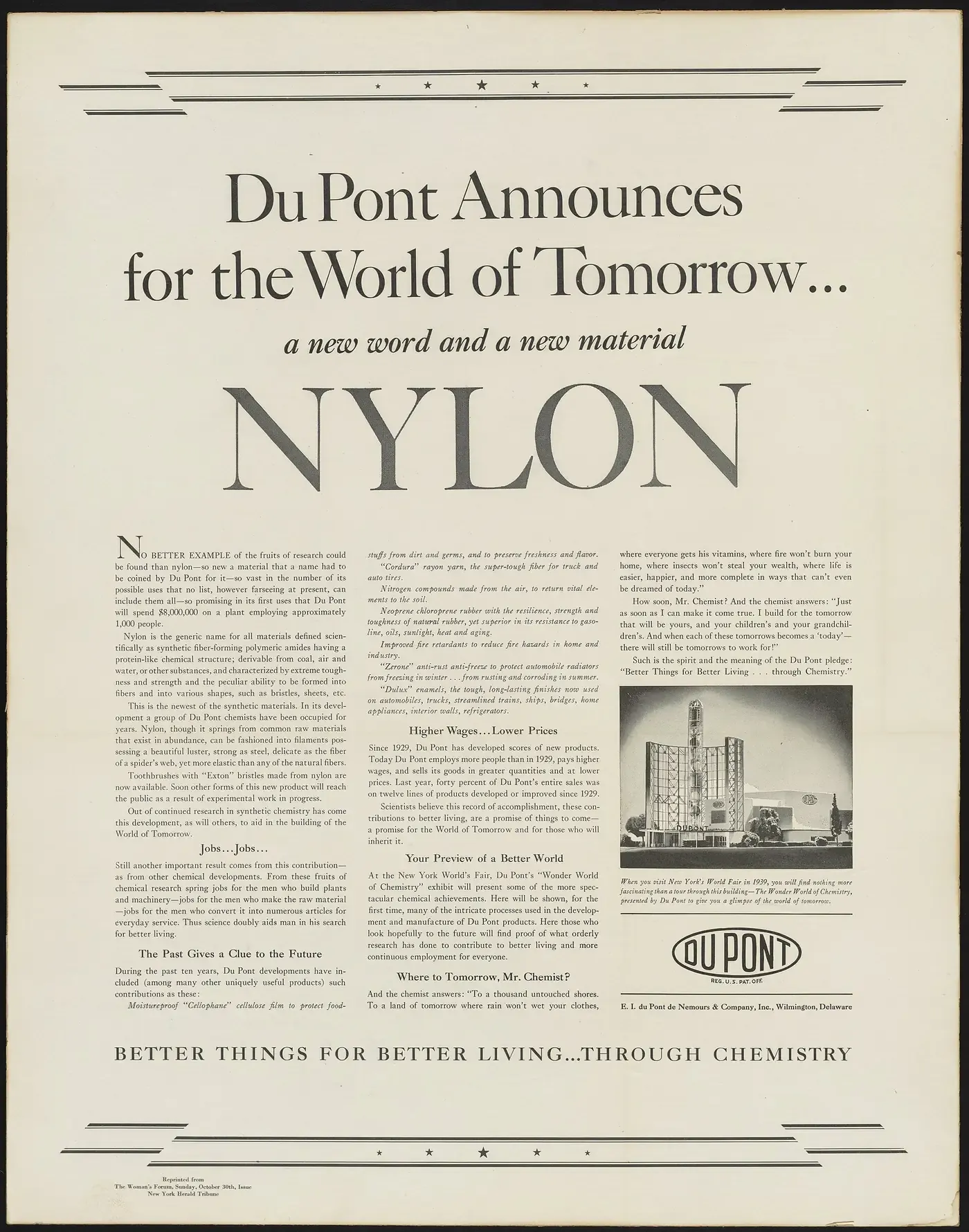
On 30 April 1939, the New York World’s Fair opened on reclaimed marshland in Queens under a single motto: “The World of Tomorrow.” Visitors queued for a television set, a robot that smoked cigarettes, and a time capsule not to be opened for five thousand years. DuPont built an entire pavilion, the “Wonder World of Chemistry,” to show off what its own laboratories had been quietly producing for a decade, and the exhibit that stopped the most people in their tracks was a fiber that had not existed in nature a year before. DuPont had announced it to the press the previous October, in an advertisement promising “a new word and a new material”: nylon.
Plate I


Plate II

The fair’s own subtitle would prove unbearably ironic. Four months after it opened, Germany invaded Poland and Europe was at war. The material DuPont had built for stockings, toothbrush bristles and fishing line would spend most of the next six years doing something else entirely.
The Chemist Behind the Fiber
Nylon 6,6 was invented at DuPont’s Wilmington laboratory by Wallace Hume Carothers, whose team first drew it from a flask on the last day of February 1935. Carothers does not get his life told again here: his biography, his theoretical breakthroughs, and his death by suicide in 1937, two years before the material he built reached the public, belong to his own page in this Atlas. What belongs here is the material itself: what it is, why 1939 was the year the world met it, and what it went on to do.
The “66” in its name is bookkeeping, not marketing: it comes from hexamethylenediamine and adipic acid, each contributing a chain six carbons long, joined end to end in alternation. Every amide bond that forms between them releases a water molecule, which is why the reaction is called a condensation polymerization: the chain grows by continuously shedding the very water that its two ingredients started with.
Structure and the Trick That Makes It Strong
Nylon 6,6’s backbone repeats the same short sequence over and over: a stretch of methylene groups, an amide linkage, a shorter stretch of methylene groups, another amide linkage. Each amide group carries both a hydrogen-bond donor and acceptor, and when the chains are drawn out straight and packed side by side, those groups line up between neighbouring chains like rows of hooks catching loops. On its own a single chain is unremarkable; a bundle of aligned chains, hydrogen-bonded shoulder to shoulder along their whole length, behaves like something closer to a woven rope. That alignment does not happen for free; it is put there deliberately, during cold drawing, when a freshly spun fiber is stretched to several times its original length. The pulling does two things at once: it lines the chains up parallel to the fiber axis, and it lets the amide groups on adjacent chains find each other and lock in place. An undrawn nylon filament is soft and unremarkable; the same filament after drawing is what went into parachute cord.
What the Fiber Actually Does
Nylon 6,6 sits solidly in the middle of the engineering plastics: denser than water, lighter than the metals it has displaced in countless small parts, and tough enough to take a sudden impact without shattering, which none of the brittle materials of Bakelite’s generation could do. It softens noticeably above room temperature and only becomes fully rigid again well below freezing, but its melting point is comfortably above anything a kitchen or an engine bay will throw at it short of a fire. It resists oils, greases and fuels well, which is why it lives happily under the hood of a car, but concentrated acids and alkalis attack it, and so do many chlorinated solvents. Its one real eccentricity is water: nylon absorbs moisture readily, and as it does, the material softens and its dimensions creep: a dry nylon gear and a humid-day nylon gear are not quite the same size, which is a detail every engineer who has ever specified a nylon part has had to design around. That same thirst for water is, not coincidentally, why an old nylon stocking’s fit changes with the weather.
From Flask to Fiber
Industrial production runs the two monomers together as a salt in water, then drives the polycondensation forward at high temperature under nitrogen, first at a lower temperature to build short chains and then hotter still to bring the molecular weight up to fiber-grade. The molten polymer is extruded through a spinneret (a metal disc pierced with holes finer than a hair) into filaments, which are then cold-drawn to align and strengthen them before being wound, textured or cut to length. The same chemistry, run to a lower molecular weight and injection-moulded rather than spun, produces the solid nylon parts found in everything from zip ties to gearwheels.
Stockings, Then War
The public got its first chance to buy nylon on 24 October 1939, when 4,000 pairs of stockings went on sale to DuPont employees’ families in Wilmington, Delaware, and sold out within three hours. The company held the fiber back from full national release for another seven months, partly to build up stock: on 16 May 1940 (remembered ever after as “Nylon Day”), some four million pairs reached department stores nationwide and were gone within two days. By the end of that first year on general sale, DuPont had sold on the order of sixty million pairs.
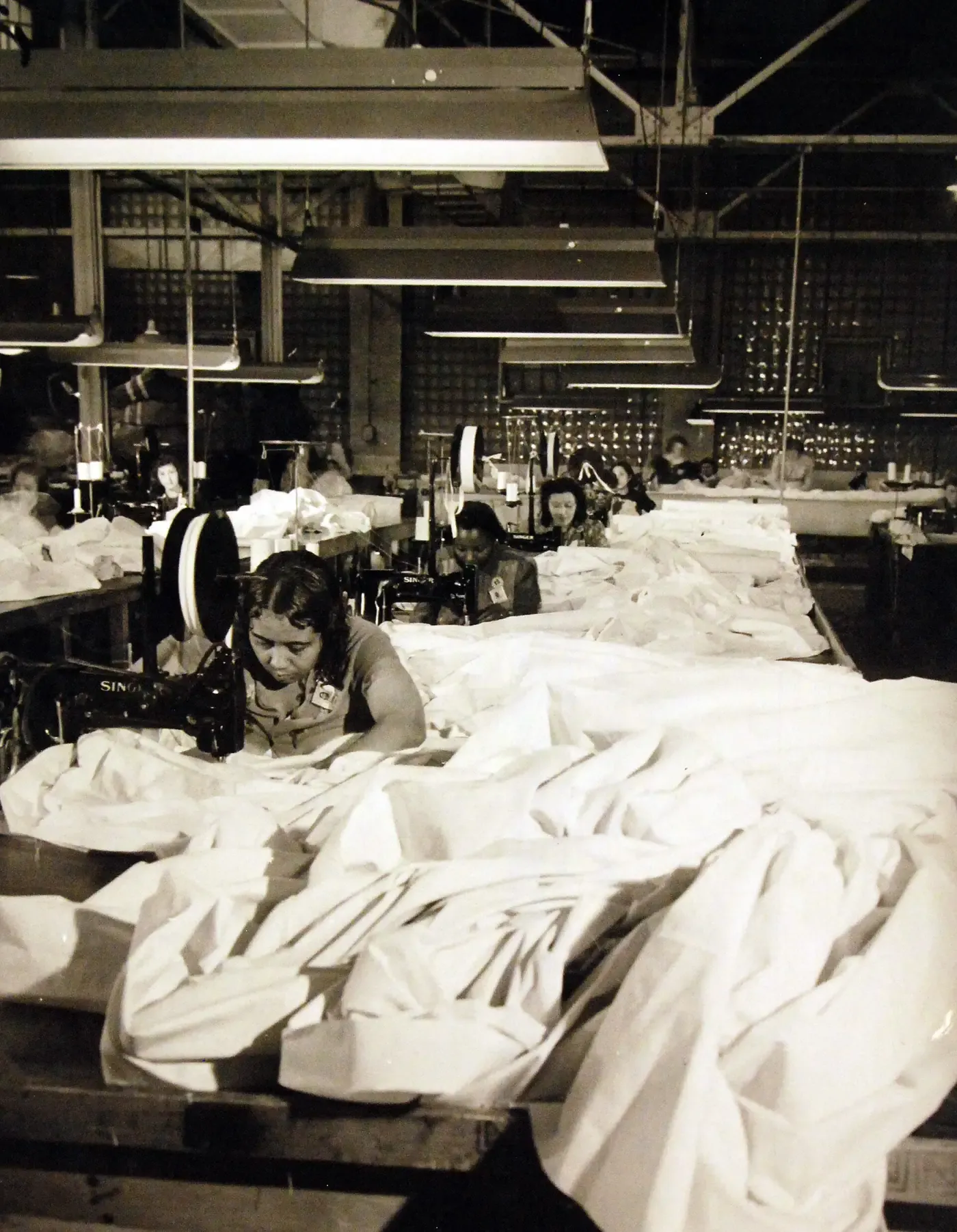
Then came Pearl Harbor. Most of America’s raw silk had come from Japan, and the attack severed that supply overnight; within weeks the War Production Board had commandeered DuPont’s entire nylon output for the military. Nylon production, which had run at a little over a million pounds in 1940, climbed past eighty million pounds by the war’s last full year. It went into parachute canopies and cord, into glider tow ropes, into mosquito netting and tents and the webbing of a soldier’s pack: anywhere a fiber needed to be strong, light, and indifferent to being soaked.
Plate III
.jpg)
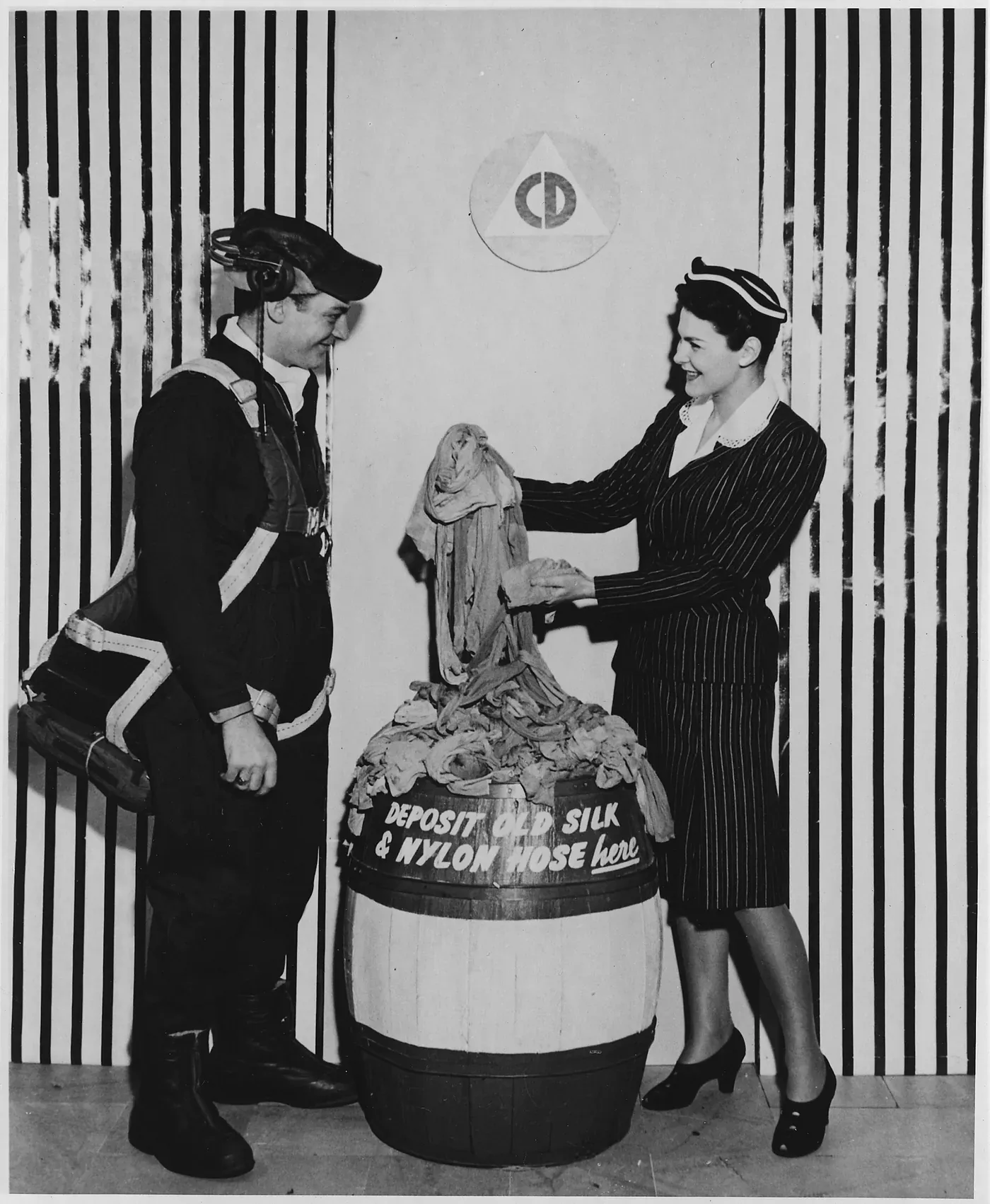
The stockings themselves went to war too. With both silk and nylon suddenly precious, civil-defense volunteers ran public collection drives asking women to hand over their old hose (worn nylons and silk alike) to be reprocessed into parachute cloth and gunpowder bags.
Plate IV

Carothers’ equation for step-growth polymerization (the mathematics of exactly how far a reaction like this one has to run before it turns from a liquid into an unworkable gel) has its own page elsewhere in this Atlas. It is worth saying here only that the theory and the fiber came from the same small Wilmington team within the same few years: Carothers proved macromolecules could be built to order, and nylon was the proof that mattered to the outside world.
The Nylon Family
Nylon 6,6 was the first of a whole family of polyamides distinguished mainly by the length of the carbon chains between their amide groups, and each finds its own niche. Nylon 6, made in Germany from a single monomer (caprolactam) as a way around DuPont’s patents, is slightly less strong than 6,6 but easier to process, and dominates textile and moulded-parts markets to this day. Nylon 4,6, with the shortest, most densely amide-packed backbone in the family, resists heat better than any of its relatives and is the one automotive engineers reach for under the bonnet. Nylon 6,12 and the long-chain nylons 11 and 12, at the other end of the family, trade some heat resistance for a backbone that simply does not absorb much water, which makes them the choice for fuel lines and parts that must hold a precise dimension outdoors. As a rule of thumb, heat resistance and water uptake run in opposite directions across the family: the nylon that shrugs off humidity best is rarely the one that shrugs off heat best, and 6,6 owes its long dominance to sitting in the useful middle of both scales rather than leading on either one.
A Fiber Still at Work
Nylon 6,6 never really went back to being just a stocking fiber. Its combination of heat resistance, chemical resistance and toughness has kept it in car radiator tanks and intake manifolds, in conveyor belts and industrial hose, in airbags and carpet fiber and the small moulded parts inside almost every machine built since the 1950s. Eighty-five years after a DuPont chemist coined a word to describe it, nylon remains one of the most-produced synthetic fibers on Earth. It is the material a fashion crisis and a war both needed at once, arriving, by no coincidence at all, in the same single year.
values with [n] cite the numbered references·estimates are flagged·“not yet available” and “N/A” are honest states, not gaps
fetching the model…
Nylon repeat unit
- Abbreviation
- PA66
- Type
- polymer family (hub)
- CAS number
- 32131-17-2
- Resin ID code
- none assigned
- Formula
- (C12H22N2O2)n[-NH-(CH2)6-NH-CO-(CH2)4-CO-]nThis hub is represented by nylon 6,6 (poly(hexamethylene adipamide)) as the archetypal nylon; other nylons (nylon 6, nylon 4,6, nylon 6,12) have their own distinct repeat units.
- Repeat unit (BigSMILES)
{[][>]NCCCCCCNC(=O)CCCCC(=O)[<][]}- IUPAC name
- Poly(hexamethylene adipamide)
- Synonyms
- polyamide 66; PA 6,6
- Also known as
- PA66polyamide 6,6
- Chemical family
- polyamide
- Backbone class
- heterochain
- Polymerization mechanism
- step-growth-condensation
- Constitutional monomer
- HexamethylenediamineAdipic acid
- Polymer class
- thermoplastic
- Year of origin
- 1939
- Era
- The Wartime Innovation Period (1939-1945)
- Key figures
- Wallace Carothers
- Events referenced
- 1939 New York World's Fair ("The World of Tomorrow") · Outbreak of World War II in Europe (September 1939) · Attack on Pearl Harbor and the wartime silk shortage (December 1941)
- Polymerization type
- step-growth condensation
- Common monomers (feedstocks)
- hexamethylenediamine, adipic acid
- Catalysts
- not yet available
Wallace Carothers' DuPont team first made nylon 6,6 on February 28, 1935 (publicly announced October 27, 1938, after Carothers' death); commercial nylon stockings launched in 1940. Equivalent amounts of hexamethylenediamine and adipic acid are combined in water; removing water drives amide-bond formation (polymerization). The resulting polymer can be extruded into granules or directly melt-spun into fiber. ~2 million tonnes produced worldwide as of 2011.
- Tacticity
- not yet available
- Crystal structure
- PA-6: monoclinic α-form (hydrogen-bonded sheets), unit cell a:b:c = 0.956:0.801:1.724 nm. PA-6,6: triclinic α and β forms, plus a pseudohexagonal γ form at high temperature.
- Typical crystallinity
- 26–65 %[3]PA-6: 26–50% (~42% dry as molded, ~34% wet); PA-6,6: 32–65% (~43% dry, ~39% wet)
Molecular weight
- Number average (Mn)
- 17500–48100 g/mol[3]PA-6: 20,800–48,100 g/mol; PA-6,6: 17,500–18,040 g/mol
- Mass average (Mw)
- 16000–94000 g/mol[3]PA-6: 17,000–94,000 g/mol; PA-6,6: 16,000–30,000 g/mol
- Dispersity (Mw/Mn)
- 1.7–2.4[3]PA-6: 1.7–2.4; PA-6,6: 1.7–2.1
| Solvent | T | M range | K | a |
|---|---|---|---|---|
| 85% formic acid (PA-6)[4] | 298 K | — | 0.023 mL/g | 0.82 |
| o-chlorophenol (PA-6,6)[4] | 298 K | 14,000–50,000 g/mol (Mn) | 168 mL/g | 0.62 |
| m-cresol (PA-6,6)[4] | 298 K | 14,000–50,000 g/mol (Mn) | 240 mL/g | 0.61 |
| aqueous formic acid, 90% (PA-6,6)[4] | 298 K | 6,000–65,000 g/mol (Mn) | 35.3 mL/g | 0.786 |
| sulfuric acid, 96% (PA-6,6)[4] | 298 K | 14,000–50,000 g/mol (Mn) | 115 mL/g | 0.67 |
Regular amide-hydrogen-bonding pattern along the backbone gives nylon 6,6 good mechanical strength, rigidity, and heat/chemical resistance.
Amide groups hydrogen-bond with absorbed water, which plasticizes the chain: PA-6 Tg falls from ~50–75 °C dry to 3–20 °C at 50% RH and -22 to -32 °C at saturation; PA-6,6 falls from ~56–70 °C dry to -15 °C at saturation.
- Density
- 1.05–1.16 g/cm³[3]dry as molded, unfilled; PA-6 1.06–1.16 g/cm³, PA-6,6 1.05–1.14 g/cm³
- Melt flow index
- 7.7–36.4 g/10min[3]PA-6, 190 °C/2.16 kg
- Refractive index
- 1.53–1.568[3]PA-6 exp. = 1.53; PA-6,6 1.565–1.568
- Transmittance
- 85 %[3]PA-6
- Haze
- not yet available
- Gloss
- not yet available
- Water absorption
- 7.1–10 %[3]equilibrium in water immersion, 23 °C, dry unfilled; PA-6 7.1–10%, PA-6,6 8.5–9.0%. Equilibrium at 50% RH (not immersion) is much lower, ~2–3%
- Dielectric constant
- 3.6–3.8[3]1 MHz, dry; PA-6 3.8, PA-6,6 3.6 (PA-6,6 also reports 4.0 at 100 Hz)
- Dielectric strength
- 25–30.5 kV/mm[3]PA-6,6, K20/P50 electrodes, d=0.6–0.8 mm; 30–30.5 dry, 25 conditioned. PA-6's reported figure in the same source (up to 460) is inconsistent with this and was not used
- Electrical conductivity
- 1 × 10⁻¹³ S/m[3]reciprocal of volume resistivity (1×10¹³ Ω·m), dry as molded; PA-6 and PA-6,6 both report this value
- Glass transition (Tg)
- 50–75 °C[3]dry as molded; PA-6 exp. 50–75 °C, PA-6,6 56–70 °C. Strongly moisture-sensitive: drops toward -15 to -32 °C at saturation
- Melting temperature (Tm)
- 220–270 °C[3]DSC; PA-6 220–260 °C, PA-6,6 257–270 °C; the two most common nylons differ by roughly 40 °C
- Crystallization (Tc)
- 191.8–193.2 °C[3]PA-6, DSC crystallization temperature. PA-6,6's reported 'rapid crystallization temperature' (230 °C) is a different metric and not merged here
- Heat deflection (HDT)
- 42–86 °C[3]ASTM D6481.8 MPa, dry as molded; PA-6 42–65 °C, PA-6,6 70–86 °C
- Decomposition onset
- 300–340 °C[3]PA-6: thermal decomposition onset >300 °C; PA-6,6: 340 °C
- Thermal conductivity
- 0.23–0.25 W/(m·K)[4]solid, general; PA-6 0.23, PA-6,6 0.25
- Tensile modulus
- 780–3800 MPa[3]dry as molded; PA-6 780–3,800 MPa, PA-6,6 3,000–3,600 MPa. Conditioned (moisture-equilibrated) values are roughly half
- Yield strength
- 36–95 MPa[3]tensile stress at yield, dry as molded; PA-6 36–95 MPa, PA-6,6 82–95 MPa. Conditioned values are lower (PA-6 32–55 MPa, PA-6,6 55–60 MPa)
- Tensile strength at break
- 70–106 MPa[3]unqualified 'tensile strength' row, distinct from tensile stress at yield above; dry as molded; PA-6 74–106 MPa, PA-6,6 70–88 MPa
- Elongation at break
- 10–160 %[3]dry as molded; PA-6 10–160%, PA-6,6 10–45%. Conditioned (moisture-equilibrated) elongation is much higher, >50–327%
- Impact strength (Izod)
- 53–64 J/m[4]ASTM D256notched, 23 °C, dry as molded; PA-6 53 J/m (no break at 50% RH); PA-6,6 53–64 J/m dry, 112–133 J/m at 50% RH
- Impact strength (Charpy)
- 3.5–82 kJ/m²[3]notched, 23 °C, dry as molded; PA-6 3.5–82 kJ/m², PA-6,6 4.9–6 kJ/m²
- Hardness
- 119 Rockwell R[4]ASTM D785PA-6, neat resin, dry as molded
- Flexural modulus
- 2600–2800 MPa[3]dry as molded; PA-6 2,600 MPa, PA-6,6 2,800 MPa
- Poisson's ratio
- 0.33[3]PA-6, exp.; PA-6,6 reported range 0.3–0.5
- Coefficient of friction
- 0.26[3]PA-6, static, chrome-steel counterface, dry (ASTM D1894); PA-6,6 reports 0.35–0.5 without counterface specified
- Solvent: dilute acids
- good[3]PA-6 and PA-6,6
- Solvent: concentrated acids
- poor[3]PA-6 and PA-6,6
- Solvent: alcohols
- good[3]PA-6 and PA-6,6
- Solvent: dilute alkalis
- good[3]PA-6 and PA-6,6
- Solvent: concentrated alkalis
- poor[3]PA-6 and PA-6,6
- Solvent: aliphatic hydrocarbons
- good[3]PA-6,6 (reported as "resistant" in PA-6)
- Solvent: aromatic hydrocarbons
- fair[3]PA-6,6 (reported as "resistant" in PA-6)
- Solvent: esters
- good[3]PA-6,6
- Solvent: greases & oils
- good[3]PA-6,6 (reported as "resistant" in PA-6)
- Solvent: halogenated hydrocarbons
- poor[3]PA-6,6
- Solvent: ketones
- good[3]PA-6,6 (reported as "resistant" in PA-6)
- Weathering / UV
- not yet available
- Hydrolysis resistance
- generally resists hydrolysis at room temperature; amide linkages are cleaved by strong acids or bases, especially at elevated temperature[4]PA-6,6
- Flammability (UL94)
- V-2[4]PA-6, neat resin, 3.2 mm (Mark); Wypych reports HB to V-2 across PA-6 and PA-6,6 unfilled grades
- Limiting oxygen index
- 20–31 %[3]PA-6 20–27%, PA-6,6 28–31%
- Solubility parameter (δ)
- 20.3–25.8 MPa^0.5[3]exp.; PA-6 20.3, PA-6,6 22.87–25.8
Gas permeability
- CO₂
- 5.2 × 10⁻¹⁵ cm³(STP)·cm/(cm²·s·Pa)[4]PA-6,6, 25 °C, undrawn fiber
Polymer-solvent interaction parameter (χ)
not yet available
- Textiles & fiberscarpets · apparel · luggage (Cordura) · airbags
- Automotiveradiator tanks · air intake manifolds · hinges · bearing cages
- Industrialzip ties · conveyor belts · pipes · hoses
- Recyclable
- Yes
- Biodegradable
- No
- Degradation pathway
- not yet available
- LD50 (oral, rat)
- 10000 mg/kg[3]PA-6,6, reported as >10,000 mg/kg (practically nontoxic)
- NFPA health
- 1[3]HMIS rating, 0–4 scale; PA-6,6 reports 1, PA-6 reports 0–1
- NFPA flammability
- 1[3]HMIS rating, 0–4 scale; PA-6,6 reports 1, PA-6 reports 0–1
- NFPA reactivity
- 0[3]HMIS rating, 0–4 scale; PA-6 and PA-6,6 both report 0
- Carcinogenic classification
- not listed by ACGIH, IARC, or NTP[3]PA-6 and PA-6,6
Combustion produces CO and, for PA-6, HCN and caprolactam vapor; PA-6,6 combustion products include cyclopentanone and hexamethylenediamine. Not a skin irritant in rabbit testing (PA-6,6).
- [1]Nylon 66WikipediaAccessed 2026-07-14https://en.wikipedia.org/wiki/Nylon_66[wiki-nylon66]
- [2]Nylon 6/6 [poly(hexamethylene adipamide)], CAS 32131-17-2BOC SciencesAccessed 2026-07-14; CAS cross-referenced against Alfa Chemistry, ChemicalBook, and Sigma-Aldrich/NISThttps://www.bocsci.com/product/nylon-6-6-cas-32131-17-2-66003.html[bocsci-nylon66-cas]
- [3]Handbook of PolymersChemTec Publishinghttps://www.worldcat.org/isbn/9781895198928[handbook-wypych-2016]
- [4]Polymer Data HandbookOxford University Presshttps://search.worldcat.org/search?q=Polymer+Data+Handbook+Mark+1999[handbook-mark-1999]
Illustrations
- Plate IThe 1939 New York World's Fair, built around the promise that science had already designed tomorrow. Nylon, barely a year old, was one of the exhibits meant to prove it.Wikimedia Commons
- Plate IIDuPont's own announcement, reprinted from the New York Herald Tribune in October 1938, five months before the fair opened and a full year before the first stockings went on sale.Wikimedia Commons
- Plate IIINaval Aircraft Factory workers in Philadelphia sewing parachute canopies in May 1942: still silk here, at the exact moment the material was being displaced by nylon across the American parachute industry.Wikimedia Commons
- Plate IVA wartime stocking-collection drive: worn silk and nylon hose, reprocessed into parachute cloth, at a moment when the fiber that had been sold as a stockings replacement two years earlier had become a strategic material.Wikimedia Commons