The Engineering Polymers Era (1961-1979)
Polyimide (PI)
The Golden Guardian of the Space Age
On 31 July 1964, a spacecraft the size of a small car aimed its cameras at the Moon and kept taking pictures as it fell toward it, transmitting each frame back to Earth in the seconds before it hit. Ranger 7 sent home over four thousand images before it struck Mare Cognitum, and the last few, taken from less than a mile up, showed craters and boulders no telescope on Earth had ever resolved. It was the United States’ first real look at the Moon’s surface up close, and it existed because a machine had been built to survive a fall that nothing was meant to survive.
Plate I
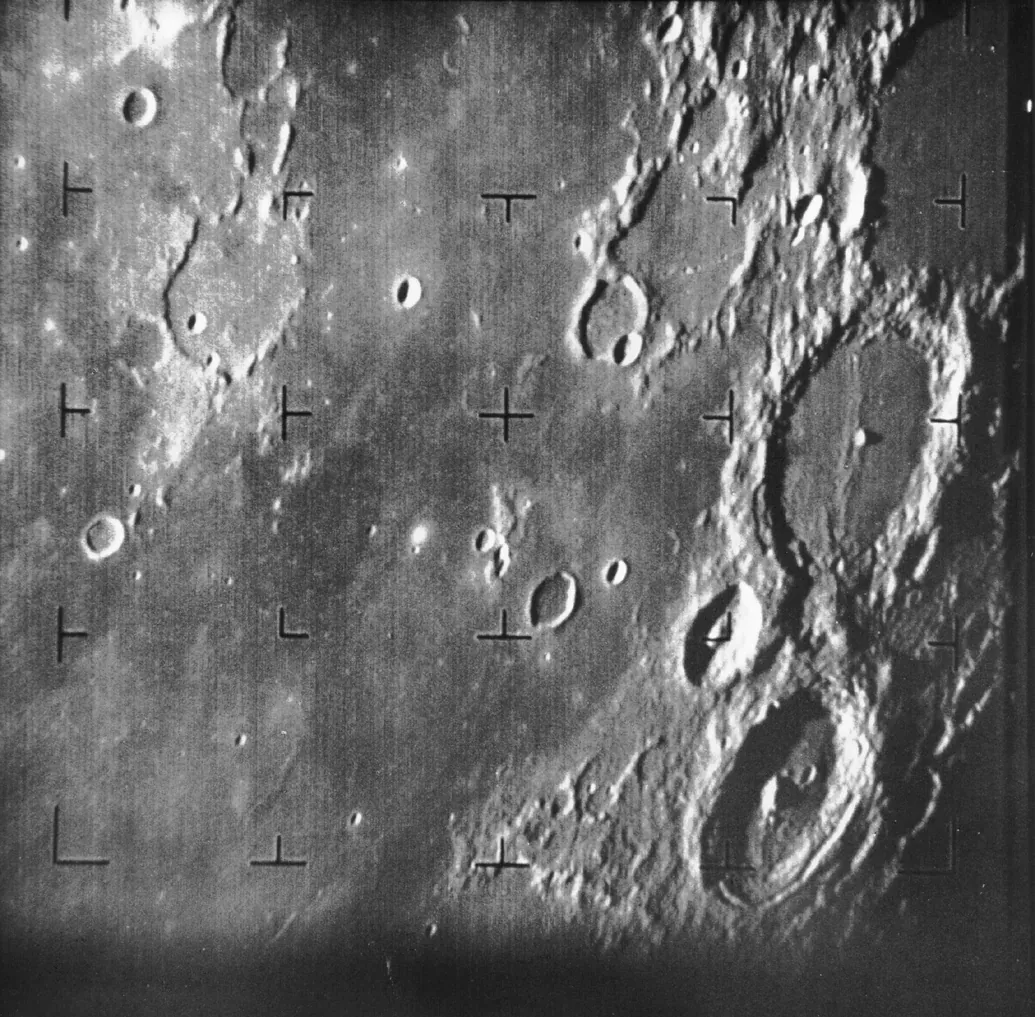

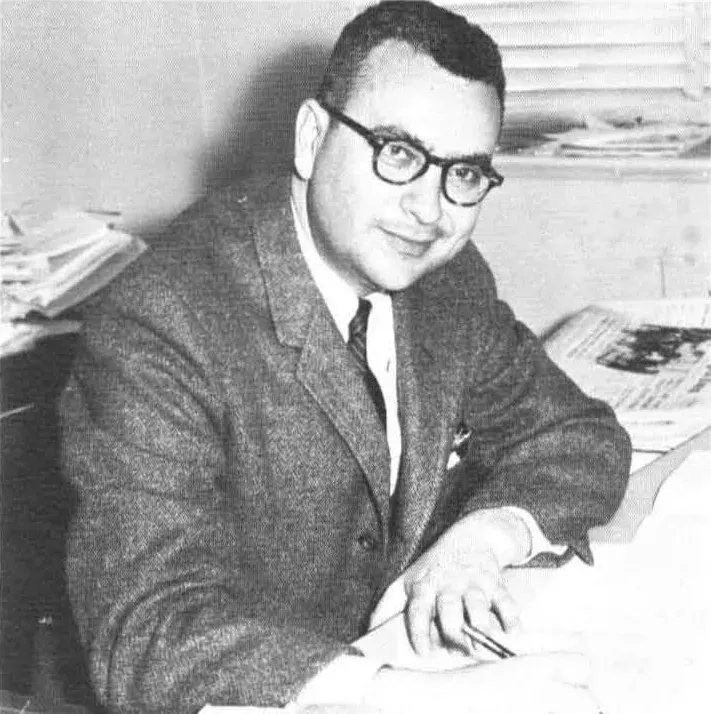
The same year, two physicists working independently, Murray Gell-Mann at Caltech and George Zweig at CERN, proposed that the protons and neutrons everyone had been treating as fundamental were themselves built from smaller pieces. Gell-Mann called them quarks. Neither man could point to one directly; the case was made entirely from how the known particles’ properties fell into families once you assumed they existed. 1964 was a year for going smaller and going farther in the same twelve months: probing the architecture of matter at one end, and the architecture of the Moon at the other.
Plate II

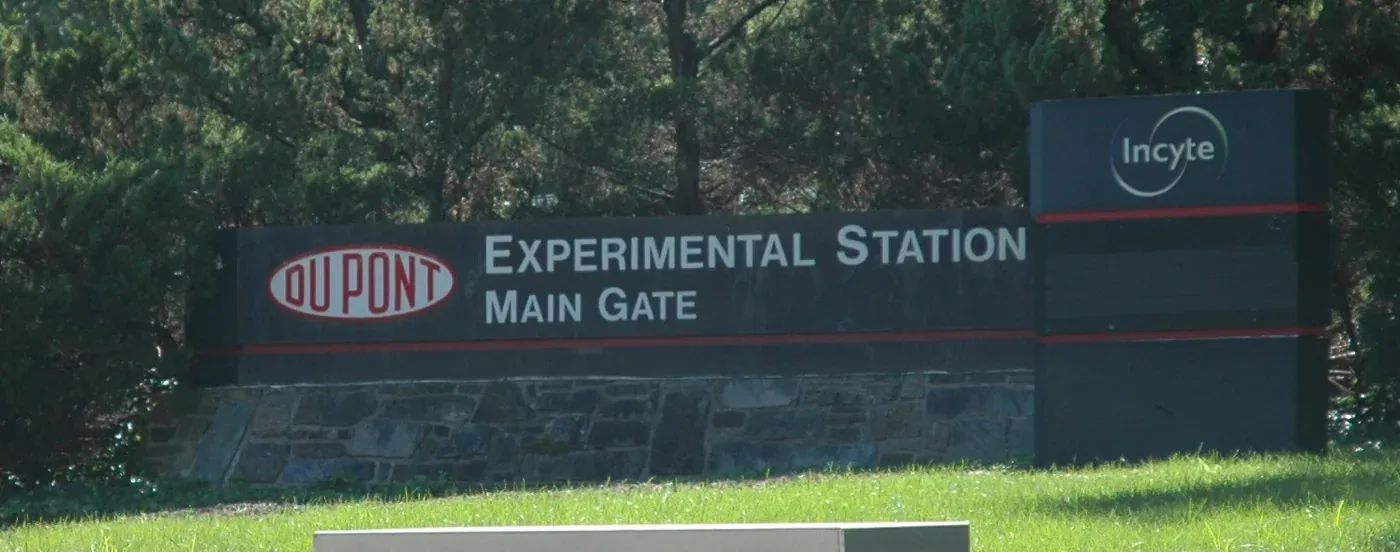
Neither story mentions plastic, but a third kind of architecture was being finished that year, at DuPont’s Experimental Station outside Wilmington, Delaware. It shared the quark physicists’ instinct: build something new by fixing exactly how its smallest pieces connect.
A Ring Built to Survive Fire
The reaction itself was not new. Marston Bogert and Robert Renshaw had made the first polyimide back in 1908, and DuPont chemists Walter Edwards and Robert Maxwell had patented an early aromatic version in 1955. What none of that work had produced was a polymer anyone could actually shape into something useful: high-molecular-weight aromatic polyimide is so intractable, so resistant to melting or dissolving, that it could not be cast, spun, or molded by any conventional route. It was a superb idea sitting behind an impossible manufacturing problem.
Edwards solved the problem, not the chemistry. His patent, filed in 1961, described making the polymer in two stages instead of one: react the dianhydride and diamine at room temperature to get a soluble intermediate (a polyamic acid, ordinary enough to cast into a film or fiber like any other resin) and only then close the imide rings with heat, after the material had already been shaped. By the time the ring closed, it was too late for the finished part to un-shape itself. DuPont brought the resulting film to market as Kapton in the mid-1960s, alongside a machinable molding form sold as Vespel and a wire enamel sold as Pyre-ML.
Plate III

The Architecture Itself
A polyimide chain is built from two kinds of piece, alternating: a rigid aromatic block contributed by the dianhydride, and a second aromatic block (often, as in Kapton, two phenyl rings joined through an oxygen) contributed by the diamine. Where they meet, the dianhydride’s carbon and nitrogen atoms close into a five-membered imide ring, a small, flat, chemically stubborn knot that does not hydrolyze, does not easily oxidize, and does not soften on its own. String enough of these knots together with enough aromatic rings between them and the whole chain becomes something closer to a girder than a strand: flexible enough to bend into a film, too stiff and too well-anchored at every joint to melt in any ordinary sense.
What the Architecture Buys
That rigidity is the whole point, and it shows up everywhere the material is used. A Kapton film stays dimensionally stable and electrically insulating from the temperature of liquid helium to well past the boiling point of lead-free solder, a working range wider than almost anything else in this atlas. Unlike most of its neighbors on that list, it does not have a melting point to eventually reach; it chars and decomposes rather than flows. Mechanically the film is genuinely tough for something this heat-resistant, taking a real stretch before it tears, while the molded Vespel grades trade away most of that stretch for outright stiffness and wear resistance instead. Both forms resist solvents, oils, and hydrocarbons thoroughly, though the imide ring’s one real weakness is exposed here too: strong acids and strong alkalis will attack and eventually break it down, and the material is more hygroscopic than its reputation suggests, which is why it has to be dried carefully before processing. Electrically it is an excellent insulator across a broad range of conditions, and it resists ignition and ultraviolet exposure about as well as an organic polymer can, though prolonged outdoor exposure does erode the surface over time.
A Family of Golden Films
Kapton was never one material so much as a chemistry that could be retuned. Swap the dianhydride or the diamine and the same imide-forming reaction yields grades biased toward easier processing, greater flexibility, or still higher heat resistance, which is how the Kapton line grew from a single amber film into a family sold for purposes as different as flexible circuit substrates and rigid aerospace connectors.
Plate IV

From the Moon to Your Pocket
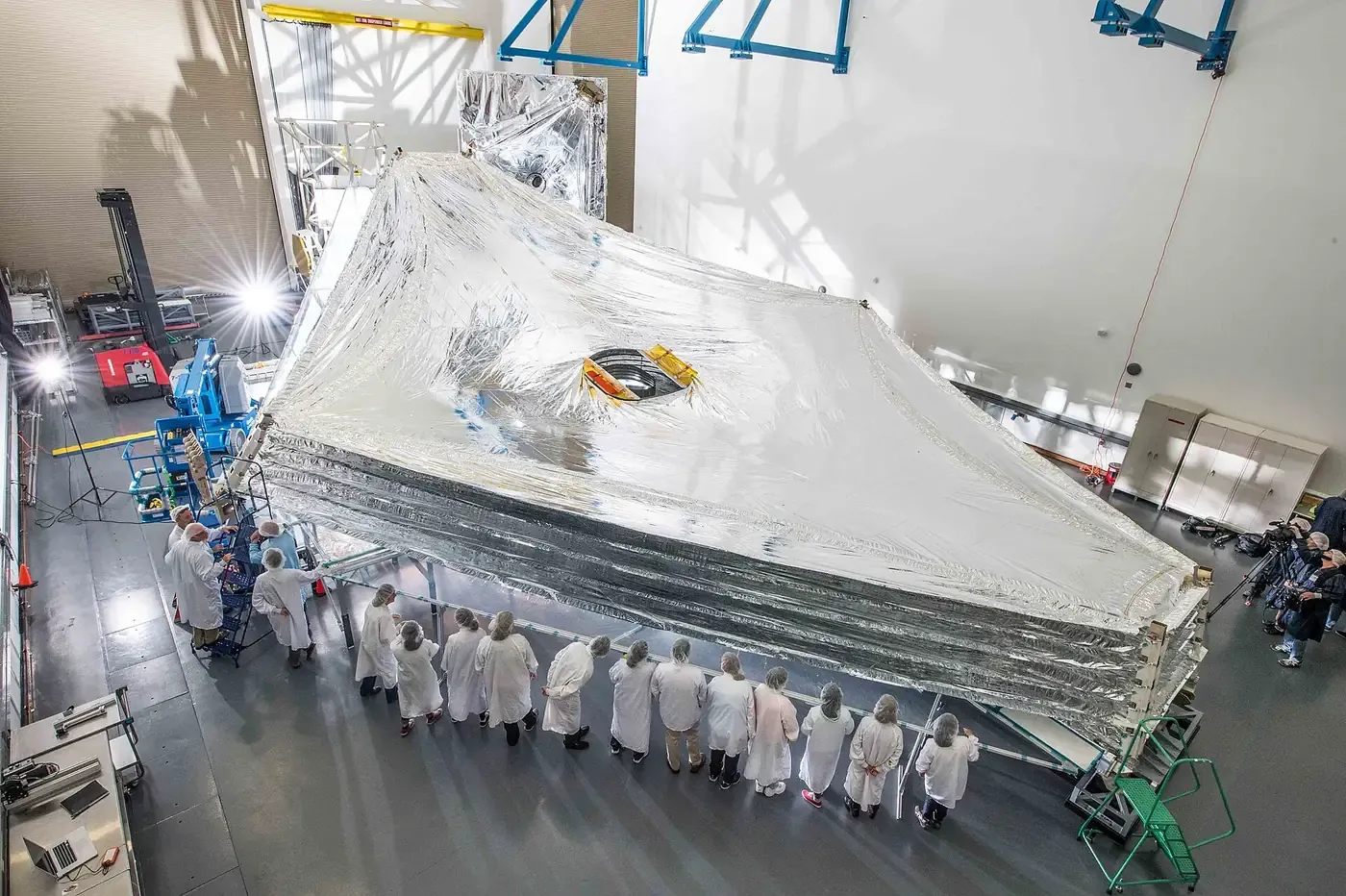
Kapton’s association with spaceflight only deepened after 1964. Apollo-era spacecraft used aluminized Kapton as multi-layer insulation, the gold-foil blankets visible in nearly every photograph of a lunar module, and Kapton film insulated wiring that had to survive extreme swings between sunlight and shadow. Decades later, the James Webb Space Telescope’s sunshield (five stacked layers of Kapton, some coated with aluminum and some with silicon) does essentially the same job at a scale Apollo’s engineers never had to consider: it holds a temperature difference of hundreds of degrees across a few meters of coated film, unfolded once and never touched again.
Plate V

Back on Earth, the same chemistry ended up somewhere far more ordinary: bent, not stretched into orbit. Because a thin polyimide film can be flexed millions of times without cracking, it became the substrate of choice for flexible printed circuits: the ribbon connectors folded inside laptops, cameras, and nearly every modern smartphone, and, more recently, the hinge layer inside foldable phone screens. A film developed to protect wiring from the vacuum of space now spends most of its life being quietly bent back and forth in someone’s coat pocket.
values with [n] cite the numbered references·estimates are flagged·“not yet available” and “N/A” are honest states, not gaps
fetching the model…
Polyimide repeat unit
- Abbreviation
- PI
- Type
- polymer family (hub)
- CAS number
- None (heterogeneous class or not assigned)
- Resin ID code
- none assigned
- Formula
- (C22H10N2O5)n[-N(CO)2-C6H2-(CO)2-N-C6H4-O-C6H4-]nThe PMDA-ODA polyimide shown is the archetype, sold as Kapton. Each (CO)2 bridge is one of the two fused five-membered imide rings, written open rather than as a ring for readability; the family is large, and other dianhydride/diamine pairs give quite different properties.
- Repeat unit (BigSMILES)
{[][>]N1C(=O)c2cc3c(cc2C1=O)C(=O)N(C3=O)c1ccc(cc1)Oc1ccc(cc1)[<][]}- IUPAC name
- —
- Synonyms
- Kapton
- Also known as
- Kapton
- Chemical family
- polyimide
- Backbone class
- heterochain
- Polymerization mechanism
- step-growth-condensation
- Constitutional monomer
- Pyromellitic dianhydride4,4'-Oxydianiline
- Polymer class
- thermoplastic
- Year of origin
- 1964
- Era
- The Engineering Polymers Era (1961-1979)
- Key figures
- Walter M. Edwards · DuPont
- Events referenced
- Ranger 7 first close-up photographs of the Moon (1964) · Gell-Mann and Zweig's proposal of quarks (1964)
- Polymerization type
- step-growth condensation (polyamic acid formation, then thermal/chemical imidization)
- Common monomers (feedstocks)
- pyromellitic dianhydride, 4,4'-oxydianiline
- Catalysts
- not yet available
The first polyimide was discovered in 1908, but the commercially significant DuPont Kapton chemistry was pioneered in the 1950s, with polyimides in mass production since 1955.
- Tacticity
- not yet available
- Crystal structure
- Orthorhombic unit cell, a:b:c = 0.635:0.405:3.26 nm (c = chain axis), planar zig-zag chain conformation; a monoclinic polymorph is also reported (Mark).
- Typical crystallinity
- 44–60 %[2]Wypych reports this range with supporting crystal-structure data (orthorhombic unit cell); standard Kapton film is typically regarded as amorphous, so this may reflect specific processing/annealing conditions or other PI grades within the broader class
Molecular weight
- Number average (Mn)
- 10000–100000 g/mol[2]
- Mass average (Mw)
- 10000–210000 g/mol[2]
- Dispersity (Mw/Mn)
- 1.2–2.6[2]
Mark-Houwink constants
not yet available
Rigid aromatic imide backbone gives exceptional thermal and dimensional stability, maintaining useful properties up to ~232°C in continuous service.
Tg varies widely by grade and measurement method: Wypych reports 190–385 °C for the broader PI class (some grades, e.g. Vespel, show no distinct Tg); Kapton HN film specifically clusters at 360–410 °C (633–683 K, DSC/thermomechanical, Mark).
- Density
- 1.31–1.43 g/cm³[2]Kapton film specifically 1.42, Vespel SP-1 1.43 (Mark)
- Melt flow index
- 10 g/10min[2]400 °C/6.6 kg. Most polyimide forms (Kapton film, Vespel) are effectively infusible; this reflects a specific melt-processable grade
- Refractive index
- 1.61–1.8[2]Wypych exp. 1.61–1.68; Mark reports 1.70–1.80 (visible range) for Kapton film
- Transmittance
- not yet available
- Haze
- not yet available
- Gloss
- not yet available
- Water absorption
- 0.39–2.9 %[2]24 h water immersion, 23 °C; at 50% RH equilibrium, 1–1.8%. Similarly 1.8%/2.8% for Kapton film and 1.0–1.3%/0.24% for Vespel (immersion/RH, Mark)
- Dielectric constant
- 2.74–3.64[2]wide range reflects different PI grades/frequencies; Kapton film ~3.0–3.4, Vespel SP-1 ~3.55–3.64 (Mark)
- Dielectric strength
- 22–506 kV/mm[2]wide range from strong thickness dependence: thick molded Vespel ~22 kV/mm (2 mm thick, Mark) vs thin Kapton film several hundred kV/mm (25 μm)
- Electrical conductivity
- 1 × 10⁻¹⁶–1 × 10⁻¹³ S/m[2]reciprocal of volume resistivity range (1×10¹³-1×10¹⁶ Ω·m); varies strongly by grade, temperature and humidity
- Glass transition (Tg)
- 190–410 °C[2]wide grade dependence; some forms (e.g. Vespel) show no distinct Tg. Kapton HN film specifically: 360–410 °C (633–683 K, DSC/thermomechanical, Mark)
- Melting temperature (Tm)
- Not applicablePMDA-ODA (Kapton) itself shows no distinct melting point (confirmed absent, ASTM E-794, in Mark's dedicated chapter). Some other polyimide chemistries within the broader PI class exhibit DSC melting endotherms around 340–408 °C (Wypych).
- Crystallization (Tc)
- Not applicable
- Heat deflection (HDT)
- 221–360 °C[2]1.8 MPa; Mark confirms ~360 °C for Vespel SP-1 (ASTM D648, 264 psi)
- Decomposition onset
- 185–400 °C[2]370 °C reported for fiber form
- Thermal conductivity
- 0.12–0.35 W/(m·K)[2]Kapton film 0.12, Vespel SP-1 0.35 (Mark)
- Tensile modulus
- 1200–3800 MPa[2]Kapton HN film: 2,500 MPa at 23 °C (dropping to 2,000 at 200 °C); Vespel SP-1 flexural modulus 3,102 MPa at 23 °C (Mark)
- Yield strength
- 112–120 MPa[2]Mark reports a differently-defined 'yield point at 3% strain' of 69 MPa (23 °C) for Kapton HN film
- Tensile strength at break
- 81–241 MPa[2]unqualified 'tensile strength' row; Kapton HN film 231 MPa and Vespel SP-1 86.2 MPa at 23 °C (Mark)
- Elongation at break
- 7–95 %[2]Kapton HN film ~72–83%, Vespel SP-1 ~6–7.5% (Mark), which differs substantially by form/grade
- Impact strength (Izod)
- 42.7–110 J/m[2]notched, 23 °C; Vespel SP-1 (Mark) 42.7 J/m matches the low end. Unnotched values run much higher (up to 750 J/m, Wypych; 747 J/m Vespel SP-1, Mark)
- Impact strength (Charpy)
- 20–22 kJ/m²[2]notched, 23 °C
- Hardness
- 112 Rockwell M[2]Vespel-specific grades range M92-102, or Rockwell E 45–60 (Mark)
- Flexural modulus
- 2900–3520 MPa[2]Vespel SP-1 (Mark): 3,102 MPa at 23 °C, dropping to 1,724 MPa at 260 °C
- Poisson's ratio
- 0.15–0.42[2]Kapton film 0.34, Vespel SP-1 0.41 (Mark)
- Coefficient of friction
- 0.29–0.63[2]kinetic 0.29–0.48, static 0.35–0.63; Vespel (unlubricated, in air) at the low end, Kapton film-to-film at the high end (Mark)
- Solvent: dilute acids
- non-resistant[2]
- Solvent: concentrated acids
- non-resistant[2]
- Solvent: alcohols
- resistant[2]
- Solvent: alkalis
- non-resistant[2]
- Solvent: aliphatic hydrocarbons
- resistant[2]
- Solvent: aromatic hydrocarbons
- resistant[2]
- Solvent: esters
- resistant[2]
- Solvent: greases & oils
- resistant[2]
- Solvent: halogenated hydrocarbons
- resistant[2]
- Solvent: ketones
- resistant[2]
- Weathering / UV
- generally excellent UV/radiation resistance, limited mainly to surface erosion because of strong intrinsic absorption; outdoor Florida exposure reduces elongation by 50% after 1,300 h[2]
- Hydrolysis resistance
- considerable variation by grade; poor hydrolytic resistance in 10% NaOH (Kapton)[3]
- Flammability (UL94)
- V-0[2]
- Limiting oxygen index
- 37–53 %[2]Kapton film 37%, Vespel SP-1 53% (Mark)
- Solubility parameter (δ)
- not yet available
Gas permeability
not yet available
Polymer-solvent interaction parameter (χ)
not yet available
- Processing methods
- polyamic acid solution casting + thermal imidization (film)compression molding (shapes)
- Drying required
- Yes
- Aerospacemulti-layer spacecraft insulation (metal-coated polyimide film)
- Electronicsflexible printed circuits · magnet wire insulating film
- Industrial & medicalfiltration membranes · medical device components
- Recyclable
- No
- Biodegradable
- No
- Degradation pathway
- not yet available
- [1]PolyimideWikipediaAccessed 2026-07-14https://en.wikipedia.org/wiki/Polyimide[wiki-polyimide]
- [2]Handbook of PolymersChemTec Publishinghttps://www.worldcat.org/isbn/9781895198928[handbook-wypych-2016]
- [3]Polymer Data HandbookOxford University Presshttps://search.worldcat.org/search?q=Polymer+Data+Handbook+Mark+1999[handbook-mark-1999]
Illustrations
- Plate IOne of the last images Ranger 7 transmitted before impact, taken from roughly a thousand miles up on 31 July 1964. These were the first close-up photographs of the Moon in history.Wikimedia Commons
- Plate IIMurray Gell-Mann, photographed the year after he and George Zweig independently proposed that protons and neutrons were built from smaller, more fundamental particles.Wikimedia Commons
- Plate IIIThe entrance to DuPont's Experimental Station in Wilmington, Delaware, where the two-stage polyamic-acid process that made Kapton possible was developed.Wikimedia Commons
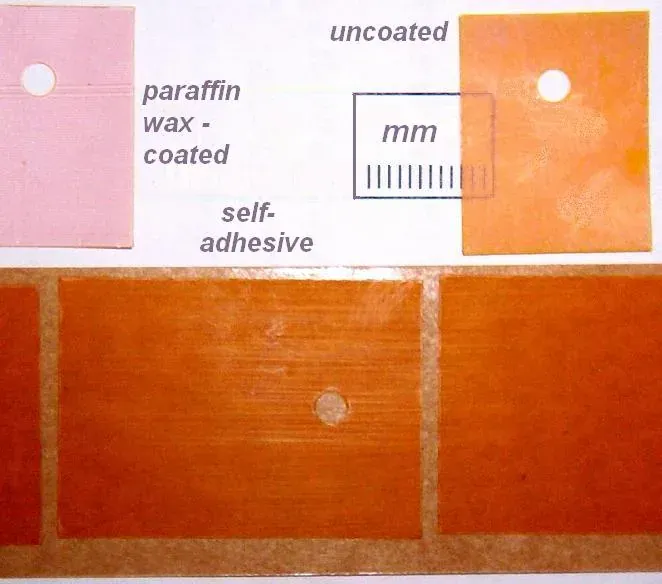
- Plate IVKapton thermal pads used to electrically insulate a power transistor from its heat sink. This is the same imide chemistry doing quiet, unglamorous work far from any spacecraft.Wikimedia Commons
- Plate VA full-size test of the James Webb Space Telescope's five-layer Kapton sunshield, unfurled inside a cleanroom before launch.Wikimedia Commons