The Engineering Polymers Era (1961-1979)
Polyphenylene Sulfide (PPS)
The Spoon Slayer!
By October 1973, gas stations across the United States were taping handwritten signs to their windows: NO GAS TODAY. The Arab oil embargo, launched that month over Western support for Israel in the Yom Kippur War, cut the country’s oil imports overnight, and an entire industry built on turning crude oil into everything else (fuel, fertilizer, fabric, plastic) was suddenly explaining itself to a public that had never had reason to think about where any of it came from.
Plate I


Phillips Petroleum, an oil company headquartered in Bartlesville, Oklahoma, happened to be launching a new engineering plastic that same year. The plastic was built, like everything else Phillips made, from the same crude-oil chemistry the embargo had just put under a spotlight. What made it worth notice was not that an oil company had made a plastic; that was ordinary enough. It was that Phillips had just solved a problem chemists had been failing to solve for most of a century.
Seventy Years of an Unusable Polymer
The chemistry itself was old. A French chemist named Genvresse described making a sulfur-linked, aromatic polymer back in 1897, and in 1948 an American chemist named Macallum patented an improved route: melt p-dichlorobenzene together with sodium carbonate and sulfur, and the same kind of polymer would form. Both methods worked, in the narrow sense that they produced the right molecule. Neither produced a material anyone could use. Macallum’s version came out of the melt as a low-molecular-weight, infusible brown powder: chains too short to be strong, and, once formed, impossible to melt or dissolve into anything else. For nearly seventy years, poly(phenylene sulfide) existed mainly as a fact chemists could write on a blackboard. Nobody could turn it into a fiber, a film, or a molded part.
The Bartlesville Solution
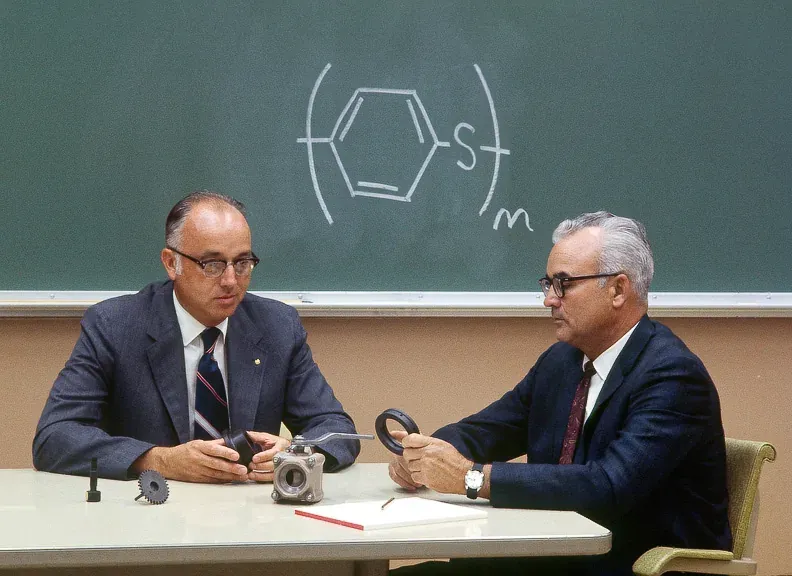
Phillips chemists James T. Edmonds Jr. and H. Wayne Hill Jr. broke the deadlock by changing the reaction itself rather than trying to push the old one harder. Instead of melting the ingredients dry, they dissolved p-dichlorobenzene and sodium sulfide together in a hot polar solvent, N-methylpyrrolidone. Kept in solution, the growing chains stayed mobile long enough to reach genuinely high molecular weight before the reaction stalled. This was exactly what Macallum’s dry melt had never allowed. The two filed their patent in 1967, and Phillips brought the resulting resin to market under the trade name Ryton in 1973, just as the embargo it had nothing to do with was reshaping how the country thought about everything made from oil.
Plate II

Sulfur Bridges, Rigid Rings
PPS’s backbone is about as simple as an aromatic polymer gets: a benzene ring, a sulfur atom, a benzene ring, a sulfur atom, on and on down the chain. The sulfur linkage is the whole design. Its two lone electron pairs let each ring rotate and pack against its neighbors more freely than the fully locked ether linkage in a polymer like PPO does, which is exactly why PPS chains, unlike PPO’s, crystallize readily into a dense, ordered solid rather than staying stubbornly amorphous. That crystallinity, combined with a backbone built almost entirely from chemically inert aromatic rings and sulfide bonds, is what gives the finished polymer so little for a solvent or an acid to attack: there is no soft segment, no easily hydrolyzed link, and no loosely packed region for a small molecule to work its way into.
A Polymer Built to Outlast Everything Around It
None of PPS’s reputation for shrugging off chemicals is exaggerated once the numbers behind it are read. Essentially no ordinary organic solvent will dissolve it at ordinary or even fairly elevated temperatures, and it shrugs off dilute acids, alkalis, hydrocarbons, esters, ketones, oils and greases with barely a mark, losing ground only against the very strongest concentrated acids. It takes up almost no water at all, which keeps its properties stable in wet or humid service where many engineering plastics drift over time, and months of accelerated weathering leave it largely unchanged. This is a genuinely unusual trait in a polymer this rigid. It is hard to ignite and stops burning the moment a flame is taken away, among the most naturally flame-resistant plastics in this atlas without any flame-retardant additive doing the work. Heat resistance follows the same pattern of comfortable margin: PPS holds its shape under load well above the boiling point of water, holds it considerably higher again once reinforced with glass fiber, and does not begin to break down until it is hotter than almost anything else in this collection of engineering plastics. This is a wide gap between “still working” and “falling apart” that gives manufacturers real room to breathe. All of that comes at a cost in ductility. PPS is stiff and hard, denser than water but far lighter than the metals it often replaces, and it will crack under a sharp, sudden load rather than bend. It is a genuinely brittle material on its own, which is why it is almost always sold reinforced with glass fiber or mineral filler rather than neat.
From Coal Boilers to Fuel Rails
Ryton’s earliest customers were exactly the industries an oil company would expect to sell to first: coatings and linings for pumps, valves and vessels handling corrosive process chemicals in refineries not unlike Phillips’s own.
Plate III


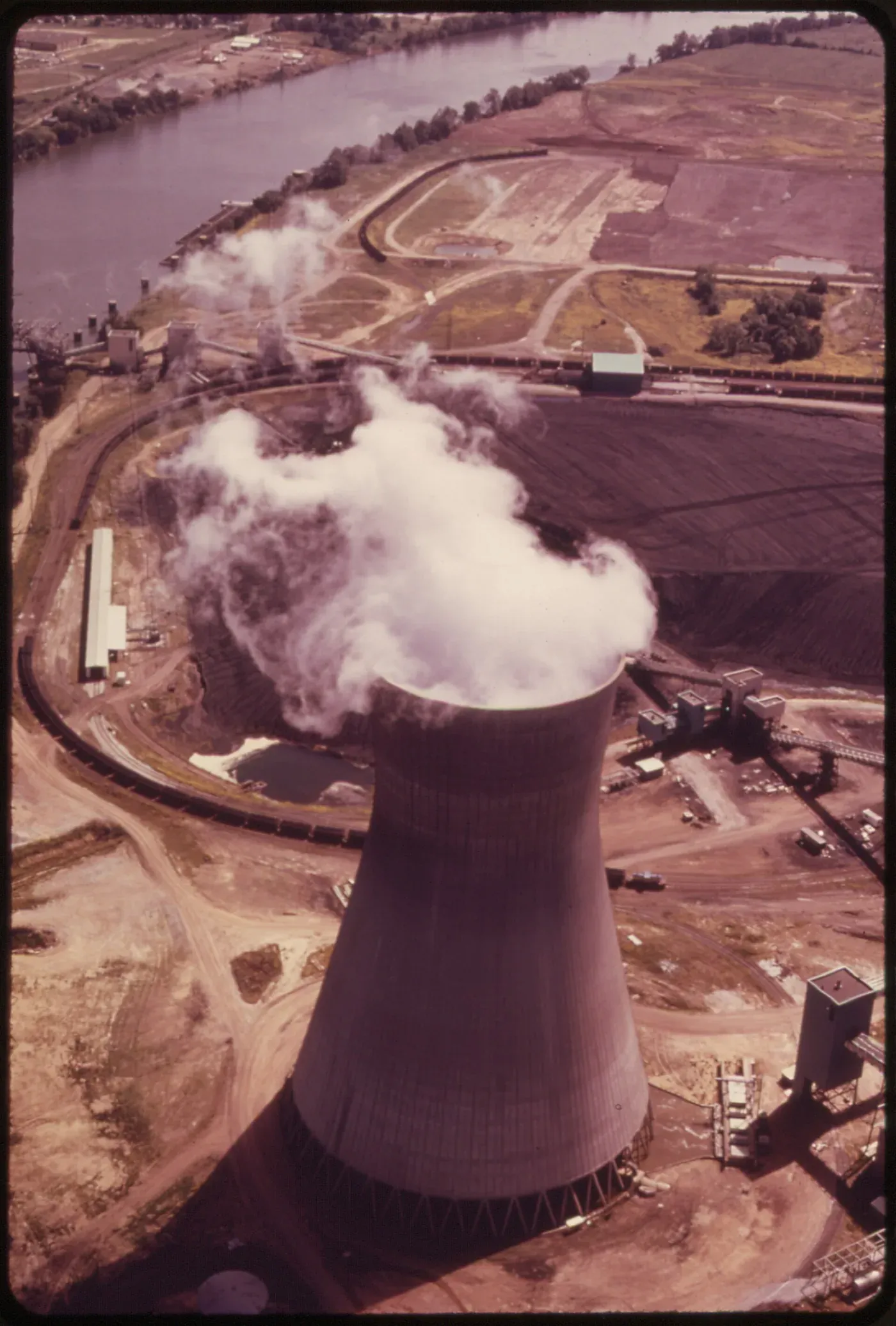
From there it moved into filtration: woven PPS fabric lines the fabric filters, or baghouses, that strip particulates out of the exhaust from coal-fired boilers and papermaking operations, environments hot and chemically hostile enough to destroy an ordinary filter cloth in weeks.
Plate IV

In electronics it became a housing and insulation material and the dielectric layer inside film capacitors; under a car’s hood it turned up in fuel-system and connector components that have to tolerate gasoline, oil and engine heat all at once, and, more unexpectedly, in gaskets, membranes and even components of musical instruments, wherever its combination of chemical inertness and dimensional stability mattered more than its cost.
None of that fiber and film work would have been possible with the branched, low-molecular-weight material Macallum’s melt reaction produced back in 1948. It took another Phillips chemist, Robert W. Campbell, to invent a linear, higher-molecular-weight form of PPS tough enough to be melt-spun into continuous filament rather than only molded, and in 1983, exactly a decade after Ryton’s own commercial debut, Phillips Fibers Corporation shipped the first American commercial PPS fiber, cloth that today filters the exhaust of the same kind of coal-burning power plants that, in the years after 1973, took on a larger share of the country’s electricity precisely because there was less oil to burn instead.
values with [n] cite the numbered references·estimates are flagged·“not yet available” and “N/A” are honest states, not gaps
fetching the model…
Polyphenylene Sulfide repeat unit
- Abbreviation
- PPS
- Type
- polymer family (hub)
- CAS number
- None (heterogeneous class or not assigned)
- Resin ID code
- none assigned
- Formula
- (C6H4S)n[-C6H4-S-]nShown is the linear para-phenylene sulfide homopolymer backbone. Commercial Ryton and equivalent grades are almost always sold reinforced with glass fiber or mineral filler, which this formula does not capture.
- Repeat unit (BigSMILES)
{[][>]Sc1ccc(cc1)[<][]}- IUPAC name
- Poly(phenylene sulfide)
- Synonyms
- —
- Also known as
- —
- Chemical family
- polyketone
- Backbone class
- heterochain
- Polymerization mechanism
- step-growth-condensation
- Constitutional monomer
- p-Dichlorobenzene
- Polymer class
- thermoplastic
- Year of origin
- 1973
- Era
- The Engineering Polymers Era (1961-1979)
- Key figures
- James T. Edmonds Jr. · H. Wayne Hill Jr.
- Events referenced
- OPEC oil embargo begins (October 1973)
- Polymerization type
- step-growth condensation
- Common monomers (feedstocks)
- p-dichlorobenzene, sodium sulfide
- Catalysts
- not yet available
Commercial process initially developed by H. Wayne Hill Jr. and James T. Edmonds Jr. at Phillips Petroleum; Robert W. Campbell later invented the linear, high-molecular-weight PPS suitable for extrusion and fiber spinning. The first US commercial PPS fiber was produced in 1983 by Phillips Fibers Corporation.
- Tacticity
- not yet available
- Crystal structure
- not yet available
- Typical crystallinity
- 40–83 %[2]Mark's X-ray diffraction figure for a fully crystalline reference sample is 65% (handbook-mark-1999)
Molecular weight
- Number average (Mn)
- not yet available
- Mass average (Mw)
- 12000–1400000 g/mol[2]
- Dispersity (Mw/Mn)
- 1.4–2[2]
| Solvent | T | M range | K | a |
|---|---|---|---|---|
| 1-chloronaphthalene[3] | 481.15 K | — | 0.0000891 mL/g | 0.747 |
Aromatic-ring/sulfide-linkage backbone gives PPS very high chemical, thermal, and dimensional stability, at the cost of low toughness relative to more flexible engineering plastics.
- Density
- 1.35 (1.34–1.36) g/cm³[2]20 °C, unfilled; amorphous 1.32 g/cm³, crystalline 1.425–1.44 g/cm³
- Melt flow index
- not yet available
- Refractive index
- 1.83[2]20 °C
- Transmittance
- not yet available
- Haze
- not yet available
- Gloss
- not yet available
- Water absorption
- 0.01–0.03 %[2]equilibrium, immersion in water at 23 °C
- Dielectric constant
- 3.8–5.2[2]100 Hz; at 1 MHz, 3.8–4.9
- Dielectric strength
- 18 kV/mm[2]specimen thickness 0.6–0.8 mm, unfilled; 40% glass fiber grade reaches 28 kV/mm
- Electrical conductivity
- 1 × 10⁻⁹ S/m[2]reciprocal of reported volume resistivity, 1×10⁹ Ω·m, unfilled; notably lower than glass-fiber-filled grades (>1×10¹³ Ω·m, i.e. <1×10⁻¹³ S/m)
- Glass transition (Tg)
- 84.85 °C[3]DSC (358 K); Wypych reports a broader range of 74–92 °C across grades (handbook-wypych-2016)
- Melting temperature (Tm)
- 285–295 °C[2]DSC; equilibrium (extrapolated) melting point is higher, ~303–315 °C depending on molecular weight (handbook-mark-1999)
- Crystallization (Tc)
- not yet available
- Heat deflection (HDT)
- 114.85 °C[3]ASTM D648, 1.82 MPaunfilled, linear-type PPS; unfilled cured-feedstock grade (annealed) is 134.85 °C. 40% glass fiber and glass/mineral-filled grades exceed 259.85 °C.
- Decomposition onset
- 450–480 °C[2]a higher value of 532 °C is also reported. Mark reports thermogravimetric onset at 424.85 °C and 20% mass loss at 549.85 °C (handbook-mark-1999).
- Thermal conductivity
- 0.29 W/(m·K)[2]20 °C, unfilled; matches value independently reported in handbook-mark-1999. Glass-fiber-filled grade is lower, 0.20 W/(m·K).
- Tensile modulus
- 3800 MPa[2]unfilled grade; 40% glass fiber grades reach 14,500–19,100 MPa
- Yield strength
- 80 MPa[3]unfilled, linear-type PPS
- Tensile strength at break
- 90 MPa[2]unfilled grade; Mark reports 65 MPa (cured feedstock) to 86 MPa (linear type), ASTM D638 (handbook-mark-1999)
- Elongation at break
- 3–8 %[2]unfilled grade; Mark reports 1.6–2% for cured/feedstock grades and up to 21% for some linear-type samples, depending on test method (handbook-mark-1999)
- Impact strength (Izod)
- 2.6–3.5 J/m[2]notched, 23 °C, unfilled; Mark reports notably higher values for unfilled grades, 16 J/m (cured feedstock) to 26 J/m (linear type), ASTM D256 (handbook-mark-1999)
- Impact strength (Charpy)
- not yet available
- Hardness
- 90–95 Rockwell M[2]unfilled; Mark reports Rockwell R120 for unfilled, cured feedstock grade (handbook-mark-1999)
- Flexural modulus
- 3750–4200 MPa[2]unfilled grade; Mark reports 3400–4130 MPa for various unfilled grades (handbook-mark-1999)
- Poisson's ratio
- not yet available
- Coefficient of friction
- 0.4[2]in air, unfilled; 0.22 in water, 0.6 for 40% glass-fiber grade
- Solvent: organic_solvents_below_200c
- Does not dissolve in solvents below approximately 200°C[1]
- Solvent: dilute acids
- very good[2]nitric acid; ranges from dilute (very good) to concentrated (fair)
- Solvent: concentrated acids
- fair[2]nitric acid; ranges from dilute (very good) to concentrated (fair)
- Solvent: alcohols
- very good[2]
- Solvent: alkalis
- very good[2]
- Solvent: aliphatic hydrocarbons
- very good[2]
- Solvent: aromatic hydrocarbons
- very good[2]
- Solvent: esters
- very good[2]
- Solvent: greases & oils
- very good[2]
- Solvent: halogenated hydrocarbons
- good[2]
- Solvent: ketones
- very good[2]
- Weathering / UV
- Weatherometer (WOM) exposure to 2000 h causes little change in tensile and impact strength[2]
- Hydrolysis resistance
- Resistant to acids and alkalis[1]
- Flammability (UL94)
- V-0[2]
- Limiting oxygen index
- 40 %[2]unfilled grade; Mark reports 44% via ASTM D2863 (handbook-mark-1999)
- Solubility parameter (δ)
- 19.8 MPa^0.5[2]
Gas permeability
not yet available
Polymer-solvent interaction parameter (χ)
not yet available
- Industrial filtrationfilter fabrics for coal boilers · papermaking felts
- Electricalelectrical insulation · film capacitors
- Specialtymembranes · gaskets and packings · musical instrument components
- Automotive & electronicsunder-hood components · connectors
- Recyclable
- Yes
- Biodegradable
- No
- Degradation pathway
- not yet available
- [1]Polyphenylene sulfideWikipediaAccessed 2026-07-14https://en.wikipedia.org/wiki/Polyphenylene_sulfide[wiki-pps]
- [2]Handbook of PolymersChemTec Publishinghttps://www.worldcat.org/isbn/9781895198928[handbook-wypych-2016]
- [3]Polymer Data HandbookOxford University Presshttps://search.worldcat.org/search?q=Polymer+Data+Handbook+Mark+1999[handbook-mark-1999]
Illustrations
- Plate IA gas station sign in Oregon, autumn 1973, during the Arab oil embargo. This was the same year an Oklahoma oil company was bringing a new plastic to market.Wikimedia Commons
- Plate IIH. Wayne Hill Jr. and James T. Edmonds Jr., the Phillips Petroleum chemists whose solvent-based process finally made poly(phenylene sulfide) into a real material, examining early molded Ryton parts.Wikimedia Commons
- Plate IIIThe Frank Phillips Tower in downtown Bartlesville, Oklahoma, once part of Phillips Petroleum's headquarters complex. This was the same company, in the same small city, where Edmonds and Hill developed Ryton.Wikimedia Commons
- Plate IVA coal-fired power plant photographed in September 1973, the same year Ryton reached the market. It was the kind of plant whose exhaust, decades later, would be filtered through baghouses lined with woven PPS fabric.Wikimedia Commons