The Engineering Polymers Era (1961-1979)
Polyetherimide (PEI)
The Amber Guardian of the Electronics Age
In July 1975, an American Apollo capsule and a Soviet Soyuz spacecraft docked in Earth orbit, and for two days five men who had spent careers training to beat each other to the Moon shook hands through an open hatch instead. The hardware that made it possible was itself a small miracle of joining incompatible systems: American and Soviet docking mechanisms, electrical standards and life-support chemistries had to be redesigned from scratch so that two spacecraft built by rival superpowers could connect without killing anyone.
Plate I


A smaller, quieter act of joining two incompatible systems was going on that same year inside General Electric’s Corporate Research and Development Center in Schenectady, New York. Aromatic polyimides (the Kapton-style chemistry already a decade old by 1975) were superb insulators and could shrug off heat that would destroy an ordinary plastic, but they shared a stubborn family trait: once the imide rings closed, the polymer would not melt, which meant it could only be cast as a film or built up as a solution-processed coating, never simply injection-molded the way an ordinary thermoplastic could. Chemist Tohru Takekoshi, working with John Kochanowski, found a way around that limit: build the imide rings onto a backbone that also carried flexible ether linkages between them, breaking up the rigid stacking that made conventional polyimide so heat-tolerant and so unmeltable at the same time. Their process patent, describing what would become polyetherimide, was granted on 16 September 1975.
Plate II


The One That Melts
Every other imide-ring polymer in this atlas earns its place by refusing to soften: that refusal is precisely what makes Kapton film survive a spacecraft’s temperature swings and Torlon bearings survive friction that would melt an ordinary plastic. Polyetherimide’s whole reason for existing is that it breaks that rule just enough. The ether oxygen between imide-bearing segments gives the chain a hinge the fully rigid polyimides don’t have, so instead of decomposing before it ever reaches a melt, the polymer flows like glass above its softening point and can be injection molded, extruded, or 3D-printed on equipment built for ordinary engineering plastics, at higher temperatures than those plastics tolerate, but on the same machines. GE brought the result to market a few years later as Ultem, and the “meltable polyimide” description has stuck to it ever since as the trait that sets it apart from its more rigid relatives.
Plate III
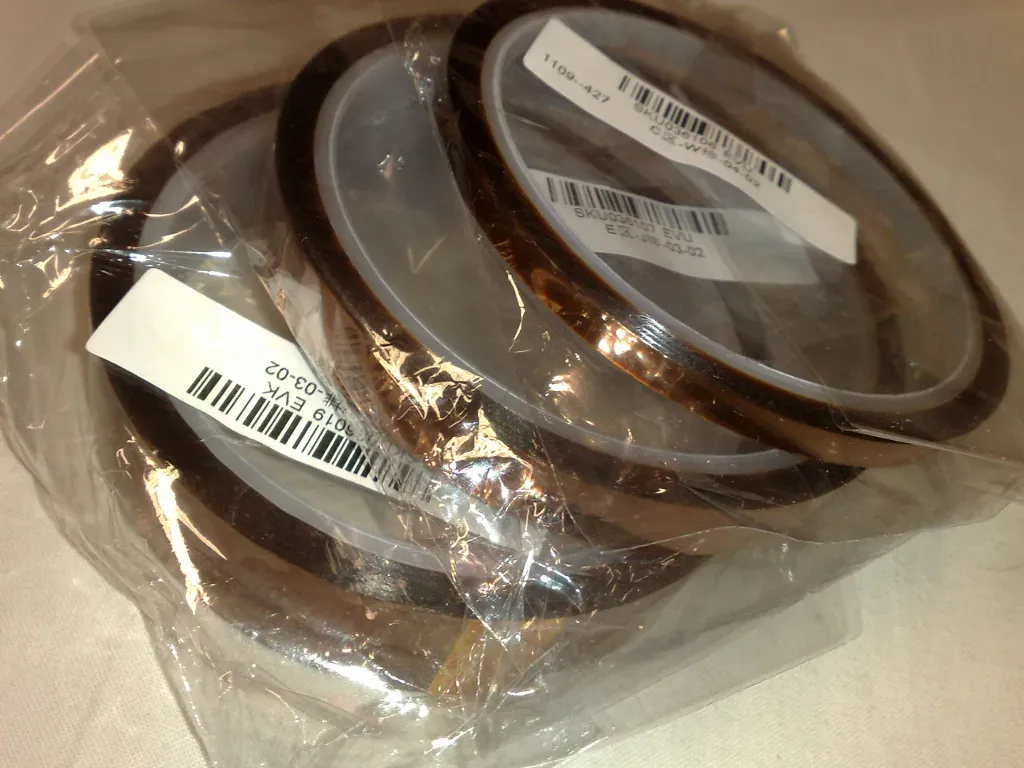

What the Trade-Off Buys
Because it is fully amorphous rather than crystalline, Ultem is naturally transparent with a distinctive amber tint, clear enough to see fluid levels through a molded part. This is an unusual property for a polymer this heat-resistant, and one most of its imide relatives simply don’t have. It tolerates heat well above the point that softens ordinary engineering plastics without needing any additive to do so, and it self-extinguishes readily, producing little smoke when it does burn, which is precisely why it ended up in aircraft cabin interiors subject to strict fire, smoke and toxicity rules. Mechanically it is stiff and strong enough to substitute for metal in lightly loaded parts, though (like most of the rigid, aromatic polymers in this atlas) it does not stretch far before it breaks. It shrugs off acids, alkalis, oils and greases without much trouble, and holds up reasonably well against alcohols, esters and hydrocarbons too, a broader chemical tolerance than many high-heat plastics manage. Being amorphous does cost it a little in moisture uptake compared with the fully rigid polyimides, so parts are dried carefully before molding, but that is a small price for a resin that processes on an injection press rather than only as a cast film.
Plate IV
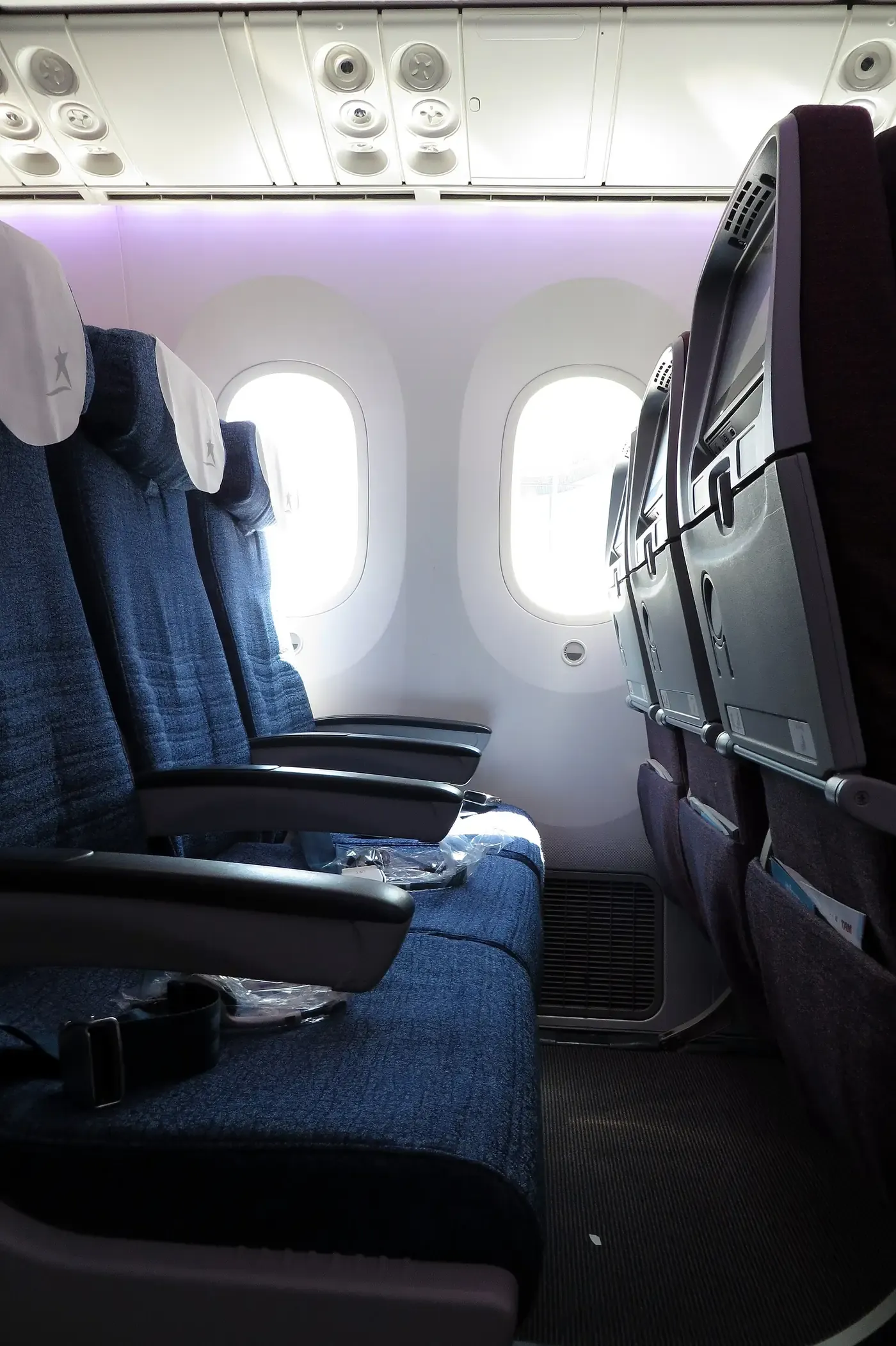

From Cockpit to Kitchen Drawer
Ultem’s aerospace career came first: aircraft interior panels, ducting and connectors that had to meet strict flammability rules while still being light enough to matter, and later structural components on the Boeing 787 substituting for metal parts to save weight aircraft-wide. But the same amber resin turned up somewhere far more ordinary: inside the sterilizable trays and surgical instrument handles that pass through a hospital autoclave hundreds of times without warping, and later as filament for high-temperature 3D printers, letting engineers print load-bearing prototypes in a material that would previously have needed a mold. A polymer developed to solve one very specific problem (melting a polyimide without breaking its heat resistance) ended up wherever that same combination of properties happened to matter.
Fifty Years of the Meltable Polyimide
Apollo-Soyuz was a one-time gesture, retired along with the hardware that made it possible. Polyetherimide’s trick, breaking the imide backbone’s stubborn refusal to flow, has aged rather better: five decades on, it is still the polyimide chemists reach for whenever the job calls for injection-molding, not casting.
values with [n] cite the numbered references·estimates are flagged·“not yet available” and “N/A” are honest states, not gaps
fetching the model…
Polyetherimide repeat unit
- Abbreviation
- PEI
- Type
- polymer family (hub)
- CAS number
- 61128-46-9
- Resin ID code
- none assigned
- Formula
- (C37H24N2O6)n[-N(CO)2-C6H3-O-C6H4-C(CH3)2-C6H4-O-C6H3-(CO)2-N-C6H4-]nThe bisphenol A-based polyetherimide shown is the commercial archetype (Ultem). Each (CO)2 bridge is one fused five-membered imide ring, written open for readability; the ether links either side of the bisphenol A bridge are what make this polymer melt-processable, unlike the fully rigid polyimides.
- Repeat unit (BigSMILES)
{[][>]N1C(=O)c2ccc(Oc3ccc(cc3)C(C)(C)c3ccc(cc3)Oc3ccc4C(=O)N(C(=O)c4c3)c3cccc(c3)[<])cc2C1=O[]}- IUPAC name
- —
- Synonyms
- Ultem
- Also known as
- Ultem
- Chemical family
- polyimide
- Backbone class
- heterochain
- Polymerization mechanism
- step-growth-condensation
- Constitutional monomer
- Bisphenol A dianhydridem-Phenylenediamine
- Polymer class
- thermoplastic
- Year of origin
- 1975
- Era
- The Engineering Polymers Era (1961-1979)
- Key figures
- Tohru Takekoshi · General Electric
- Events referenced
- Apollo-Soyuz Test Project docking (July 1975) · Takekoshi and Kochanowski's polyetherimide patent grant (16 September 1975)
- Polymerization type
- step-growth condensation (imidization)
- Common monomers (feedstocks)
- bisphenol A dianhydride, m-phenylenediamine
- Catalysts
- not yet available
Research by J.G. Wirth's team at General Electric in the early 1970s led to commercial introduction in 1982 under the trade name Ultem. Made via imidization of a flexible dianhydride with m-phenylenediamine.
- Tacticity
- not yet available
- Crystal structure
- not yet available
- Typical crystallinity
- 0 %[2]Amorphous, which underlies its amber transparency.
Molecular weight
- Number average (Mn)
- 10000–42000 g/mol[2]
- Mass average (Mw)
- 30000–75000 g/mol[2]
- Dispersity (Mw/Mn)
- 1.6[2]
Mark-Houwink constants
not yet available
Combines aromatic imide rigidity (heat/chemical resistance) with ether linkages that improve melt-processability relative to fully rigid polyimides like Kapton.
- Density
- 1.27 (1.27–1.31) g/cm³[2]amorphous, unfilled
- Melt flow index
- 14–18 g/10min[2]230 °C/3.8 kg
- Refractive index
- 1.63–1.687[2]
- Transmittance
- 58 %[2]
- Haze
- 2 %[2]
- Gloss
- not yet available
- Water absorption
- 0.65–1.75 %[2]equilibrium in water immersion, 23 °C; 0.65% at 24 h, 1.75% at 30 days
- Dielectric constant
- 3.15[2]100 Hz-1 MHz; essentially frequency-independent (Wypych, Mark)
- Dielectric strength
- 14–33 kV/mm[2]K20/P50 electrodes, d=0.6–0.8 mm (Wypych); Mark reports 33 kV/mm at 1.6 mm in air, dropping to 20 kV/mm at 3.2 mm in oil
- Electrical conductivity
- 1 × 10⁻¹⁵–1 × 10⁻¹³ S/m[2]reciprocal of volume resistivity range (1×10¹³-1×10¹⁵ Ω·m)
- Glass transition (Tg)
- 209–249 °C[2]commonly cited as ~217 °C; range reflects different test methods (torsion pendulum, DMA, dielectric measurement)
- Melting temperature (Tm)
- Not applicableAmorphous; no true melting point.
- Crystallization (Tc)
- Not applicable
- Heat deflection (HDT)
- 190–235 °C[2]ASTM D6481.8 MPa; Mark reports 200 °C for Ultem 1000, unannealed, 6.4 mm
- Decomposition onset
- not yet available
- Thermal conductivity
- 0.22 W/(m·K)[3]ASTM C177
- Tensile modulus
- 3000–3700 MPa[2]Wypych 3,420–3,700 MPa; Mark reports 3,000 MPa for Ultem 1000 (ASTM D638)
- Yield strength
- 96–105 MPa[2]tensile stress at yield; Wypych 96–103 MPa, Mark 105 MPa for Ultem 1000 (ASTM D638)
- Tensile strength at break
- 53–124 MPa[2]unqualified 'tensile strength' row, distinct from tensile stress at yield above
- Elongation at break
- 14–60 %[2]Wypych 14–50%; Mark reports 60% ultimate elongation at break for Ultem 1000 (ASTM D638)
- Impact strength (Izod)
- 27–69 J/m[2]notched, 23 °C; Mark reports 50 J/m for Ultem 1000 (ASTM D256)
- Impact strength (Charpy)
- 21 kJ/m²[2]notched, 23 °C
- Hardness
- 127 Rockwell R[2]Mark separately reports 109 for Ultem 1000, scale not specified in source (ASTM D785)
- Flexural modulus
- 3040–3810 MPa[2]Mark reports 3,300 MPa for Ultem 1000 (ASTM D790)
- Poisson's ratio
- 0.36[2]
- Coefficient of friction
- 0.15–0.7[2]against steel; varies with sliding speed and applied pressure
- Solvent: dilute acids
- very good[2]
- Solvent: concentrated acids
- very good[2]
- Solvent: alcohols
- good[2]
- Solvent: alkalis
- very good[2]
- Solvent: aliphatic hydrocarbons
- good[2]
- Solvent: aromatic hydrocarbons
- good[2]
- Solvent: esters
- good[2]
- Solvent: greases & oils
- very good[2]
- Solvent: halogenated hydrocarbons
- very good[2]
- Solvent: ketones
- good[2]
- Weathering / UV
- not yet available
- Hydrolysis resistance
- not yet available
- Flammability (UL94)
- V-0[2]V-0 achieved at 0.41 mm thickness; 5VA rating achieved at 1.9 mm (Mark, Ultem 1000)
- Limiting oxygen index
- 45–47 %[2]
- Solubility parameter (δ)
- 19.8 MPa^0.5[2]
Gas permeability
- O₂
- 3.75 × 10⁻¹⁴ cm³(STP)·cm/(cm²·s·Pa)[2]25 °C; converted from 0.5 barrer
- N₂
- 5.25 × 10⁻¹⁵ cm³(STP)·cm/(cm²·s·Pa)[2]25 °C; converted from 0.07 barrer
- CO₂
- 9.975 × 10⁻¹⁴ cm³(STP)·cm/(cm²·s·Pa)[3]35 °C, 10 atm; converted from 1.33 barrer (Ultem 1000)
Polymer-solvent interaction parameter (χ)
not yet available
- Aerospaceaircraft interior components
- Medicalsterilizable devices
- Electronicscomponents requiring stable electrical properties across frequencies · 3D printer build plates
- Recyclable
- Yes
- Biodegradable
- No
- Degradation pathway
- not yet available
- LD50 (oral, rat)
- 5000 mg/kg[2]reported as >5,000 mg/kg
- NFPA health
- 0[2]HMIS rating, 0–4 scale
- NFPA flammability
- 1[2]HMIS rating, 0–4 scale
- NFPA reactivity
- 0[2]HMIS rating, 0–4 scale
- Carcinogenic classification
- not listed by ACGIH, NIOSH, NTP[2]
Thermal/photooxidative degradation products include acetophenone, phenylacetic acid, phenols, benzoic acid, and phthalic anhydride/acid chain-end groups.
- [1]PolyetherimideWikipediaAccessed 2026-07-14https://en.wikipedia.org/wiki/Polyetherimide[wiki-pei]
- [2]Handbook of PolymersChemTec Publishinghttps://www.worldcat.org/isbn/9781895198928[handbook-wypych-2016]
- [3]Polymer Data HandbookOxford University Presshttps://search.worldcat.org/search?q=Polymer+Data+Handbook+Mark+1999[handbook-mark-1999]
Illustrations
- Plate IThe Apollo and Soyuz crews, photographed together ahead of the July 1975 docking mission that required American and Soviet hardware to be engineered to work as one system.Wikimedia Commons
- Plate IIGeneral Electric's Research and Development Center in Schenectady, New York, where Tohru Takekoshi's team developed the ether-linked polyimide chemistry behind Ultem.Wikimedia Commons
- Plate IIIRolls of Kapton polyimide tape, the rigid, unmeltable chemistry that polyetherimide shares an imide ring with, but that it alone among this family can also melt and mold.Wikimedia Commons
- Plate IVAn aircraft cabin interior, the kind of environment where Ultem-family resins are chosen for panels and ducting precisely because they resist fire and produce little smoke.Wikimedia Commons