Persian · Main Course
Zereshk Polo ba Morgh
Saffron-braised chicken alongside basmati rice studded with tart, sugar-glossed barberries, a festive Persian pairing of sweet, sour and saffron.
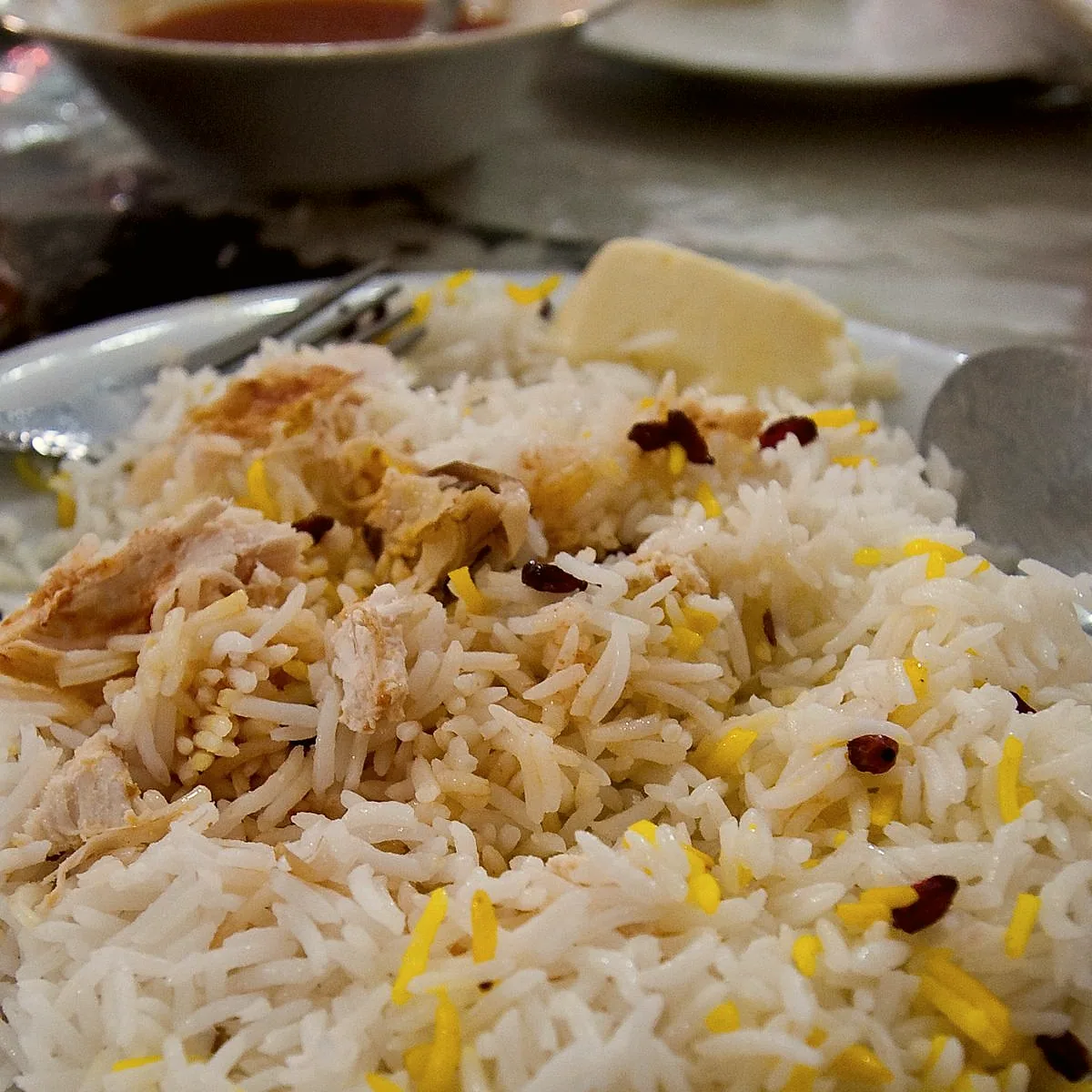

CC BY 2.0. Cropped and colour-adjusted for this site.
Method
Season the 700 g chicken thigh with the 3 g ground turmeric, 2 g ground black pepper and 5 g fine sea salt. Melt the 25 g unsalted butter in a wide pan over a medium heat, brown the chicken on both sides, then add the 150 g yellow onion and the 20 ml freshly squeezed lemon juice. Cover and cook over a low heat for 45m, until the chicken is fully tender and the onion has collapsed into the sauce.
Rinse the 400 g basmati rice in several changes of cold water, swirling and draining each time, for 6m, until the water runs clear.
Cover the rinsed rice with the 2.5 L water and the 15 g fine sea salt and leave it to soak for 45m.
Grind the 0.4 g saffron and stir it into the hot 30 ml water, setting it aside to steep for 5m.
Melt the 15 g unsalted butter in a small pan, add the 40 g barberries and the 12 g caster sugar, and cook over a moderate heat, stirring constantly, for 8m, until glossy and just softened. Take off the heat immediately.
A short glaze in butter and sugar rather than a longer cook keeps the barberries whole and glossy; overcooked, they turn bitter and lose the sharp pop that offsets the rice.
Common pitfallBarberries scorch within moments in a hot pan because they are already dried and low in moisture. Keep the heat moderate and keep them moving.
Bring the rice in its soaking water to the boil and cook for 7m, until the grains have softened at the edge but are still firm at the core. Drain in a fine sieve.
Melt the 30 g unsalted butter in the base of a heavy, non-stick pot. Mound the drained rice over it, drizzle with the bloomed 30 ml water, cover the lid with a clean cloth and steam over a low heat for 45m, until the rice is tender and separate.
Spoon the rice onto a platter, folding through most of the glazed 40 g barberries. Arrange the braised chicken alongside, spoon over its sauce, and scatter the remaining barberries over the top. This takes 5m.
Barberries, called zereshk across most of Iran, grow wild on a thorny shrub whose red fruit ripens in midsummer, and their sharp, sour flavour has been used in Persian cooking as a seasoning for soups, rice dishes and stuffings for centuries, and zereshk polo (rice cooked with the dried berries stirred through or scattered over the top, most often alongside saffron-braised chicken) is the dish that turns that seasoning into its centrepiece [1][2].
Exactly when barberries and rice became this specific, named polow rather than just a seasoning is not precisely dated. Rice itself became a mark of Persian court luxury under the Safavid dynasty, the sixteenth to eighteenth centuries, and rice cookery was refined further still under the Qajars of the nineteenth century, whose court served rice dishes markedly more elaborate and time-consuming than anything the Safavid table had, poultry included among them at wedding feasts [2] [3]. Where zereshk polo itself (and the saffron chicken, or morgh, often served alongside it) fits on that timeline is not documented in detail, so the dish's own emergence is best read as approximate rather than settled [2][3].
What has stayed constant is the dish's status as festive rather than everyday food. It belongs to the category Persians call majlesi (gathering food) served at weddings, engagement parties and family celebrations rather than on a Tuesday, valued as much for the visual contrast of crimson berries against white, saffron-streaked rice as for its sweet-tart flavour. The technique underneath it is standard Persian rice cookery: the rice is soaked, parboiled and then steamed to finish, the same method that produces the crisp tahdig crust found under most Persian polows.
Sources
- Barberry (Zereshk, Berberis spp.), Encyclopaedia IranicaBotanical entry on Berberis in Iran, confirming its long-standing culinary use as a flavouring in soups, polows and chicken stuffing.
- Zereshk polo, WikipediaCovers the dish's emergence as a distinct polow, its Safavid-era court context and its role at weddings and celebrations.
- Qajar Dynasty xiv. Qajar Cuisine, Encyclopaedia IranicaCovers rice cookery's further refinement under the Qajars, more elaborate than Safavid-era dishes, and poultry-and-rice dishes served at weddings.