Chinese · Starter
Xiaolongbao
Pork dumplings pleated around a spoonful of jellied stock that melts into soup as they steam, so each one holds a mouthful of broth inside a thin, unleavened wrapper.
Also known asSoup dumplings · International
Not the same asKhinkali (A Georgian dumpling that also carries broth inside its wrapper, but gets there differently: khinkali's filling is raw meat worked with cold water and its own juices while it cooks, rather than xiaolongbao's diced, pre-set aspic that melts under steam.)
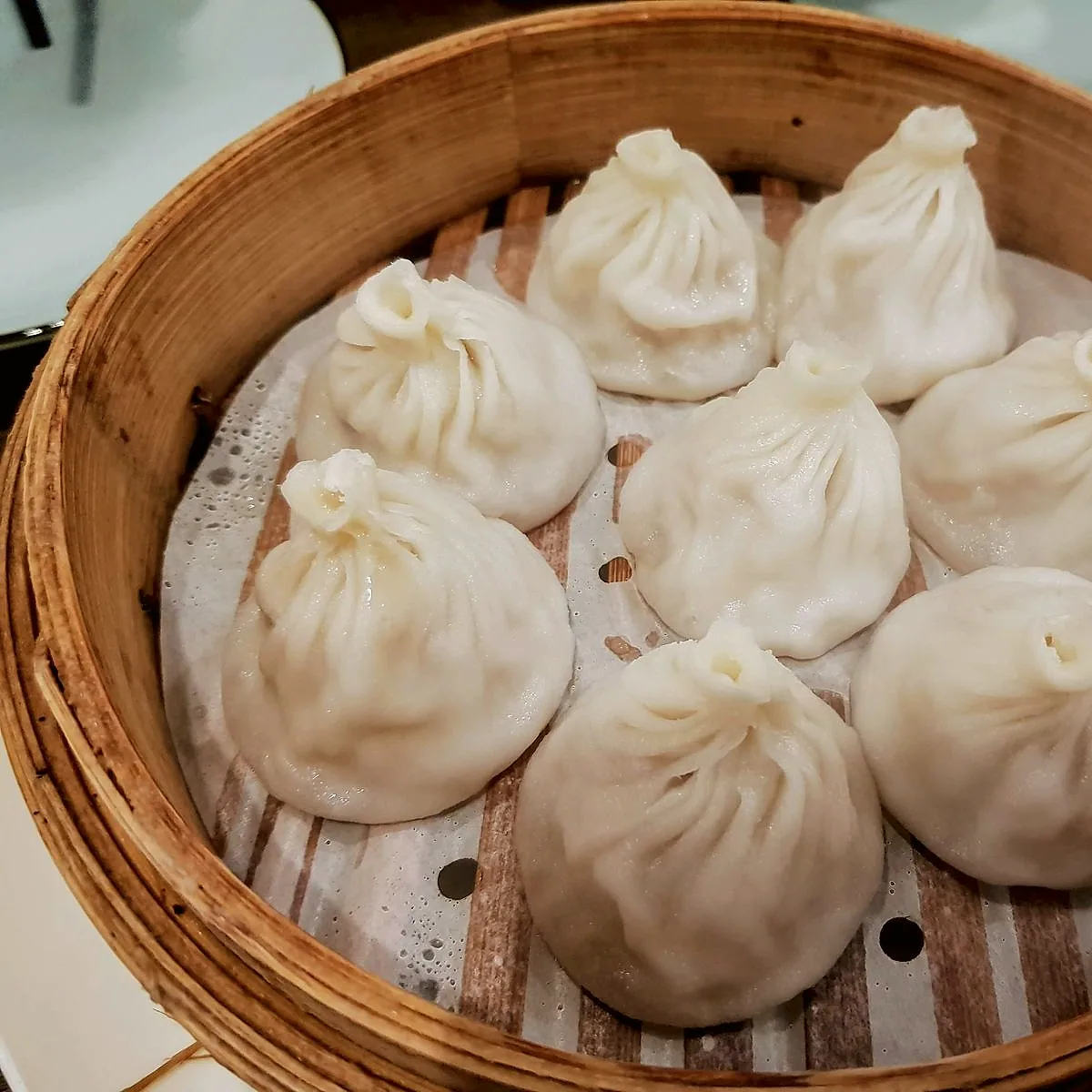

CC BY-SA 4.0. Cropped and colour-adjusted for this site.
Method
Put the 500 g chicken thigh, 1 L water and 15 g fresh ginger in a pot and bring to the boil, skimming off any foam, then lower the heat and simmer for 45m. Strain the stock, discarding the solids, and stir in the 1 ½ spring onions (20 g).
While the stock is still hot, whisk in the 12 g powdered gelatine until fully dissolved. Pour into a shallow dish to a shallow depth and chill for 4h, until firm and wobbling like a set jelly rather than a liquid.
The stock is chilled until firm and diced rather than added as a liquid, because a raw filling cannot hold liquid stock without it leaking through the wrapper during pleating. Solid aspic folds in like any other filling and only turns to soup once the heat of steaming melts it.
Meanwhile, combine the 270 g plain flour, 140 ml water and 3 g fine sea salt in a bowl and bring together into a smooth, firm dough, kneading for 10m.
Cover the dough and rest it for 20m at room temperature.
Turn the set aspic out and cut it into small, even dice, working for 5m and keeping it chilled until it goes into the filling.
Combine the 350 g pork mince, 8 g fresh ginger, 1 ½ spring onions (20 g), 15 ml light soy sauce, 8 ml toasted sesame oil, 6 g caster sugar, 2 g ground white pepper and 3 g fine sea salt in a bowl and stir hard in one direction until sticky, then fold through the diced aspic without crushing it.
Roll the rested dough into a log and pinch off small, even pieces, keeping the rest covered. Roll each piece with the 30 g plain flour underneath into a thin round, thinner at the rim than at the centre. Spoon filling into the middle of each round and gather the edge up around it into many fine pleats, twisting them together at the top to seal the dumpling closed.
Common pitfallA wrapper rolled to one even thickness throughout tears at the pleats, which carry several folds of dough stacked on each other. Roll it thinner at the centre than at the rim, the opposite of a boiled dumpling, since the centre here is under a spoonful of soft aspic rather than a seam.
Line a steamer basket so the dumplings cannot stick to the metal or bamboo directly, and set them in with space between each. Steam over rapidly boiling water for 8m, until the wrappers turn glossy and translucent. Lift each one out carefully, keeping it upright so the soup inside does not spill before it reaches the table.
Xiaolongbao's name is straightforward ("small basket bun", for the bamboo steamers it is cooked and served in), but the dumpling's origin is told as two separate, competing stories, and neither is treated as settled fact by the sources here. The better-known version credits Huang Mingxian, who ran a restaurant called Ri Hua Xuan in Nanxiang, near Shanghai, with inventing the dish in the 1870s by folding aspic into pork mince: as the dumpling steamed, the aspic melted and filled it with soup [2]. A second story sets the dumpling's fame further west, in Wuxi, where the Qianlong Emperor is said to have tasted a local version during his travels and praised it so warmly that some accounts trace the "long" in xiaolongbao to "dragon", a reference to the emperor's own nickname, rather than to the steaming basket [2]. Wikipedia's account adds a third strand, tracing a Changzhou lineage back further still, to the Northern Song dynasty's guantangbao, a soup-filled bun made in Kaifeng [1].
What both principal legends and the Changzhou lineage agree on is the mechanism, which is the part of the dish that actually matters at the stove: solid aspic, made by chilling a gelatine-rich stock until firm, is diced and folded into the raw filling exactly like any other ingredient. Only under the steamer's heat does it melt back into liquid, so the soup inside the dumpling was never poured in; it was pleated in solid and cooked into being [1]. Before refrigeration, that trick depended on the season: making aspic reliably required weather cold enough to set a stock, which is part of why the technique is remembered as a patient, hours-long process rather than a quick one [2].
Sources
- Xiaolongbao, WikipediaOn the Changzhou and Nanxiang lines of development, the Qing-dynasty dating, and the aspic-melts-to-soup mechanism.
- Legends: The Two Stories Behind Xiaolongbao, South China Morning PostSets out the two competing origin stories in full (Huang Mingxian's 1870s Nanxiang restaurant, and the Qianlong Emperor's visit to Wuxi) as legends rather than settled history.