Chinese · Main Course
Sweet and Sour Pork
Battered pork shoulder fried until crisp, tossed in a sharp, glossy sauce of vinegar, ketchup and sugar with pineapple and pepper.
Also known asGu lao rouGu lou yuk
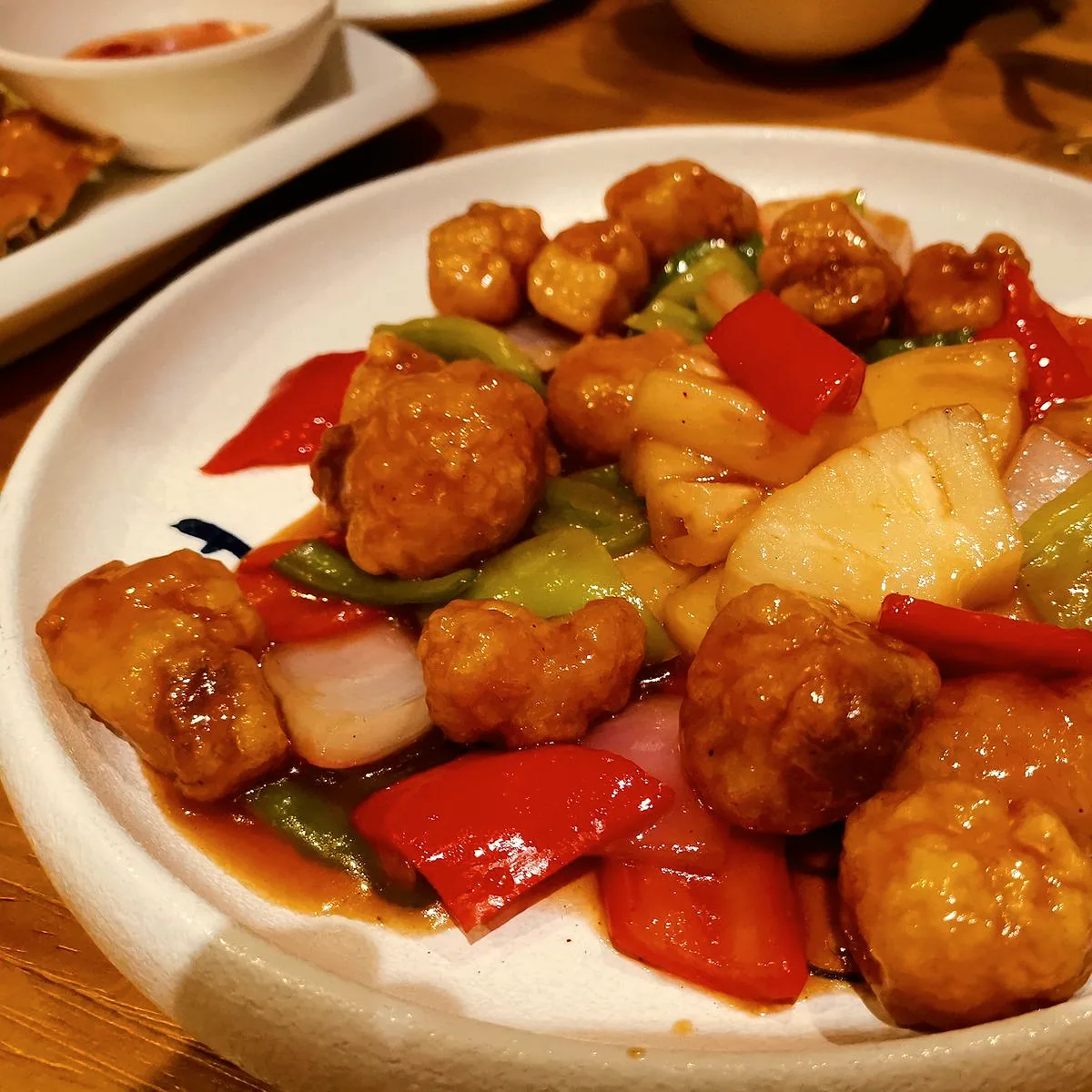

CC BY-SA 3.0. Cropped and colour-adjusted for this site.
Method
Combine the 10 ml light soy sauce and 10 ml Shaoxing wine in a bowl and turn the 400 g pork shoulder through it.
Leave the pork to marinate for 15m.
Dip each piece of pork in the 1 egg (50 g), then coat thoroughly in the 80 g cornflour, shaking off the excess, over 5m.
Heat the 800 ml vegetable oil until shimmering and fry the pork in batches for 8m, until pale gold and cooked through. Drain on a rack.
Raise the oil to a higher heat and fry the pork again, in batches, for 3m, until deeply golden and crisp. Drain again.
A brief second fry at a higher temperature, after the pork has rested, is what gives the crust its lasting crunch; without it, the crust turns soft within minutes of being tossed in sauce.
Heat the 15 ml peanut oil in a wok and stir-fry the 100 g green pepper, 100 g red pepper and 100 g white onion for a minute, then add the 150 g pineapple, 60 g tomato ketchup, 40 ml rice vinegar, 40 g caster sugar and 60 ml water. Bring to a simmer over 5m, then stir in the 8 g cornflour mixed with a little cold water and cook until thickened.
Add the fried pork to the wok and toss quickly to coat, over 3m, until glossy all over.
Common pitfallTossing the pork in the sauce too far ahead of serving softens the crust almost immediately. It goes in only at the very end, for just long enough to coat.
Sweet and sour pork is widely traced to Guangdong province, where late nineteenth-century cooks are said to have reworked a simpler pork dish using ingredients brought in by foreign merchants, adapting it to suit foreign appetites alongside a local clientele [3] [2].
Even the dish's Cantonese name, gu lou yuk, is older and less settled than that adaptation history might suggest. One theory holds that gu lou is pure onomatopoeia, imitating the gulping sound of eating something this rich; a second holds that the same syllables, said with different tones, mean "ancient," pointing to the dish's own long pedigree rather than to any sound at all. Neither explanation has displaced the other, and the dish's own history is repeated as one of Cantonese cooking's open questions rather than a settled fact [1].
The dish followed its Cantonese cooks abroad. Guangdong supplied the first large wave of Chinese emigration to North America (over three hundred thousand people entered the United States between 1852 and 1882, before the Chinese Exclusion Act cut the flow off), and the restaurants those emigrants opened, adapting their recipes further for European-American customers, made sweet and sour pork one of the first Chinese dishes many Western diners ever ate [3]. That early role as an introduction to Chinese food, rather than an insider's dish, is also why it is sometimes dismissed as inauthentic, a judgment that mistakes the dish's original purpose, appealing across a cultural divide, for a failure to do so.
Sources
- Legends: Sweet and Sour Pork, South China Morning PostSets out the two competing, unresolved theories for what gu lou means in the dish's Cantonese name.
- Sweet and sour pork, WikipediaOn the dish's eighteenth-century Guangdong origins, its development for foreign traders, and its spread with Cantonese emigration to North America.
- Diving Into Chinese American History Through Sweet-and-Sour Pork, ViceOn Guangdong cooks reworking the dish with foreign merchants' imported ingredients to suit foreign tastes, and Chinese restaurateurs adapting it further for American customers after large-scale nineteenth-century emigration.