Chinese · Starter
Siu Mai
Pork and shrimp packed into a thin wheat wrapper pleated into an open cup and steamed, the filling showing bare at the top rather than sealed away.
Also known asShumaiShaomai
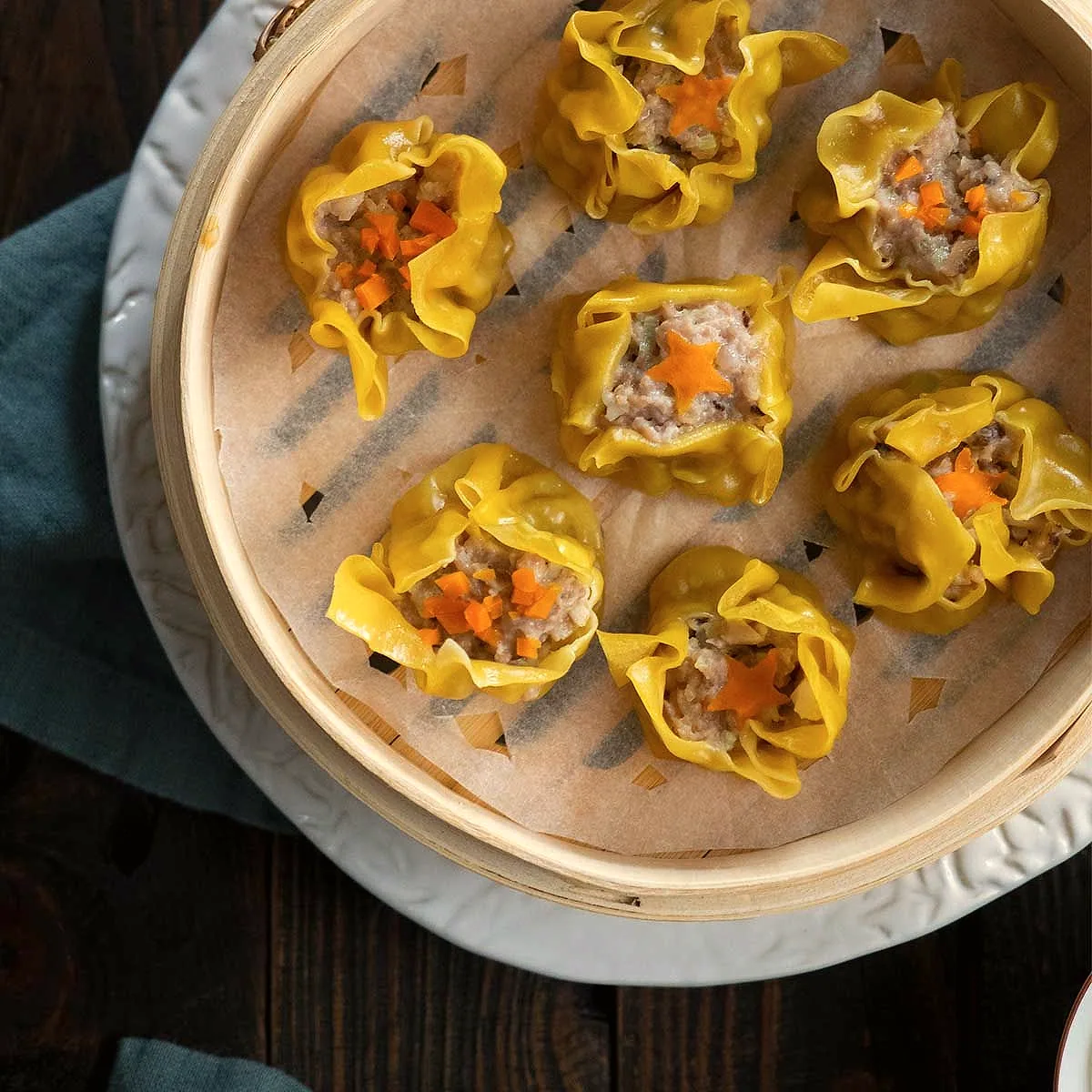

CC BY-SA 4.0. Cropped and colour-adjusted for this site.
Method
Combine the 200 g plain flour, 1 egg (50 g), 55 ml water and 2 g fine sea salt in a bowl and bring together into a firm dough, then knead for 10m until smooth.
Cover the dough and rest it for 15m at room temperature.
Meanwhile, combine the 300 g pork mince, 150 g shrimp, 60 g mushrooms, 40 g tinned bamboo shoots, 2 spring onions (30 g), 8 g fresh ginger, 15 ml light soy sauce, 8 ml toasted sesame oil, 5 g caster sugar, 1 g ground white pepper, 3 g fine sea salt and 15 g tapioca starch in a bowl and stir hard in one direction until sticky and cohesive, keeping the shrimp in distinct pieces rather than mashing it in with the pork.
Common pitfallChopping the shrimp to the same fineness as the pork loses the contrast that defines siu mai. Leave it in a coarser, distinct chop so pieces of it stay visible and bite through separately from the mince.
Roll the rested dough into a log and pinch off small, even pieces, keeping the rest covered. Roll each piece into a thin round. Cup a round in one hand, spoon filling into the centre, and gently press the wrapper up around the sides with your fingers so it pleats loosely into itself, leaving the filling showing at the top. Tap each one flat on its base so it stands upright.
Leaving the top open rather than sealing it, unlike a boiled or pan-fried dumpling, lets steam reach the filling directly and is what keeps siu mai's shape a stable, upright cup instead of a pleated dome.
Line a steamer basket and set the dumplings in with space between each. Steam over rapidly boiling water for 8m, until the wrapper is glossy and the filling is cooked through and firm to the touch.
Siu mai's name is written several ways in Chinese, and the differences are not spelling variants of one original but the record of the dish moving between regions. The earliest form, 捎賣, meant something closer to "sold on the side" (a snack offered alongside tea rather than a meal in itself) and is associated with tea houses in Hohhot, in what is now Inner Mongolia [1]. As merchants from Shanxi carried the snack toward Beijing and Tianjin, the characters shifted to their modern forms, 燒賣 and 稍美 among them, while the pronunciation stayed close to the original [1]. Cantonese siu mai is one of those descendants, adopted into Guangdong's tea house culture and, eventually, into dim sum service specifically [2].
The dish's presentation is old enough to be treated as settled rather than disputed: a thin wheat wrapper gathered loosely around a filling and left open at the top, rather than pleated shut, so the filling is visible before it is eaten [1]. In today's Cantonese kitchens that filling is built from pork and shrimp, but the open-topped wrapper (the detail that survives across every regional version, from the mutton-filled tea house snack of the north to the pork-and-shrimp dim sum staple of the south) is the part of the dish that travelled furthest with its name intact [2].
Sources
- Shumai, WikipediaOn the dish's documented association with Hohhot, the character changes behind its several romanisations, and its status as one of Cantonese dim sum's best-known staples.
- The Origins of Siu Mai — How an Iconic Dim Sum Staple Came to Be, South China Morning PostOn siu mai's roots as a tea house snack in Inner Mongolia and its later adoption into Hong Kong's everyday dim sum repertoire.