American · Main Course
Poke
Cubed raw ahi tossed with shoyu, sesame oil and a crushed roasted-nut relish, served over rice as one main-course portion.
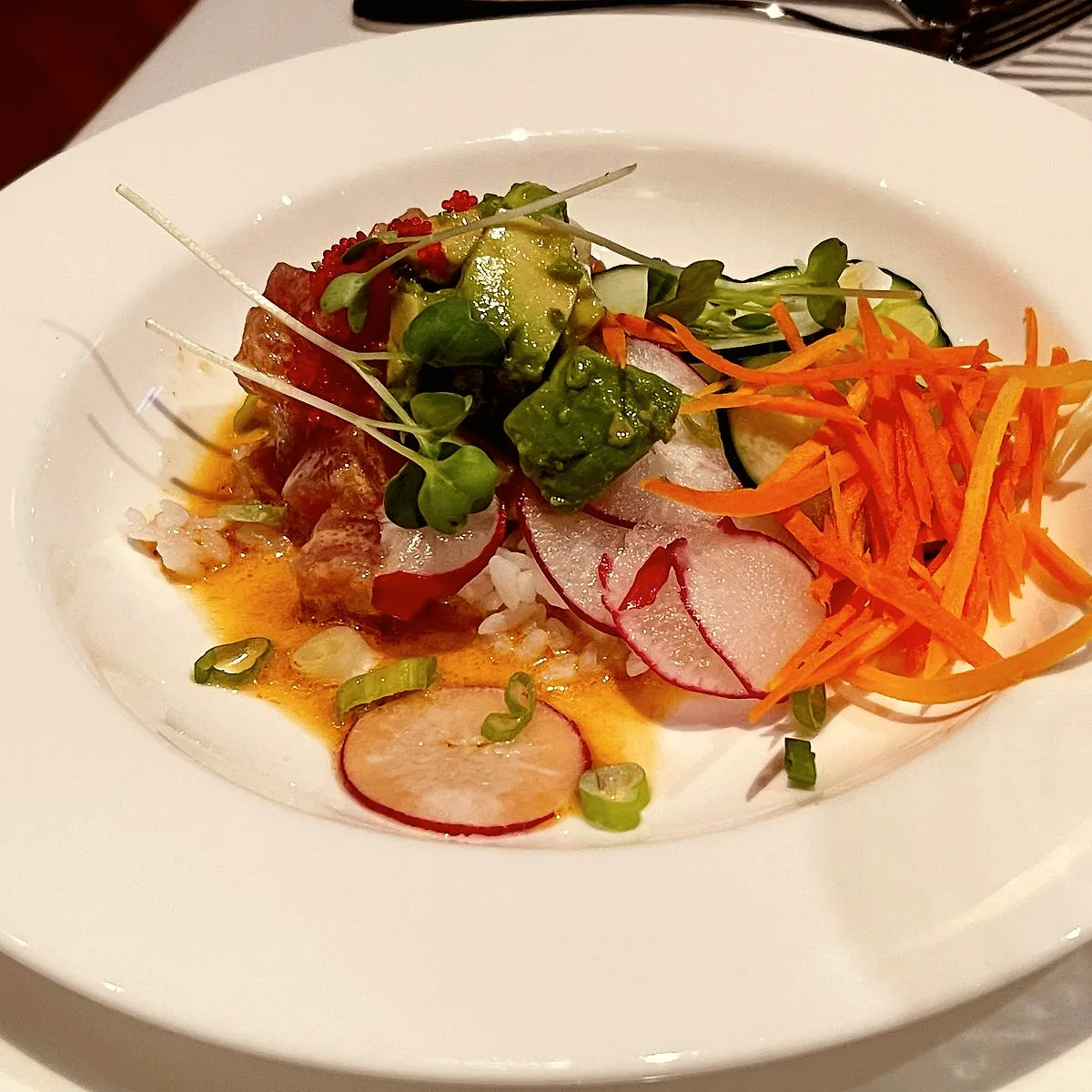

CC BY 4.0. Cropped and colour-adjusted for this site.
Method
Rinse the 160 g short-grain rice until the water runs clear, then bring it to the boil with the 220 ml water. Cover, reduce the heat to a bare simmer and cook undisturbed, then rest off the heat with the lid on. This takes 20m in total.
Cut the 400 g raw tuna into small, even cubes. This takes 8m.
Common pitfallShoyu and sesame oil do nothing to a fish's safety the way heat would, so the ahi needs to have been previously frozen to destroy parasites; fresh, never-frozen fish is not safe to eat raw this way.
Crush the 20 g roasted macadamia coarsely with the flat of a knife or a mortar and pestle, then stir in the 2 g fine sea salt. This takes 4m.
Roasted, crushed macadamia stands in here for ʻinamona, the roasted kukui-nut relish traditional poke is seasoned with; kukui is not sold as a food outside Hawaii, and macadamia gives a comparably rich, oily crunch.
Combine the fish, the 40 ml light soy sauce, 8 ml toasted sesame oil, 50 g white onion, 1 spring onion (15 g), 5 g sesame seeds and the crushed macadamia in a bowl and toss gently to coat every piece. Leave to sit for 10m so the seasoning draws into the fish.
Divide the rice between plates, spoon the poke and its juices over the top, and scatter with the 1 nori sheet (3 g). This takes 4m; serve at once.
The word poke means "to slice" or "cut crosswise" in Hawaiian, and it names exactly what fishermen did with the day's catch long before the dish looked anything like it does now [2]. The earliest preparation was raw reef fish cut into pieces and seasoned with sea salt, limu (seaweed) and ʻinamona (a relish of roasted, pounded kukui nut) eaten as a snack rather than a meal [3] [1].
Almost everything that now reads as essential to poke arrived afterward. Onions were unknown in Hawaii until Captain Cook's voyages introduced seed in 1778 [1]. Shoyu, sesame oil and ahi tuna itself entered through the Chinese, Japanese and Korean labourers brought to work the sugar and pineapple plantations from the mid-nineteenth century on, and their soy-based seasoning gradually displaced the older salt-and-ʻinamona style for many cooks [3]. The dish stayed a fish-market and home-kitchen food for most of that history, sold and eaten in small quantities as a pupu (a snack) rather than a full plate, a habit chef Keoni Chang describes as buying "a quarter or half-pound of two or three varieties" on the way home from work [4].
The poke sold on the United States mainland today, portioned into a full bowl over rice with a menu of optional toppings, is a distinct and recent format rather than a transplant of that tradition. Pokéworks partner Mike Wu frames its appeal in build-your-own terms: "it's like having your own personal sushi chef" [4], which is close to the opposite of how poke was historically bought and eaten in Hawaii. The dressed, cubed fish itself is the continuous thread through all of this; the rice, the bowl and the topping bar are the mainland's addition to it, not a return to an older form.
Sources
- Poke (dish), WikipediaOn the pre-contact preparation with ʻinamona and limu, the etymology of "poke," and the timeline of Chinese and Japanese influence.
- Hawaiian Word of the Day: May 4th, Hawaii Public RadioConfirms the Hawaiian meaning of "poke" as "to slice, cut crosswise into pieces."
- How the Hawaiian Poke Bowl Became the World's New Fast Food, HAWAIʻI MagazineConfirms the pre-contact preparation of reef fish with sea salt, limu and ʻinamona, and that Japanese, Chinese and Korean plantation laborers replaced salt and ʻinamona with shoyu and sesame oil.
- Surfer's Sashimi: How Hawaiian Poke Conquered the Mainland, NBC NewsOn how poke was traditionally sold and eaten in Hawaii, quoted against the mainland build-your-own bowl format.